

Big Social Security shift coming in 2026 will it raise your retirement age? Yes. For anyone born in 1960 or later, the full retirement age (FRA) for unreduced Social Security benefits is set at 67, completing the decades-long increase that began after the 1983 amendments. That one change reshapes the math on early claims, delayed credits, work-while-claiming limits, and how far your 2026 cost-of-living adjustment (COLA) stretches. If you turn 62 in 2026, your filing decision now carries a larger permanent tradeoff than prior cohorts faced when FRA was 66.

Social Security retirement age 2026 is the focus keyword to keep front and center. It means the earliest claim at 62 still exists, but the reduction at 62 is about 30% for a worker benefit when your FRA is 67, and roughly 35% for spousal benefits at 62. Along with the age milestone, 2026 brings a 2.8% COLA, higher earnings-test thresholds if you work while drawing benefits, and a higher taxable wage base. Put together, those updates affect how much you’ll receive, how much you can earn before benefits are withheld, and what payroll earnings count toward future benefit calculations if you’re still working.
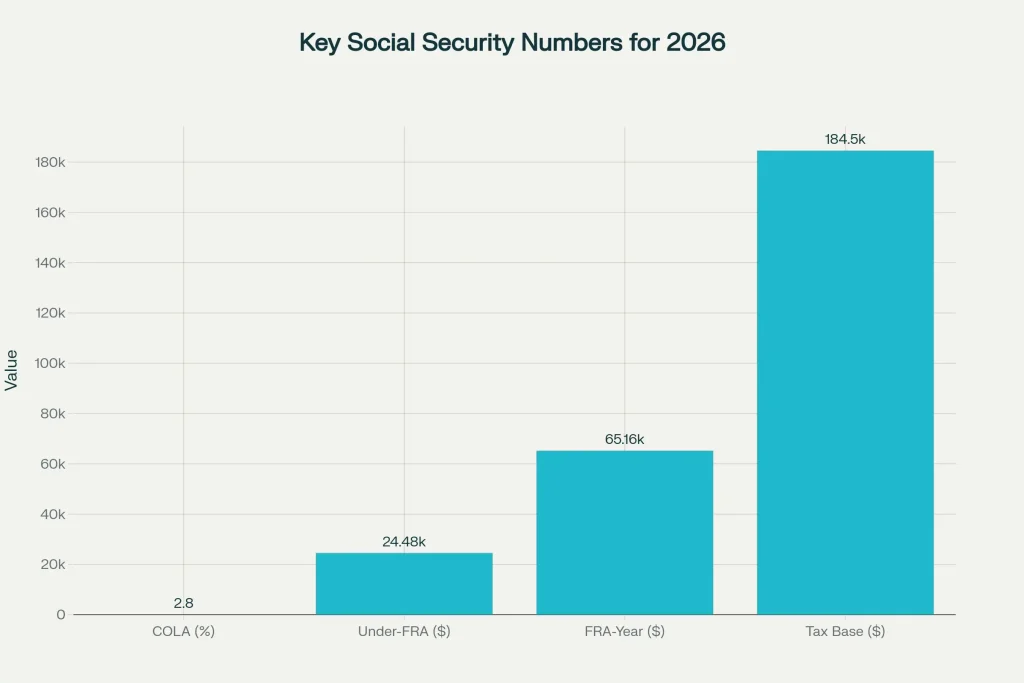
If you’re planning around Social Security retirement age 2026, here’s the short version in plain English. FRA is 67 for people born in 1960 or later, so filing at 62 locks in a bigger lifetime haircut than when FRA was 66. The 2026 COLA of 2.8% lifts checks starting in January, while the earnings test limits rise to $24,480 if you’re under FRA all year and $65,160 if you reach FRA in 2026, with standard withholding formulas ($1 for every $2 over the lower limit, and $1 for every $3 over the higher limit until your FRA month). The taxable wage base climbs to $184,500, meaning more of a high earner’s pay is subject to Social Security tax potentially increasing eventual benefits down the line. Use these numbers to map your filing month, expected work income, and taxes for 2026.
Social Security Shift Coming in 2026
| Item | 2026 Update | Why It Matters |
|---|---|---|
| Full Retirement Age | 67 for those born in 1960 or later | Earlier claims face larger permanent reductions; 67 becomes the benchmark |
| Early-Claim Reduction | About 30% at 62 for worker benefits; ~35% for spousal at 62 | Filing early locks in smaller checks for life |
| COLA | 2.8% for 2026 | Raises monthly benefits starting January |
| Earnings Test (Under FRA) | $24,480 limit; $1 withheld per $2 above | Lets early claimants earn more before withholdings |
| Earnings Test (Reach FRA in Year) | $65,160 limit; $1 withheld per $3 above until FRA month | Softer limit before FRA month; then test ends |
| Taxable Wage Base (OASDI) | $184,500 | More wages taxed at 6.2%; can lift future benefit credits |
| Max Benefit At FRA | Approximately $4,152 per month | Higher ceiling for top earners claiming at FRA |
| Average Retired Worker | Roughly $2,071 per month after COLA | Useful baseline for budgeting |
The Social Security retirement age 2026 milestone changes the rules of the game. With FRA at 67 for the 1960-and-later cohort, the early-claim haircut at 62 is larger, making timing more consequential—especially for those with long life expectancy or spouses relying on survivor benefits. Add the 2.8% COLA, higher earnings-test limits, and a higher taxable wage base, and 2026 becomes a year where the details can meaningfully affect your monthly cash flow and long-run security. Run the numbers at 62, 67, and 70, map your expected earnings to the updated thresholds, and make a choice that fits both your budget today and your longevity tomorrow.
What Exactly Changes In 2026
- Full retirement age completes its move to 67 for the 1960-and-later cohort, the final step in the long-planned shift from 65 to 67. That means the “no haircut” age is higher, and every month you file before 67 comes with a reduction.
- The 2.8% COLA lands in January 2026 for retirees, survivors, and SSI beneficiaries, raising checks to better match price pressures.
- Earnings-test thresholds increase to $24,480 if you’re under FRA all year and to $65,160 in the year you reach FRA, using the standard withholding math until your FRA month arrives.
How The New FRA Affects Your Strategy
- Social Security retirement age 2026 makes the early-claim haircut at 62 more consequential. With FRA at 67, a worker who files at 62 sees about a 30% reduction, which is larger than what those faced when FRA was 66. That makes a breakeven analysis comparing 62, 67, and 70 essentials.
- Waiting to FRA avoids reductions entirely, while delaying up to age 70 still earns delayed retirement credits of up to 8% per year after FRA. If longevity runs in your family, or if a higher survivor benefit would protect a spouse, delaying can pay off.
- COLAs accrue whether you claim now or delay. If you wait, the annual COLA applies to your projected benefit base, and then delayed credits layer on top helping reinforce your age-70 benefit.
Working While Claiming In 2026
- Under FRA all year? You can earn up to $24,480 before the earnings test withholds $1 for every $2 over the limit. Withholdings stop the month you reach FRA.
- Reaching FRA in 2026? The higher limit $65,160 applies for months before your FRA month, and the withholding eases to $1 per $3 over that threshold. After your FRA month, there’s no earnings test.
- Withheld benefits aren’t lost; your benefit is recalculated at FRA to reflect months of withholding. But the cash-flow pattern matters plan for the withholdings if you rely on a steady monthly check.
Key Dollar Amounts to Know
- Social Security retirement age 2026 aligns with higher program thresholds. The maximum taxable earnings for OASDI rise to $184,500, affecting payroll taxes for high earners.
- The maximum benefit at FRA increases to roughly $4,152 per month in 2026, reflecting the new parameters and COLA.
- The average retired worker benefit after the 2.8% adjustment is around $2,071 per month, a practical yardstick for budgeting if your earnings history is near the national average.
What Big Social Security Shift Coming in 2026 Means for You
- Informational: Social Security retirement age 2026 sets FRA at 67 for the 1960+ cohort, updates the earnings test limits, and confirms the 2.8% COLA and the $184,500 taxable wage base giving you concrete numbers to plan around.
- Transactional: If you’re picking a filing month in 2026, run a scenario at 62, 67, and 70, and overlay expected wages against the $24,480 and $65,160 limits to understand withholdings until your FRA month.
- Navigational: Use your my Social Security account to verify benefit estimates with 2026 figures before choosing a claim date, and schedule a local office appointment if you have complex earnings or survivor scenarios.
Trending And Fresh 2026
- Full retirement age hits 67 for those born in 1960 or later, the final scheduled step in the multi-decade increase.
- The 2026 COLA is 2.8%, one of the modest post-pandemic adjustments, but still meaningful for fixed budgets.
- Earnings-test thresholds rise, creating a bit more room for those who work while claiming. The taxable wage base climbs to $184,500, nudging payroll taxes and potentially benefits for high earners.
Practical Planning Steps For 2026 Retirees
- Benchmark three ages: 62, 67, and 70. Calculate how a roughly 30% reduction at 62 compares to a full check at 67 and an enhanced check at 70. If health and longevity outlooks favor a longer retirement, later claiming may improve lifetime income.
- Coordinate work and benefits. If you intend to keep working in 2026, model your expected wages against the $24,480 and $65,160 limits to avoid surprise withholdings that disrupt monthly cash flow.
- Factor in Medicare premiums. The COLA lifts your gross benefit, but Part B premiums can trim your net. Build your budget around net benefits, not just the headline COLA.
- For high earners, watch the taxable wage base. Hitting $184,500 means more wages are subject to 6.2% OASDI tax, which may influence deferral strategies, Roth vs pre-tax contributions, or timing of retirement.
- Revisit survivor planning. A higher primary insurance amount from delaying can materially improve a surviving spouse’s benefit.
Under current law for 2026, the full retirement age simply reaches 67 and stays there. There’s no enacted increase beyond 67 taking effect in 2026. Policy conversations continue in Washington about long-term solvency—ideas often include raising the normal retirement age further, lifting or eliminating the payroll cap, changing benefit formulas, or some combination. But for 2026 planning, your operative facts are straightforward: FRA at 67 for the 1960+ cohort, a 2.8% COLA, updated earnings-test thresholds, and a higher taxable wage base.
FAQs on Social Security Shift Coming in 2026
Is 2026 really raising my retirement age?
If you were born in 1960 or later, your full retirement age is 67. That’s the final step of the scheduled increases. Filing earlier than 67 triggers permanent reductions.
What is the Social Security COLA for 2026?
The cost-of-living adjustment is 2.8%, applied to January 2026 payments for retirees, survivors, and SSI beneficiaries.
How much can I earn while claiming in 2026 without losing all my benefits?
If you’re under full retirement age all year, the 2026 limit is $24,480 with $1 withheld for every $2 above. If you reach FRA in 2026, the limit is $65,160 $1 withheld for every $3 above until your FRA month. After your FRA month, the earnings test ends.
What is the Social Security taxable wage base in 2026?
It’s $184,500. Wages up to that level are subject to the 6.2% OASDI payroll tax (matched by employers). Self-employed pay both sides.