

Senior citizen FD plan seekers want safe, predictable growth that still feels rewarding, and this is exactly where cumulative fixed deposits with senior add-on rates shine for 2025. By locking ₹1,00,000 in the right tenure and choosing an issuer offering a senior premium, compounding can push the corpus toward ₹1,39,750 at maturity delivering ₹39,750 interest over the holding period, not in a single year. The idea is simple: combine a slightly higher senior rate with a cumulative option and let time do the heavy lifting. Unlike chasing volatile instruments, this strategy fits conservative profiles, offers clear timelines, and can be executed entirely online with most banks and NBFCs.

Senior citizen FD plan choices must be intentional, because the difference between a standard and a top-slab rate can meaningfully change your final maturity. The focus keyword matters here as you evaluate cumulative vs payout options, tenor buckets, and issuer credibility. If you select a special tenure where seniors get a premium often 2–3-year windows or bespoke day-count schemes and opt for cumulative compounding, the maturity on ₹1 lakh climbs faster. This is why the “₹39,750 from ₹1 lakh” examples are trending: they showcase what disciplined compounding at a higher senior rate can do when you avoid early withdrawals and let the FD run its full course.
A senior citizen FD plan works best when you combine three levers: senior add-on rates (commonly 0.25%–0.75% above public cards), cumulative compounding, and a tenure where the issuer advertises peak slabs. This approach maximizes the terminal corpus without adding market risk, making it a practical fit for retirees who prioritize stability. In many rate cards this year, the highest slabs for seniors appear around 2–3 years or in special 400–800-day windows, which can be ideal for turning a modest principal into a more impressive maturity figure.
Senior Citizen FD Plan
| Item | Details | Why It Matters |
|---|---|---|
| Senior Add-On | Typically 0.25%–0.75% above regular rates; sometimes higher for super seniors | Extra basis points compound over time, lifting maturity on the same principal |
| Tenure Selection | Peak slabs often in ~2–3 years or special day counts | The right bucket can add thousands to maturity without extra risk |
| Cumulative Option | Interest reinvested; no periodic payout | Maximizes terminal value and helps reach the ₹39,750 goal |
| Payout Option | Monthly/quarterly interest to bank account | Good for income, but reduces final maturity versus cumulative |
| TDS Threshold for Seniors | Higher year-limit for TDS compared to non-seniors | Smoother cash flows; taxation still applies per regime |
| SCSS Pairing | 8.2% p.a. quarterly, 5-year lock, sovereign-backed | Combine with FD for income plus terminal growth |
A well-structured senior citizen FD plan can turn ₹1,00,000 into approximately ₹1,39,750 at maturity through the synergy of senior add-on rates, cumulative compounding, and the right tenure window. Treat the ₹39,750 as a multi-year cumulative outcome. To optimize, shortlist issuers with the highest senior slabs, pick cumulative over payout, avoid premature withdrawals, leverage SCSS for sovereign-backed income, and use the higher TDS threshold wisely. With that roadmap, retirees can keep risk low, cash flows predictable, and the final corpus meaningfully higher without chasing volatility.
What “₹39,750 From ₹1 Lakh” Really Means
That headline points to cumulative interest over the entire tenure, not a one-year promise. On ₹1,00,000, a senior-specific slab in the upper band paired with cumulative compounding can deliver about ₹39,750 total interest when held for long enough. It’s crucial to understand the maturity math: a single year at even a strong senior rate won’t create such a gap; the compounding effect over multi-year windows or special tenures is what gets you there. If you need monthly income, you can still choose payout but know that it reduces the final maturity compared to cumulative.
Rate Landscape Seniors Should Watch
- Large banks: Reliable but typically post lower peaks for standard 1–3-year buckets than the best-in-market slabs.
- Small finance banks and select NBFC/corporate FDs: Often show higher senior slabs in targeted windows (e.g., ~750 days or 2–3 years).
- Super senior benefits: Some issuers add extra basis points for 80+ depositors, helpful if you want to nudge the rate without changing risk levels.
How To Replicate the Outcome
- Pick cumulative FDs in top slabs: Review issuer cards and select the highest senior slab in the 2–3-year range or a special-day window. This is where the compounding advantage is strongest for a ₹1 lakh principal.
- Avoid breaking FDs: Premature withdrawal penalties can erode gains; keep an emergency buffer elsewhere so you don’t touch the cumulative FD before maturity.
- Ladder the tickets: Split ₹1,00,000 into two or three deposits across different issuers/tenures to balance liquidity, reinvestment risk, and rate hunting.
- Review tax and TDS: Seniors enjoy a higher TDS threshold on FD interest; submit the correct declarations only if eligible. Regardless of TDS, total interest is taxable per your regime.
- Reinvest smartly: On maturity, reassess the interest-rate cycle. If rates have softened, consider laddering shorter tenures; if rates are higher, lock a longer window.
FD Or SCSS: Which to Choose First
If the goal is predictable quarterly income with sovereign backing, SCSS at 8.2% p.a. and a 5-year lock can anchor your plan. It fits those who want steady cash flows and comfort first. FDs then play the role of flexible compounding instruments especially cumulative senior deposits to boost the terminal value. Many retirees combine both: allocate to SCSS for income, then use cumulative FDs to chase a bigger maturity from the remaining corpus.
Practical Illustration
Think of ₹1,00,000 placed into a cumulative senior slab around the higher end of current offerings, with a multi-year hold. Over time, the added basis points for seniors amplify compounding, nudging the final maturity toward ₹1,39,750. Shorter tenures and lower rates will naturally yield less, so align expectations with tenure. If your risk tolerance and liquidity allow, favor the exact tenure window where the issuer posts the best senior rate those extra basis points are what make the headline numbers plausible.
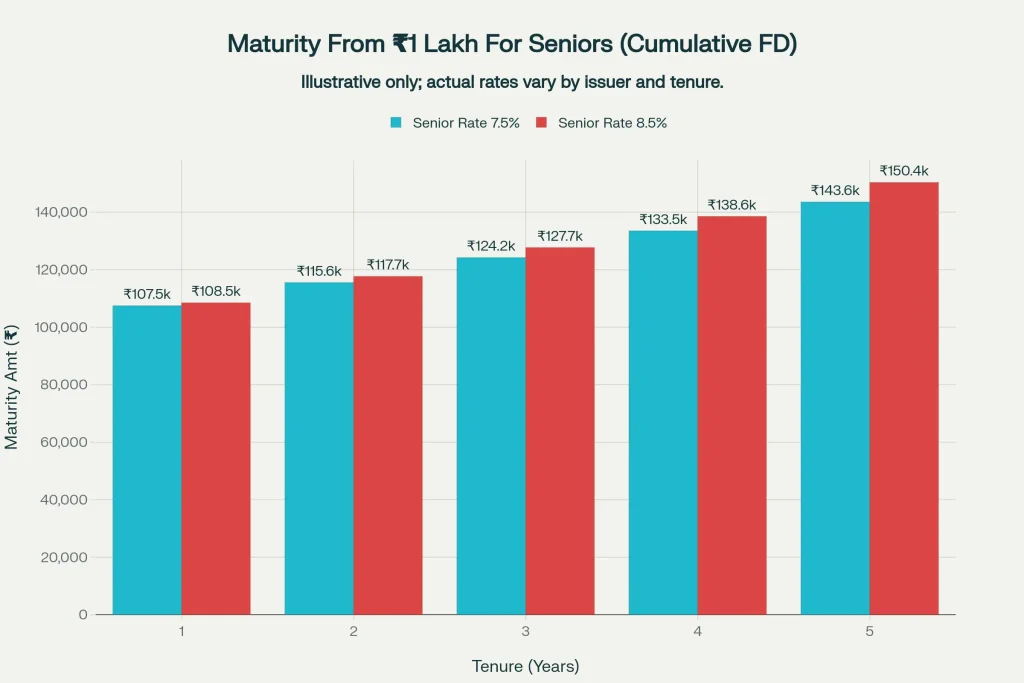
Safety, Diversification, And Liquidity
- Stick to rated issuers: For banks, verify they are scheduled and understand deposit insurance norms. For NBFCs/corporate FDs, review ratings and track records before locking a long tenure.
- Read premature withdrawal terms: Some issuers levy steeper penalties or reduce the applicable interest if you break early.
- Distribute across issuers: Diversification lowers issuer-specific risk and helps you capture more top-slab windows without overexposing to one institution.
Taxes, Forms, And Cash Flow
Senior depositors have a higher annual TDS threshold for FD interest, improving in-hand cash flows even though total tax liability still depends on your overall income and chosen tax regime. If eligible, submit the correct declaration to avoid unnecessary TDS, but ensure your final tax return reflects the full interest accrued, especially for cumulative deposits where interest compounds each year. If you hold multiple FDs across banks or NBFCs, track the combined interest against thresholds to prevent surprises at year-end.
Maharashtra Government Urges Ladki Bahin Beneficiaries to Complete e-KYC by November 18
Senior Citizen FD Plan Checklist
- Identify the highest senior slab across 2–3 issuers.
- Choose cumulative compounding to maximize maturity.
- Select tenure windows with special day-count or 2–3-year peaks.
- Keep a liquidity buffer outside the FD to avoid breakage.
- Confirm TDS thresholds and file correct declarations where eligible.
- Rebalance on maturity based on the prevailing rate cycle.
FAQs on Senior Citizen FD Plan
How can a senior citizen earn ₹39,750 from ₹1 lakh in FD?
Choose a cumulative senior FD in a high-rate slab and hold it for a multi-year tenure until the maturity approaches ₹1,39,750. The ₹39,750 is the total interest over the tenure, not a one-year return.
What are the highest FD rates for senior citizens in 2025?
Top slabs for seniors often cluster around special windows and 2–3-year tenures, with select banks and NBFCs offering upper-band rates. Large banks tend to post lower peaks on standard buckets.
Is SCSS better than a bank FD for seniors?
SCSS offers sovereign-backed stability with quarterly payouts at a competitive rate, making it ideal for income. FDs are better for flexible tenure choices and maximizing terminal value through cumulative compounding. Many seniors use both.
What is the TDS threshold for senior citizens on FD interest?
Seniors have a higher annual TDS threshold than non-seniors. Even with reduced TDS friction, the interest remains taxable as per your income and tax regime, so account for it in your planning.