

A ₹4,000 monthly deposit in Post Office RD 2025 can realistically build to a maturity of roughly ₹2,85,459 over five years, with about ₹45,459 coming purely from interest thanks to the fixed 6.7% annual rate and quarterly compounding that reward disciplined, on-time contributions. This is a safe, rule-based way to grow savings without market volatility, backed by the government and designed for steady, predictable outcomes.
Post Office RD 2025 is a five-year recurring deposit where you invest a fixed amount every month and earn interest compounded quarterly at the currently notified rate. At ₹4,000 per month for 60 months, the indicative maturity comes out near ₹2.85 lakh in common illustrations used by financial calculators, implying about ₹45.4k in interest at 6.7% p.a. Keep in mind, the Ministry of Finance reviews small savings rates quarterly, so always check the prevailing rate before opening or projecting returns.
Post Office RD 2025
| Feature | Details |
|---|---|
| Scheme | Post Office Recurring Deposit (RD) |
| Tenure | 5 years (60 monthly deposits) |
| Current rate | 6.7% per annum, compounded quarterly |
| Example contribution | ₹4,000 per month |
| Indicative maturity | ~₹2,85,459 (illustrative at 6.7% p.a.) |
| Interest earned | ~₹45,459 (illustrative for ₹4,000 x 60) |
| Minimum deposit | ₹100 per month; multiples of ₹10 |
| Loan facility | Up to 50% of balance after 12 instalments; interest = RD rate + 2% |
| Default penalty | ₹1 per ₹100 per missed instalment (pro‑rata) |
| Premature closure | Allowed after 3 years with scheme conditions |
What Makes Post Office RD 2025 Reliable
The Post Office RD 2025 runs under India’s small savings framework, which means sovereign backing and a clearly defined, transparent rulebook for deposits, compounding, penalties, and closure. For conservative savers, the appeal lies in guaranteed returns no market swings, no NAV fluctuations just a fixed path to a known maturity when instalments are paid on time. This predictability is especially useful for short‑ to mid‑term goals such as an emergency buffer, education fund top‑ups, or planned purchases.
How ₹4,000 Becomes ₹45,459 In Interest in Post Office RD 2025 Scheme
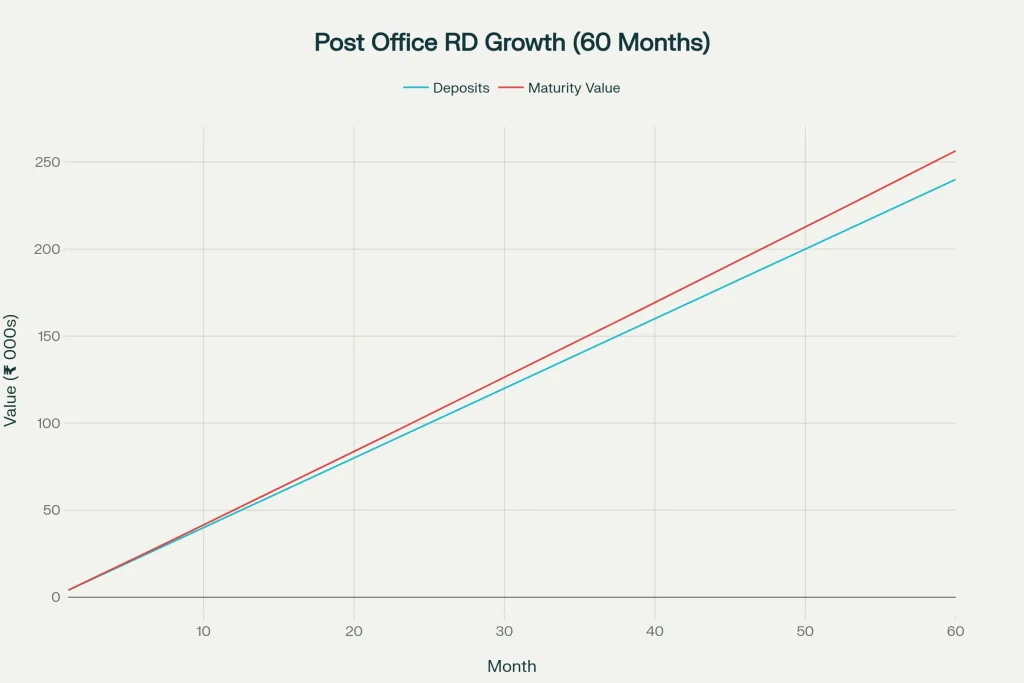
Recurring deposits compound quarterly, but each instalment sits for a different length of time. Early deposits compound through many quarters, while later deposits compound through fewer, producing a stepped growth curve. On a ₹4,000 monthly plan at 6.7% p.a. for 60 months, common RD calculators show a maturity near ₹2.85 lakh, which implies about ₹45,459 of interest over five years. Your exact figure can vary a bit based on deposit dates, compounding cut‑offs, and calendar alignment.
Eligibility, Deposits, And Flexibility for Post Office RD 2025
Opening is simple: minimum ₹100 per month in multiples of ₹10, with no stated upper cap, so it scales well from beginners to disciplined high savers. You can open accounts individually, jointly, or for minors via a guardian, making it flexible for families and goal‑based planning. Many branches and linked accounts support digital deposits and auto‑debit, which help ensure you never miss a month and preserve compounding efficiency.
Missed Payments and Penalties
If you miss a monthly instalment, a small default fee of ₹1 per ₹100 of the scheduled deposit applies. Keeping up with the timeline matters: too many consecutive misses can deactivate the account, though revival windows typically exist. The best practice is setting an auto‑payment and keeping a small buffer in the linked account so the instalment goes through even if a salary credit arrives late.
Premature Closure Rules You Should Know
Premature closure is generally permitted after three years from account opening, but doing so usually trims overall returns versus staying to the full five years. If liquidity is a concern, consider the inbuilt loan facility first it allows borrowing up to 50% of the balance after a year of regular deposits, at an interest spread over the RD rate. That way, you can solve a short‑term cash need without sacrificing your compounding journey.
Rate Check: Stay Updated Each Quarter
Small savings rates, including RD, are reviewed every quarter, broadly in line with government bond yield movements. The commonly referenced Post Office RD rate is 6.7% p.a. right now, but confirm the prevailing rate on the day you open the account. If the rate changes later, new accounts reflect the new rate; some extensions or new deposits may also be affected. For planning, revisit your projections at least once a quarter.
Tax And Documentation Basics
Interest from Post Office RD is taxable as “Income from Other Sources” and is added to your total income; your final tax depends on your slab. Keep PAN, Aadhaar, and basic KYC handy when opening an account, and consider using net banking or the Department of Post ecosystem to track deposits, interest accruals, and maturity timelines. RD doesn’t offer Section 80C for the interest; if you need tax savings, compare with PPF, SCSS, or tax‑saving FDs for the right mix.
Who Should Choose This RD
- Salaried professionals who want a hands‑off, guaranteed 5‑year plan with auto‑debit.
- First‑time savers who value predictability and a low monthly entry point.
- Parents planning mid‑term goals for children without market exposure.
- Conservative investors who prefer a steady path over chasing higher but volatile returns.
Practical Tips to Maximize Returns
- Start early in the month if convenient so each instalment gets the longest possible compounding span within the quarter’s schedule.
- Use auto‑debit and keep a small balance buffer in your linked account to avoid default penalties.
- Review rates quarterly; if rates rise, consider opening an additional RD or adjusting monthly contributions for new goals.
- Align the RD maturity with your life event (down payment, fees, travel), so the money works until the last practical month.
SBI PPF 2025 Update: Latest Interest Rate and Smart Tips to Maximize Returns
Common Mistakes to Avoid
- Treating RD like a short‑term parking lot if you need liquidity inside 36 months, the rules can dent returns.
- Missing instalments repeatedly penalties are small, but the opportunity cost of lost compounding is not.
- Ignoring taxes in your net return math compare post‑tax outcomes across RD, FD, and debt mutual funds based on your slab.
If your goal is a safe, predictable five‑year plan that turns small, steady deposits into a meaningful corpus, Post Office RD 2025 delivers. At ₹4,000 a month, you’re looking at a practical path to around ₹2.85 lakh in five years under today’s indicative rate without needing to track markets or time entries. Set it, automate it, and let compounding do the heavy lifting while you focus on your goals.
FAQs on Post Office RD 2025
Is Post Office RD 2025 safe for beginners?
Yes. It’s government‑backed, runs on clear rules, has a low ₹100 monthly minimum, and compounds quarterly. It’s simple to start, easy to automate, and designed for predictable outcomes.
Can ₹4,000 monthly really become about ₹2,85,459?
With a 6.7% annual rate and quarterly compounding over 60 deposits, typical RD calculators show a maturity near ₹2.85 lakh, which includes roughly ₹45,459 in interest. Exact results vary slightly by dates and rounding.
What happens if I miss a monthly deposit?
A small default fee of ₹1 per ₹100 of the scheduled amount applies for each missed month. Consistent auto‑debits help avoid penalties and protect your compounding.
Can I close the RD early or take a loan?
Premature closure is generally allowed after three years, often with a lower effective return than staying to maturity. Alternatively, after one year with 12 instalments, you can typically borrow up to 50% of the RD balance at a modest spread over the RD rate.