

The claim that a one-time ₹10,000 deposit in a Post Office FD (Time Deposit) can generate ₹5,000 in monthly interest is not possible at current 2025 interest rates; Post Office TD rates range roughly from 6.9% to 7.5% per annum, which yields only a small annual return on ₹10,000, not a four-figure monthly payout. If monthly income is the goal, the Post Office Monthly Income Scheme (POMIS) pays interest monthly at around 7.4% p.a., but even there, a payout like ₹5,000 per month needs a principal in lakhs, not ₹10,000.

Post Office FD Scheme 2025 is formally the National Savings Time Deposit, available for 1, 2, 3, and 5 years, with interest compounded quarterly and paid annually for the cumulative option, offering sovereign-backed safety and predictable returns. The current slab commonly published for 2025 is 6.9% (1-year), 7.0% (2-year), 7.1% (3-year), and 7.5% (5-year), and rates do not vary by age in TD, unlike some bank FDs.
Post Office FD Scheme 2025
Post Office FD Scheme 2025 is a safe, sovereign-backed avenue for assured returns at 6.9%–7.5% p.a., best suited for steady accumulation rather than outsized monthly income from small sums. For a genuine monthly payout, evaluate POMIS and align your principal with your target income, recognizing that meaningful monthly inflows require investments in the range of several lakhs, not ₹10,000.
Reality Check on The Headline Claim
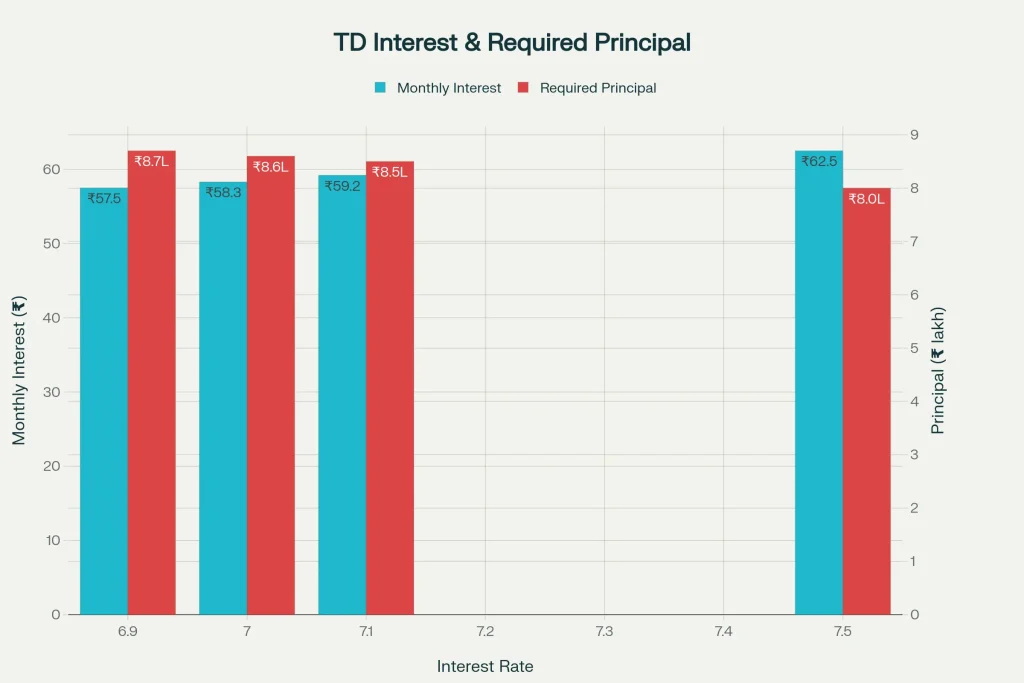
At 7.5% p.a., a ₹10,000 deposit earns ₹750 in interest in a full year, which averages roughly ₹62.5 if you think of it monthly nowhere close to ₹5,000 per month. To actually earn ₹5,000 monthly at about 7.4%–7.5% per annum, you would need a principal in the ballpark of ₹8 lakh or more, underscoring that social posts promising huge monthly income from tiny sums are misleading.
What Is Post Office FD (Time Deposit) In 2025
This is a government small savings instrument with fixed tenures and notified rates, suitable for risk-averse investors seeking stability and assured accumulation rather than monthly cash flow. Because interest is compounded quarterly and paid annually under the cumulative option, it is ideal for those who can wait for annual credit or maturity proceeds.
Latest Interest Rates For 2025
The widely cited 2025 slab for Post Office TD places 1-year at 6.9%, 2-year at 7.0%, 3-year at 7.1%, and 5-year at 7.5%, aligning across major finance references. These rates are periodically reviewed as part of small savings notifications, but the spread has stayed in the stated band through 2025.
Can You Get Monthly Interest from Post Office Products
Yes, but not from the cumulative Time Deposit as a monthly payout; instead, consider the Post Office Monthly Income Scheme (POMIS), which credits interest monthly at around 7.4% p.a. in FY 2025–26. Even with POMIS, achieving ₹5,000 per month requires investing several lakhs, since the monthly credit is a function of principal and the annual rate.
How Much Principal Do You Need For ₹5,000 Monthly
Using a simple approximation, monthly interest equals principal × annual rate ÷ 12; rearranging for principal gives principal ≈ monthly target × 12 ÷ rate. At 7.4% p.a., principal needed ≈ 5,000 × 12 ÷ 0.074 ≈ ₹8,10,811, which is far higher than ₹10,000 and consistent with realistic POMIS outcomes.
Who Should Choose Post Office FD
Choose the FD if you want assured growth over 1–5 years, prefer sovereign safety, and don’t need monthly cash flows, because the payout in the cumulative option is annual. It also suits those planning for a specific short-to-medium horizon goal where predictable compounding matters more than regular income.
Who Should Choose POMIS
Choose POMIS if your goal is regular monthly income from a government-backed vehicle at a known rate, and you have sufficient principal to meet a monthly target. Note that POMIS has investment caps and is designed specifically for periodic payouts; it is not a compounding product like the cumulative TD.
Common Misconceptions To Avoid
A frequent mistake is assuming that any “FD” can be configured for monthly interest; Post Office TD is primarily structured with annual interest credit for the cumulative option, unlike many bank FDs that offer monthly payouts. Another misconception is underestimating the principal needed for a target monthly income; at 7%–8% rates, five-figure monthly income needs large deposits.
Simple Illustrations at Current Rates
- ₹10,000 in a 5-year Post Office FD at 7.5% p.a. earns ₹750 in a year, which is roughly ₹62.5 per month viewed as an average, not as an actual monthly credit.
- To aim for ₹5,000 monthly, plan for more than ₹8 lakh at roughly 7.4%–7.5% p.a., or adjust your monthly target downward if your investable principal is lower.
8th Pay Commission Update: New Pay Matrix Coming from January 1, 2026 – Big Salary Hike Expected
Practical Steps to Decide
- Define the objective: growth (FD) versus income (POMIS).
- Estimate the principal required for your monthly target at prevailing rates, and verify against official or widely cited rate tables for the current quarter.
Whenever you encounter eye‑catching lines about turning tiny sums into large monthly income through any “Post Office FD,” pause and verify the math against the current rate card. Government‑backed schemes are designed for stability, not windfalls, and that’s their true strength: transparent rules, assured returns, and peace of mind when the objective is safety and predictability.