

India is accelerating the rollout of the PM Kisan Samriddhi Kendra network, converting fertiliser shops into integrated service centres offering inputs, soil testing, and advisory support across rural districts. Officials say the programme aims to improve access to accurate information, quality materials, and modern farming practices for millions of farmers.

Understanding the Purpose Behind PM Kisan Samriddhi Kendra
The PM Kisan Samriddhi Kendra (PMKSK) initiative is a flagship effort by the Ministry of Chemicals and Fertilizers to strengthen last-mile delivery of agricultural services. The government plans to convert nearly 330,000 fertiliser retail shops into multifunctional centres providing fertilisers, seeds, pesticides, soil health services, and crop advisory support.
A senior ministry official said the centres are intended to “bridge long-standing gaps in supply, knowledge, and service availability that limit farmer productivity in many regions.”
The initiative aligns with broader agricultural reforms, including digital crop monitoring, improved fertiliser distribution, and efforts to promote balanced nutrient application.
Why the Programme Was Needed
India’s agriculture sector supports nearly half the population but faces persistent structural challenges. These include shrinking landholdings, unpredictable monsoon patterns, nutrient imbalance due to excessive fertiliser use, and limited access to scientific advisory services.
Small and marginal farmers—who represent 86 percent of India’s farming households—are the most affected. According to the National Sample Survey Office, more than half of farmers rely on informal or unverified sources for crop information, often resulting in low productivity and higher production costs.
PMKSK centres are meant to provide reliable, uniform, government-backed information and services that smallholders can trust.
What PMKSK Centres Offer to Farmers
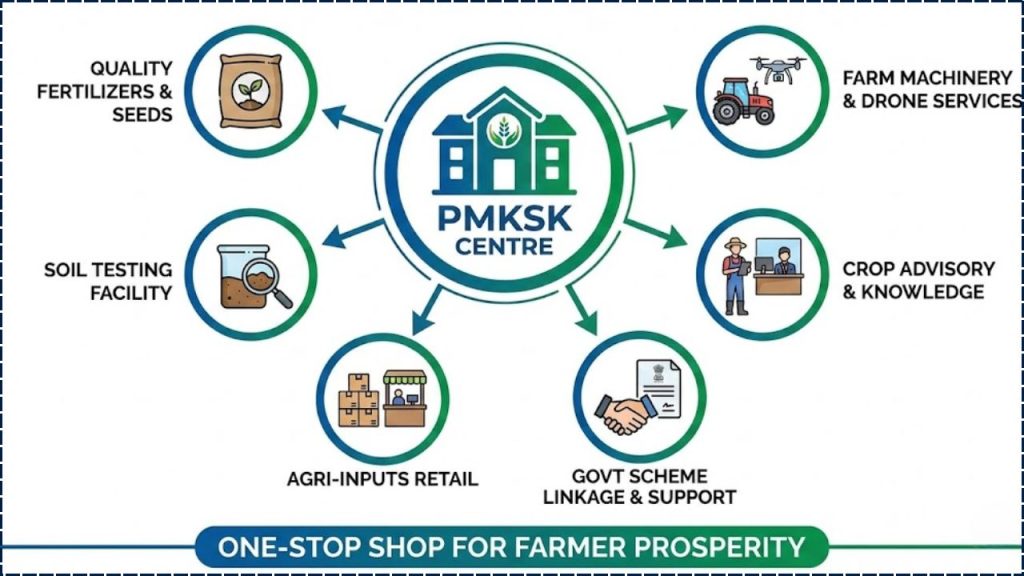
PMKSK centres are intended to function as one-stop agricultural support hubs. Each outlet is expected to provide both agricultural inputs and technical resources needed for improved farming decisions.
Range of Products and Services
Key offerings include:
- Subsidised Bharat-brand fertilisers
- Certified seeds and crop protection chemicals
- Soil testing kits and soil sample collection
- Nutrient analysis and crop-specific advice
- Guidance on balanced fertiliser use
- Information about central and state agriculture schemes
Officials say the advisory component is essential. An agriculture extension officer in Madhya Pradesh noted that “the goal is to bring scientific knowledge closer to farmers, especially in villages where formal extension systems have not reached effectively.”
How PMKSK Centres Support Farmers on the Ground
The benefits of PMKSK centres differ across states, depending on how quickly each district is integrating the model and training staff.
Improving Access to Quality Inputs
Before PMKSKs, many farmers relied on private retailers for fertilisers and seeds, often paying different prices for products of varied reliability. PMKSK centres ensure uniform branding and pricing of subsidised fertilisers, reducing confusion and limiting counterfeit products.
A fertiliser dealer in Haryana, now part of the PMKSK network, said the uniform Bharat branding “has made it easier for farmers to compare product quality and make informed decisions.”
Boosting Scientific Nutrient Management
Soil health management is a major focus of the initiative. Overuse of urea has degraded soil quality in several states. According to the Indian Council of Agricultural Research (ICAR), nitrogen application in some districts of Punjab, Haryana, and Uttar Pradesh exceeds recommended levels by nearly double.
By offering soil health checks and tailored fertiliser recommendations, PMKSK centres aim to correct nutrient imbalance and improve long-term soil productivity.
Real-World Farmer Experiences
While the programme is still expanding, early experiences offer insight into its strengths and challenges.
Positive Feedback from High-Access States
In Uttar Pradesh, Rajasthan, Maharashtra, and Tamil Nadu, farmers have reported smoother fertiliser access and better service during peak sowing seasons.
A sugarcane farmer from Baghpat district in Uttar Pradesh said PMKSK services helped him “reduce urea use by 20 percent after a soil test and increase yield by nearly 12 percent.”
Challenges in Remote and Tribal Regions
In Odisha, Jharkhand, and Chhattisgarh, farmers report delays in establishing soil testing units and shortages in trained advisory staff.
A district agriculture officer in Odisha said that infrastructure gaps “remain significant in remote blocks,” and mobile soil testing labs are being deployed to fill the gap.
Integration with National Agriculture Reforms
The PMKSK network is linked to several other national agricultural initiatives focused on modernisation and transparency.
Link to One Nation One Fertiliser
The One Nation One Fertiliser policy introduced uniform Bharat branding for subsidised fertilisers. PMKSK centres are central to distributing these products consistently across the country.
The Department of Fertilizers stated that the uniform branding will reduce marketing-related confusion and improve transparency in subsidy delivery.
Role in Digital Agriculture Push
Several PMKSK centres are involved in early-stage digital agriculture pilots, including:
- QR-code-based fertiliser tracking
- Digital soil health cards
- Farmer registration and service logs
- Geo-tagging of retail outlets
Officials say these digital tools will improve supply chain transparency and strengthen data-driven decision-making.
Training and Capacity Building
Training is central to the PMKSK model, as many dealers previously focused solely on product sales. Now, they must provide agronomic advice and customer support.
Public sector units such as National Fertilizers Limited (NFL) and Rashtriya Chemicals and Fertilizers (RCF) are conducting training sessions on soil health, plant nutrients, crop management, and advisory communication.
Dr. Alka Singh, a professor of agricultural economics at the University of Delhi, said the success of the initiative “depends on the credibility and accuracy of advice given at these centres.”
Economic Significance of the PMKSK Programme
The programme has implications beyond service delivery.
Impact on Fertiliser Subsidy Efficiency
India spends over ₹2 lakh crore annually on fertiliser subsidies. A policy brief by the National Institute of Public Finance and Policy suggested that more balanced nutrient management could reduce long-term fertiliser demand and strengthen subsidy efficiency.
By improving distribution and reducing misuse, PMKSKs could help save public funds.
Increased Crop Productivity
Better soil health and scientific fertiliser use can significantly raise crop yields. Even a small nationwide increase of 5 to 10 percent could improve food security and farming incomes.
Higher yields in cereal crops such as wheat, paddy, and maize would have the greatest impact, given their share in India’s food system.
International Comparisons and Lessons
Other countries also operate integrated agricultural service hubs.
- Kenya’s hubs integrate farmer training and access to credit.
- Vietnam’s cooperatives centralise input distribution and marketing.
- China’s village centres use digital platforms for real-time crop monitoring.
Experts say India’s PMKSK model can draw from these countries’ experiences, especially in integrating credit channels and digital advisory services.
Future Roadmap for PMKSK Centres
The government plans to expand and strengthen PMKSK centres in several ways.
Planned Enhancements
Future features may include:
- Credit and crop insurance desks
- Rental services for farm machinery
- Integration with Farmer Producer Organisations (FPOs)
- Enhanced digital connectivity
- Extended mobile advisory services for remote areas
Officials say the long-term goal is to build a village-level agricultural service ecosystem that improves productivity and enhances rural earning potential.
Women to Get Biggest Electric Scooter Subsidy in 2025 — Up to ₹46,000 Benefit
Conclusion
The PM Kisan Samriddhi Kendra programme is one of the government’s most ambitious efforts to modernise agricultural service delivery. By integrating input supply, soil testing, advisory support, and scheme information, PMKSK centres aim to close long-standing gaps in rural extension services.
The programme’s success will depend on sustained investment, trained personnel, digital integration, and strong monitoring. As the network expands, farmer feedback and ground-level implementation will play a central role in shaping its long-term impact on productivity, soil health, and rural incomes.