

Arbitrage mutual funds are a practical home for short-to-medium term money right now, especially if you want low volatility with equity taxation and steady, cash-like returns. In November 2025, healthy cash–futures spreads and active derivatives markets are supporting outcomes that typically cluster around the 6–7% annualized band when held for a sensible horizon. The appeal is simple: these funds largely hedge away direction risk by locking in spreads, so you’re earning market inefficiency rather than betting on market direction.

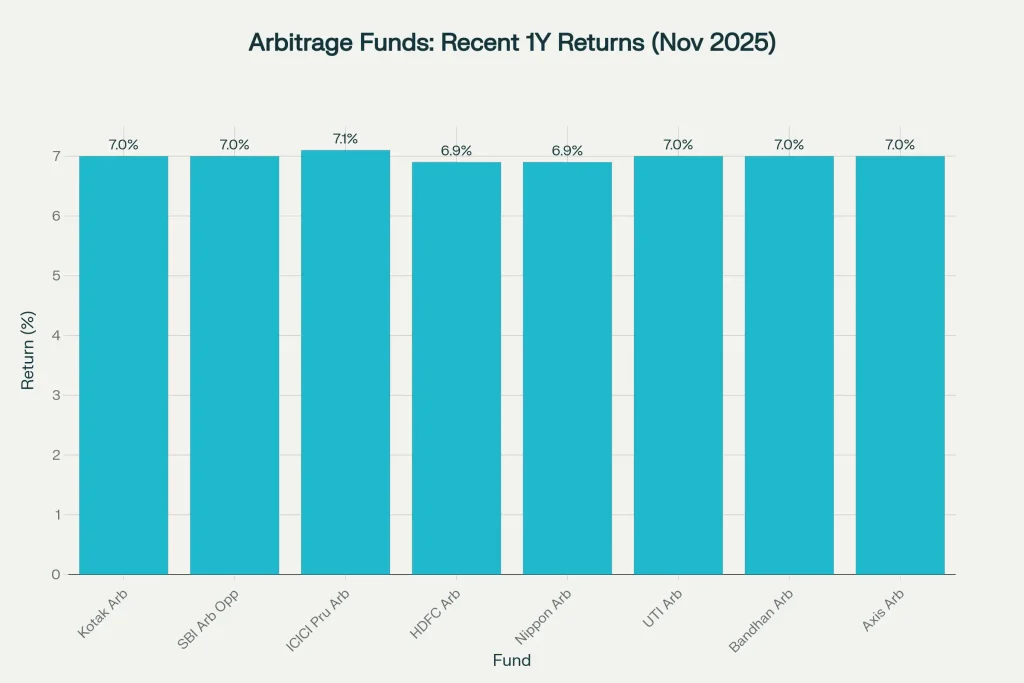
Arbitrage funds November 2025 picks deserve a closer look if your goal is stability without giving up the tax profile of equity-oriented schemes. For readers searching specifically for arbitrage funds November 2025 picks, the strongest shortlists this month gravitate to large, liquid funds known for consistent execution and scale think Kotak Arbitrage, SBI Arbitrage Opportunities, ICICI Prudential Equity Arbitrage, Nippon India Arbitrage, HDFC Arbitrage, UTI Arbitrage, Bandhan Arbitrage, and Axis Arbitrage. These are widely used by both retail and treasury-style allocators for parking cash, running STPs into equity, or building a “volatility sink” sleeve within a broader portfolio.
November 2025 Arbitrage Picks
| Fund | AUM (approx) | 1Y return (recent) | 3Y annualized | 5Y annualized | Min lump sum / SIP |
|---|---|---|---|---|---|
| Kotak Arbitrage Fund | ₹72,279 Cr | ~7.0% | ~7.9% | ~6.6% | ₹100 / ₹100 |
| SBI Arbitrage Opportunities Fund | ₹39,858 Cr | ~7.0% | ~7.8% | ~6.4% | ₹5,000 / ₹500 |
| ICICI Prudential Equity Arbitrage | ~₹32,195 Cr | ~7.0% | ~7.7% | ~6.4% | ₹5,000 / ₹1,000 |
| HDFC Arbitrage Fund | ₹23,009 Cr | ~6.9% | ~7.7% | ~6.3% | ₹100 / ₹100 |
| Nippon India Arbitrage Fund | ₹15,894 Cr | ~6.9% | ~7.8% | ~6.4% | ₹5,000 / ₹100 |
| UTI Arbitrage Fund | ₹10,105 Cr | ~7.0% | ~7.8% | ~6.4% | ₹5,000 / ₹500 |
| Bandhan Arbitrage Fund | ₹8,747 Cr | ~7.0% | ~7.8% | ~6.4% | ₹100 / ₹100 |
| Axis Arbitrage Fund | ₹7,873 Cr | ~7.0% | ~7.7% | ~6.4% | ₹500 / ₹100 |
If your checklist reads low volatility, equity taxation, and steady carry for 3–12 months, arbitrage funds deserve a spot on the shortlist. For November 2025, large, liquid schemes Kotak Arbitrage, SBI Arbitrage Opportunities, ICICI Prudential Equity Arbitrage, HDFC Arbitrage, Nippon India Arbitrage, UTI Arbitrage, Bandhan Arbitrage, and Axis Arbitrage offer a balanced mix of scale, consistency, and accessibility. Expect returns to cluster near the 6–7% band subject to spreads, prioritize bigger AUMs for cleaner execution, keep an eye on exit loads and costs, and use SIP/STP to smooth timing. That combination gives you a practical, low-drama way to keep idle cash working without straying far up the risk curve.
How Arbitrage Funds Work
- These funds buy a stock in the cash market and sell a matching futures position, locking the spread until expiry and neutralizing most market-direction risk.
- The NAV mainly reflects the cash–futures basis minus costs and mark-to-market effects, turning volatility into a carry-like return stream.
- When spreads are robust, the category tends to annualize close to short-term debt but with equity taxation making it attractive for 3–12 month use cases.
Why November 2025 Looks Constructive
- Derivatives participation is high and periodic volatility has kept spreads healthy, which is exactly when arbitrage strategies tend to shine.
- One-year outcomes across the largest schemes have been hovering near the 7% mark in recent snapshots, acknowledging that month-to-month basis can vary.
- AUM concentration in top funds can help with inventory sourcing, execution consistency, and cost efficiencies at scale.
Methodology Signals Seen in Shortlists
- Emphasis on rolling returns and consistency metrics helps identify funds that handle basis compression and stress without outsized blips.
- Minimum AUM thresholds matter because larger books usually mean better liquidity, tighter implementation, and fewer slippage surprises.
- Long track records provide context on how desks handled different market regimes, including low-volatility phases.
Arbitrage Funds November 2025 Picks: Quick Takes
- Kotak Arbitrage Fund: A category heavyweight with scale, strong dealing infrastructure, and accessible ₹100/₹100 minimums for tactical deployments.
- SBI Arbitrage Opportunities Fund: Popular with retail and treasury allocators; practical ₹5,000/₹500 minimums and consistent near-category-average returns.
- ICICI Prudential Equity Arbitrage: Solid 3- and 5-year metrics, reliable execution, and a straightforward choice for spreads-driven carry.
- HDFC Arbitrage Fund: Large AUM, mainstream option, and a steady long-horizon record close to category averages.
- Nippon India Arbitrage Fund: Deep franchise and liquidity, with time-tested category-band performance across 3–5 years.
- UTI Arbitrage Fund: Well-known scheme with a balanced mix of AUM and consistency, suitable for short-term parking and STPs.
- Bandhan Arbitrage Fund: Retail-friendly minimums and competitive recent returns make it easy to fit into monthly cash management.
- Axis Arbitrage Fund: Practical minimums and a track record that aligns with the category’s expected band.
Taxation And Holding Periods
- Arbitrage funds qualify as equity for taxation, which is a core reason investors choose them over comparable low-volatility debt options.
- A practical holding window of at least 3 months is advisable; many investors target 6–12 months to ride out basis fluctuations and exit-load windows.
- Always confirm the latest rates and rules with your advisor; the policy environment can change, and thresholds matter for your net outcome.
Practical Allocation Pointers
- Favor larger AUM: better liquidity, stronger access to inventory, and tighter tracking of basis across expiries.
- Watch exit loads and costs: if you churn positions inside 30–60 days, realized returns may lag category snapshots.
- Use SIP/STP: stagger entries to average basis conditions and reduce timing risk from month-end compressions.
- Keep expectations realistic: spreads ebb and flow; outcomes tend to cluster, not guarantee, especially over short windows.
Risks And Expectations To Watch
- Basis compression: when volatility fades or trades get crowded, annualized returns can slide toward the mid-5s.
- Mark-to-market swings: hedged books can still show temporary blips in stressed sessions; normalization typically occurs by expiry.
- Liquidity in components: while the headline hedge neutralizes direction, real-world costs and execution still drive net outcomes.
Who Should Consider These Funds
- Investors seeking low-volatility, equity-taxed carry for surplus cash with a 3–12 month view.
- Those planning systematic transfers into equity funds who want to earn a spread while phasing market exposure.
- Conservative allocators aiming to build a “volatility sink” sleeve that offsets equity drawdowns without taking duration risk.
Students Get a Boost in 2025 — A New Laptop Scheme Opens for Online Applications
How To Use These November 2025 Arbitrage Picks
- Parking cash: move beyond overnight/liquid for a potential yield pickup while staying in a lower-volatility lane.
- STP engine: set up monthly transfers into chosen equity funds and let the arbitrage sleeve harvest spreads in the interim.
- Portfolio ballast: pair with equity and short-duration debt to stabilize aggregate volatility across market regimes.
FAQs on November 2025 Arbitrage Picks
Are arbitrage funds risk-free?
No. While market direction risk is largely hedged, basis risk, execution costs, and short-term mark-to-market moves still exist. A reasonable holding period helps smooth these effects.
What is a sensible minimum horizon?
Aim for at least 3 months; 6–12 months is more reliable to navigate basis cycles and any exit-load constraints.
Can I run an STP from arbitrage into equity?
Yes. It’s a common use-case to earn carry while phasing equity exposure, especially when index direction is uncertain.
How do they compare with ultra-short or money market funds?
Arbitrage can resemble short-duration debt in volatility but enjoys equity taxation; debt funds carry duration/credit risks and different tax treatment.