
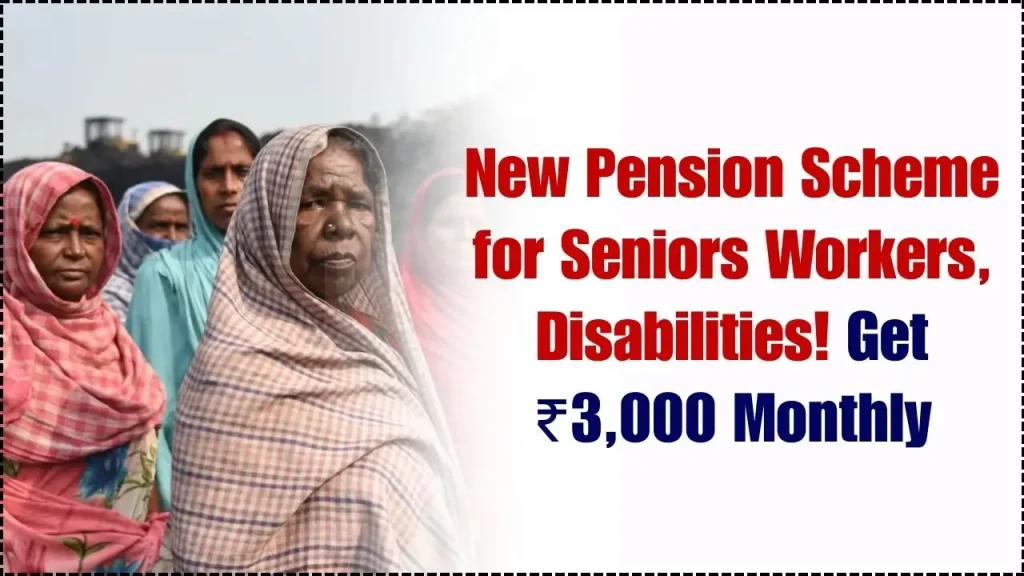
New Pension Scheme Announced: Senior Workers and Persons with Disabilities to Receive ₹3,000 Monthly has been designed with a clear focus on those who are most vulnerable in society. The target groups are senior citizens without regular income, unorganised sector workers who never had EPF or corporate pensions, widows, and persons with disabilities who often find it hard to stay in full-time work. Instead of leaving these groups fully dependent on family support, this pension framework aims to create a predictable monthly income that they can count on.
The scheme works in coordination with existing central and state pension systems so that the total monthly support can move toward or around the ₹3,000 mark for eligible beneficiaries. In the case of unorganised workers, contributory pension schemes such as government-backed old age pensions allow them to lock in ₹3,000 per month from age 60 by paying small monthly contributions during working years. For poor senior citizens and disabled persons, social assistance pensions funded by the government aim to push support closer to this benchmark through regular revisions and state-level top-ups.
New Pension Scheme
| Point | Details |
|---|---|
| New Pension Scheme | Targeted around ₹3,000 per month for senior citizens, widows and disabled persons under updated social security and contributory pension structures. |
| Main Beneficiaries | Senior workers, low-income elderly, widows and persons with disabilities identified under central and state welfare categories. |
| Core Scheme Mechanism | Combination of contributory pension for unorganised workers and non-contributory social assistance pensions for the poorest elderly and disabled. |
| Typical Age Criteria | Usually from 60 years and above for old-age pensions; higher slabs in some regions for 80+ seniors and severely disabled persons. |
| Disability Support | Separate or enhanced pension slabs for adults with benchmark or severe disabilities, based on certified percentage and income status. |
| Payment Mode | Direct Benefit Transfer (DBT) into Aadhaar-linked bank accounts on a monthly basis. |
| Application Channels | Local welfare offices, panchayats, municipal bodies, online state portals and assisted-online applications through service centres. |
Key Features of The New Pension Support
The most striking feature of the New Pension Scheme Announced: Senior Workers and Persons With Disabilities to Receive ₹3,000 Monthly is its attempt to stitch together different streams of support into a more coherent, stable income. On one side, there are contributory pensions that invite unorganised workers to join early in their career, pay a small amount every month, and in return secure a fixed ₹3,000 monthly pension once they reach 60. This gives workers in informal jobs a retirement tool that previously only formal employees enjoyed.
On the other side, non-contributory social pensions for senior citizens, widows and disabled persons are being gradually increased by both central and state governments. Where earlier amounts were sometimes too low to cover even basic needs, the new approach tries to bring the total closer to ₹3,000 or more for the most vulnerable categories. With better use of digital databases and direct transfers, leakages are reduced and the money reaches the beneficiary’s bank account more reliably.
Eligibility Criteria of New Pension Scheme For Senior Workers
- For senior workers, the New Pension Scheme Announced: Senior Workers and Persons With Disabilities to Receive ₹3,000 Monthly effectively opens two doors. The first door is for those who are still in their working years but belong to the unorganised sector. These include street vendors, domestic workers, helpers in small shops, rickshaw pullers, drivers, construction labourers and small self-employed individuals. They can enroll in government-supported contributory pension schemes through authorised centres or online platforms and start building their pension entitlement.
- The second door is for elderly citizens who are already past the age threshold and belong to low-income households. For them, the route is through social welfare pensions specifically designed for old age, often linked to poverty lines, income certificates or local verification. They may not have to contribute anything; instead, the government directly funds a monthly amount, sometimes topped up by state schemes. In many cases, elderly persons who also live with disabilities or have no earning family member are placed in higher-priority categories for faster inclusion.
Support For Persons with Disabilities
- Persons with disabilities are a core pillar of the New Pension Scheme Announced: Senior Workers and Persons With Disabilities to Receive ₹3,000 Monthly, not just an optional add-on. Disability often reduces a person’s capacity to work full-time, increases medical costs and creates extra expenses for mobility, assistive devices and caregiving. Recognising this, the pension design offers dedicated streams of financial support to adults with certified disabilities, especially those from poor or marginalised households.
- Typically, eligibility for disability pensions is anchored in an official disability certificate that records the percentage and type of disability. Schemes tend to prioritise those with higher disability percentages or multiple disabilities, ensuring that those who face the steepest daily challenges receive more consistent financial backing. Over time, states have started to move towards higher slabs for severely disabled persons, aligning their monthly income more closely with and sometimes above the ₹3,000 threshold.
How The 3000 Monthly Pension Works in Practice
In practical terms, the ₹3,000 monthly pension works like a guaranteed income floor that sits beneath whatever informal earnings or family support a person may have. For an unorganised worker enrolled in a contributory scheme, the formula is simple: join within the specified age band, contribute a fixed amount every month (which is kept modest and often age-linked), and let the government match this contribution. When the worker turns 60, they start receiving ₹3,000 per month for life. For social assistance pensions, the monthly amount is not tied to contributions but to eligibility conditions such as age, disability and income. Here, the ₹3,000 mark is used as a meaningful target that governments strive to reach through central allocations and state top-ups. While the exact amount may differ by region and category, the clear direction is towards ensuring that senior workers, widows and disabled persons do not have to survive on tiny sums that fail to keep pace with basic living costs.
Application Process and Required Documents For New Pension Scheme
- The application process for the New Pension Scheme Announced: Senior Workers and Persons With Disabilities to Receive ₹3,000 Monthly has been shaped to be simple, though it still requires careful documentation. In the case of unorganised workers joining contributory pension schemes, the usual requirements include Aadhaar, a savings or Jan Dhan bank account and a mobile number. Registration is typically done through authorised service centres or online portals, where the applicant’s details are captured, and consent is given for monthly auto-debit from the bank account.
- For senior citizens, widows and persons with disabilities seeking social assistance pensions, the process generally runs through local bodies such as panchayats, municipal offices, district social welfare offices or state-level portals. Applicants should be ready with age proof, residence proof, bank details, and where required, income certificates or poverty status documents. Persons with disabilities must also provide an official disability certificate issued by recognised medical authorities. Once verified and approved, the pension is directly transferred to the beneficiary’s bank account each month.
Meesho Work from Home: How to Start Earning Online with Zero Investment
Why This 3000 Monthly Pension Matters
- The real significance of a ₹3,000 monthly pension goes beyond numbers on paper. For many households, this amount can reliably pay for medicines, basic groceries, rent or electricity, reducing the constant anxiety of where money will come from next. In the case of senior workers and disabled persons who may not have children in stable jobs, this monthly stream becomes their most dependable source of cash. It also reduces the risk of exploitation, as financial dependence on relatives or local moneylenders comes down.
- At a larger level, the New Pension Scheme Announced: Senior Workers and Persons with Disabilities to Receive ₹3,000 Monthly reflects a shift in how society looks at ageing and disability. Instead of treating support as charity or temporary relief, it moves towards recognising regular pensions as a right tied to citizenship and dignity. As coverage expands, data from these programmes can help fine-tune future policies, adjust pension amounts with inflation, and identify groups that still need better outreach or higher support.
FAQs on New Pension Scheme
Who can benefit from the 3000 monthly pension schemes?
The main beneficiaries include low-income senior citizens, unorganised sector workers without formal retirement benefits, widows and persons with disabilities.
Do I have to contribute money every month to get the pension?
If you join a contributory pension as a worker, you do need to contribute a fixed amount each month, which the government usually matches.
How will I receive the 3000 pension every month?
Most schemes use Direct Benefit Transfer into your bank account that is linked with Aadhaar or similar identification. Once your application is approved, the pension is credited directly every month, and in many areas, you can track payments through SMS alerts or online portals.
Can senior workers and disabled persons apply online for this scheme?
Yes, in many regions, applications can be initiated or completed online through government portals or assisted-online through service centres.