

India’s new online waiver system is designed to make clearing outstanding farm loans simpler, faster, and more transparent for eligible farmers in 2025. It works primarily through state-run portals that verify your identity and loan details, match your records with cooperative and regional rural banks, and then settle approved dues directly with lenders. Once reconciled, you receive a waiver certificate confirming closure of your outstanding amount.

The New Online Waiver System is a state-led, portal-based process where you first check your beneficiary status, complete Aadhaar-based KYC, upload loan and land records, and then allow bank and revenue authorities to verify and reconcile your loan. After approval, dues are cleared automatically on the backend, and a waiver certificate is issued to you. Processes vary by state, but the core steps eligibility check, documentation, verification, bank reconciliation, and certificate download are consistent and designed to prevent duplication and speed up relief.
New Online Waiver System
| Element | Key Details |
|---|---|
| Program Owner | State governments via agriculture/rural departments; no single national waiver active |
| Covered Loans | Mainly cooperative and regional rural bank crop loans notified by the state |
| Typical Cap | Often ₹1–1.5 lakh per farmer; state notifications decide the exact limits |
| Cut-Off Dates | Commonly loans sanctioned before a notified date (many states use up to March 31, 2023) |
| Application Mode | Online via state portals; offline verification at bank/gram panchayat/revenue office may apply |
| Core Documents | Aadhaar, Aadhaar-linked bank account, loan passbook/statement, KCC details, land records |
| Verification | Beneficiary list check, bank ledger reconciliation; some states require patwari/revenue endorsement |
| Disbursal Method | Government settles with banks; loan account is closed and waiver certificate issued |
| Status Tracking | Beneficiary lists, dashboards, and grievance modules on state portals |
The New Online Waiver System in 2025 is a practical, streamlined way for eligible farmers to clear outstanding loans: check your status on the official state portal, complete Aadhaar-based KYC, upload loan and land records, finish any required offline verification, and track your application until bank reconciliation closes your dues and a waiver certificate is issued. Because every state sets its own rules caps, dates, lenders, and documentation always rely on your state agriculture or loan waiver portal for the most accurate instructions and use formal grievance channels if you spot errors.
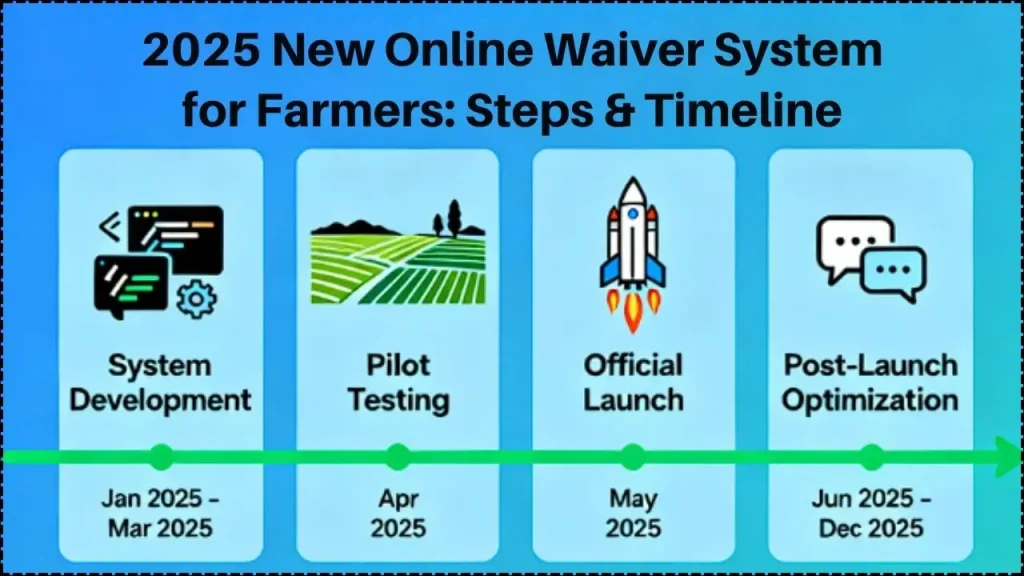
How The New Online Waiver System Works In 2025
- Check beneficiary status: Visit your state agriculture or loan waiver portal and search by district, village, ID, or mobile number to confirm whether your name is included.
- Register and complete KYC: If eligible or instructed, register on the portal, verify via Aadhaar, and confirm your Aadhaar-linked bank account for accurate settlement and identity matching.
- Upload documents: Provide your loan passbook/statement, Kisan Credit Card details, land records (ROR/Jamabandi/RTC), and any income or category certificates as specified.
- Offline verification (if required): Some states require a quick visit to the gram panchayat, cooperative bank branch, or tehsil for patwari/revenue endorsement of land and identity details.
- Bank reconciliation and settlement: Your lender and the state reconcile the sanctioned amount, interest, and eligible relief; approved dues are then settled directly.
- Waiver certificate: Download or collect the waiver certificate as proof that the outstanding loan covered under the scheme has been closed.
Why States Use the New Online Waiver System
- Speed and transparency: Portals provide an auditable trail and reduce middlemen, helping farmers track their status and avoid repeated submissions.
- Targeting and integrity: Aadhaar-based KYC, bank integration, and social audit or public dashboards help prevent duplication and ensure only eligible, verifiable loans are waived.
- Budget alignment: Digital reconciliation helps states sequence payments with budget cycles, keeping relief predictable and focused.
Who Qualifies Under Current State Waivers
- Small and marginal farmers are typically prioritized when waiving cooperative and regional rural bank crop loans, subject to caps and date cut-offs.
- Resident eligibility applies, meaning you must apply in the state where you farm and hold land records.
- Private bank loans are usually excluded unless a state explicitly includes them; always check your state’s latest notification.
Documents You’ll Need for New Online Waiver System
- Aadhaar + Aadhaar-linked bank account to enable secure identity checks and direct settlement.
- Loan passbook/statement and KCC details to match the sanctioned amount, disbursement, and outstanding balance.
- Land records (such as ROR/Jamabandi/RTC) to verify landholding and match beneficiary status; some states may ask for income or category certificates.
- Recent passport photo and mobile number linked to Aadhaar for OTP-based verification when required.
Timelines, Caps, And What to Expect
- Per-farmer caps often range from ₹1–1.5 lakh, but your state’s circular sets the final limit and whether interest/penal interest is included.
- Processing times vary by state and lender bandwidth; completing offline verifications early and ensuring clear document scans typically speeds up approvals.
- After settlement, the waiver certificate is generated; keep it safe and confirm your loan account shows “closed/settled under state waiver” with your bank.
State Portals and Beneficiary Dashboards
- Look for your state’s dedicated waiver page or agriculture department portal with a “Beneficiary List,” “Know Your Status,” or “Social Audit” section.
- Many portals allow district-wise or village-wise searches, as well as ID-based checks; use official domains only and avoid third-party apps or agents.
- If you find discrepancies, use the portal’s grievance module or visit your cooperative branch or local office with supporting documents for correction.
If Your Loan Isn’t Covered
- Explore restructuring: Ask your lender about rescheduling or restructuring, which may reduce immediate pressure and keep your account standard.
- Use formal credit: If you rely on informal lenders, consider KCC or agri-term loans for lower rates and flexible repayment aligned with crop cycles.
- Risk mitigation: Ensure crop insurance is active; enroll in state or central schemes that reduce cost of credit or offer interest subvention.
- Watch for targeted relief: States sometimes announce district- or calamity-specific relief; check notifications after major weather events.
Impact And Expert View
- Waivers can unlock short-term liquidity, help farmers re-enter formal credit, and prevent distress sales of assets.
- However, they do not fix structural issues by themselves; long-term sustainability depends on better market access, storage, irrigation, technology, and stable pricing.
- For individual farmers, the New Online Waiver System is a practical route to close eligible dues, but pairing it with credit discipline, insurance, and diversified income can reduce future stress.
Actionable Checklist For 2025
- Confirm coverage: Search your name on your state’s official portal beneficiary list or status page.
- Prepare documents: Keep Aadhaar, Aadhaar-linked bank details, loan passbook, KCC, land records, and photos ready.
- Complete KYC: Use the portal’s eKYC flow and verify OTPs from your Aadhaar-linked mobile.
- Submit clean scans: Upload legible PDFs/JPEGs with clear edges; match names across all documents.
- Finish offline steps: If patwari or bank verification is needed, visit early with originals.
- Track and follow up: Monitor your status on the portal; if stuck, use the grievance module or meet the bank’s nodal officer.
- Collect proof: Save the waiver certificate and bank statement entry showing closure under the scheme.
- Update credit: After closure, check your credit report to ensure the loan reflects “closed/settled under waiver.”
Best Practices to Avoid Delays
- Use exact spellings: Ensure your name and father’s name match across Aadhaar, bank, and land records.
- Align mobile numbers: Keep your Aadhaar-linked number active for OTPs and alerts.
- Keep copies: Maintain hard and soft copies of all submissions and receipts.
- Avoid agents: Apply only through official portals or notified help centers; never share OTPs with anyone.
- Re-check eligibility: If your loan type or date isn’t covered, do not file duplicate applications—seek alternative relief or restructuring.
Tips For Faster Approval
- Start with the beneficiary list to confirm inclusion; if not listed, check if your loan meets the notified cut-off and lender criteria.
- Pre-verify with your cooperative branch that your outstanding and KCC details are correct to prevent reconciliation errors.
- Submit all requested documents at once; partial uploads often trigger rejections or long delays.
- If land records show old ownership, update them before submission to prevent mismatches during revenue verification.
FAQs on New Online Waiver System
Is there a national farm loan waiver in 2025?
There isn’t a single nationwide waiver; states run their own programs and portals with distinct caps, loan types, and cut-off dates. Always follow your state’s latest notification.
Do I need to apply if my name is already on the beneficiary list?
In many states, banks process waivers once verification is complete. Still follow portal instructions, complete KYC, and provide documents if asked to finalize settlement.
Are private bank loans included in the New Online Waiver System?
Usually not, unless your state explicitly includes private banks in its 2025 notification. Most coverage focuses on cooperative and regional rural bank crop loans.
Will a waived loan hurt my credit score?
When a waiver settles your dues, your loan should reflect closed/settled; keep the waiver certificate and confirm updates in your credit report. Good repayment behavior going forward helps strengthen your profile.