
The Kanya Sumangala Yojana 2025 remains one of Uttar Pradesh’s most important welfare programmes for girls, offering up to ₹25,000 through phased direct transfers. The scheme aims to promote education, reduce financial barriers, and strengthen gender equity, according to state government policy guidelines and statements from senior officials.
A Comprehensive Look at the Kanya Sumangala Yojana 2025
The Kanya Sumangala Yojana 2025 is a long-running UP government scheme that provides phased financial support to girls from birth until higher education. It is implemented by the Department of Women and Child Development to improve social outcomes and strengthen girl child welfare.
The financial assistance is released in six instalments as the girl achieves key developmental and educational milestones. The model is part of a wider movement in India toward conditional cash transfers that encourage sustained schooling and health investments.
Historical Background of the Kanya Sumangala Yojana 2025
The programme was originally launched in 2019 as part of the state government’s broader strategy to address gender disparities. At its inception, families received a maximum of ₹15,000. Policy revisions in 2023 and again for Kanya Sumangala Yojana 2025 raised the total support to ₹25,000 to reflect rising education costs and inflation.
A senior state official said during a press briefing last year that the government’s objective was to “remove financial hesitation at every stage of a girl’s early life.”
How the ₹25,000 Support Is Distributed
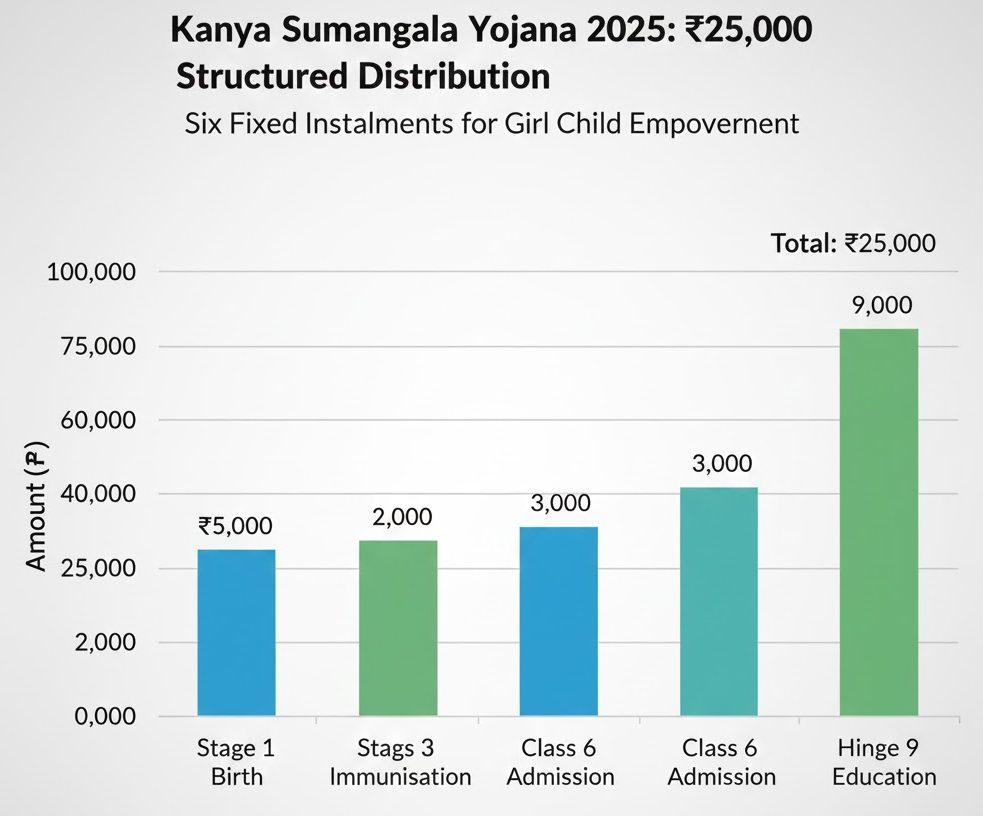
Six Structured Instalments
Government documents outline the fixed support pattern:
- ₹5,000 at Birth – upon submission of birth registration and residence proof.
- ₹2,000 After Immunisation – after mandatory vaccination completion.
- ₹3,000 on Admission to Class 1 – requires verified school entry.
- ₹3,000 on Admission to Class 6 – proof of continued schooling.
- ₹3,000 on Admission to Class 9 – intended to reduce dropout risk.
- ₹9,000 on Admission to Higher Education – the largest tranche, supporting college or technical programmes.
Officials say this phased structure helps keep families engaged throughout the child’s schooling journey.
Eligibility Criteria for Kanya Sumangala Yojana 2025
Income and Household Requirements
To qualify under the UP government scheme, applicants must meet the following:
- Annual family income not exceeding ₹3 lakh
- Permanent Uttar Pradesh residency
- Maximum of two eligible daughters per family, with specific exceptions for twins or legally adopted girls
Required Documentation
Documents needed at various stages include:
- Child’s birth certificate
- Aadhaar of parents or guardians
- Income certificate
- Proof of residence
- Bank account details for direct benefit transfer
- School certificates for education-related instalments
District-level authorities verify all documents before approving payments.
How to Apply for Kanya Sumangala Yojana 2025
Families can apply through the state’s official online portal. Steps include:
- Registering with a mobile number
- Filling in family and child details
- Uploading documents
- Submitting the form for verification
- Tracking the status online
District Child Protection Units review applications and clear payments. Verification times vary across districts.
Beneficiary Statistics and Past Impact
According to government data published in 2023–24:
- Over 18 lakh girls have received some or all instalments since the scheme’s launch.
- Districts like Prayagraj, Gorakhpur, and Lucknow reported the highest beneficiary numbers.
- Most recipients belong to families with annual incomes below ₹2 lakh.
A policy evaluation conducted by a state-supported research team in 2024 found that the scheme helped reduce dropout rates during the transition from primary to upper-primary schooling.
Expert Views and Economic Analysis
Education economists say conditional cash transfer schemes like this significantly influence schooling decisions in lower-income households.
Dr. Shalini Verma, a researcher at the Indian Institute of Management Lucknow, said the scheme “creates an economic cushion at critical educational milestones and reduces early dropout pressure.”
Economist Dr. Rajan Mehta from Delhi University noted that long-term success depends on ensuring the money is released consistently and that school infrastructure remains strong.
How the Scheme Fits into Larger Gender-Equality Goals
The Kanya Sumangala Yojana 2025 contributes to India’s commitments under various national and international frameworks such as:
- Beti Bachao Beti Padhao (Government of India)
- National Education Policy (2020)
- UN Sustainable Development Goal 4: Quality Education
- SDG 5: Gender Equality
UNICEF experts working on gender programmes in India have observed that targeted financial incentives, combined with community outreach, lead to measurable improvements in female education outcomes.
Comparison With Other State-Level Programmes
Several Indian states run comparable girl child welfare schemes:
- Madhya Pradesh – Ladli Laxmi Yojana provides up to ₹25,000 in bonds and cash transfers.
- Haryana – Ladli Social Security Allowance supports families until the girl turns 18.
- Rajasthan – Rajshree Yojana offers assistance at birth and school admissions.
Uttar Pradesh’s programme stands out for its fully digital application process and direct benefit transfer model, reducing intermediaries and improving transparency.
Ground-Level Experiences
NGOs working in rural districts report mixed experiences.
Workers from a local organisation in Sitapur district said families often struggle with documentation, especially when Aadhaar details do not match birth records.
One beneficiary, 12-year-old Radhika from Barabanki, said in a community meeting that her family used the Class 6 instalment to purchase schoolbooks and a uniform. Her mother added that the support “felt like someone stood behind us when we needed help.”
These testimonies highlight both the value of the scheme and the need for continued guidance and verification support.
Challenges in Implementation
While the scheme has strong administrative backing, policy analysts identify several key challenges:
1. Documentation Issues
Many low-income families face delays due to inconsistent or missing records.
2. Awareness Gaps
A national NGO review in 2023 found that rural families often learn about the scheme only through community workers, not official channels.
3. Technical Barriers
Online registration remains difficult in areas with limited internet connectivity.
4. Delays in Verification
Some districts experience backlog due to staff shortages.
Government officials have acknowledged these issues and proposed improvements for 2025, including mobile registration vans and simplified documentation rules.
Audits, Transparency Measures, and Government Responses
The Uttar Pradesh government has introduced several measures to enhance transparency:
- Annual third-party audit of all disbursements
- Public dashboards showing application status and approval numbers
- SMS-based alerts for each stage of verification
- District-level grievance redress centres
During a recent media briefing, a government spokesperson stated that the state had “significantly reduced processing times” through new digital tools deployed in 2024.
Policy Recommendations from Experts
Researchers propose several ways to strengthen the scheme:
- Simplify documentation requirements, especially for families with newborns.
- Increase financial literacy campaigns so families understand DBT processes.
- Improve coordination between health, education, and child welfare departments.
- Link benefits to skill-development programmes for adolescent girls.
- Strengthen monitoring systems to ensure funds reach beneficiaries on time.
These recommendations align with broader national development goals.
Maiya Samman Yojana — Monthly ₹2,500 Assistance for Women Explained
Conclusion
The Kanya Sumangala Yojana 2025 continues to play a vital role in Uttar Pradesh’s efforts to support girls’ education and strengthen gender equality. With a clear eligibility structure, phased financial support, and expanding digital systems, the scheme aims to reach millions of families. While challenges remain in documentation and outreach, sustained government interventions and community engagement can help ensure that the ₹25,000 assistance reaches every eligible household.