

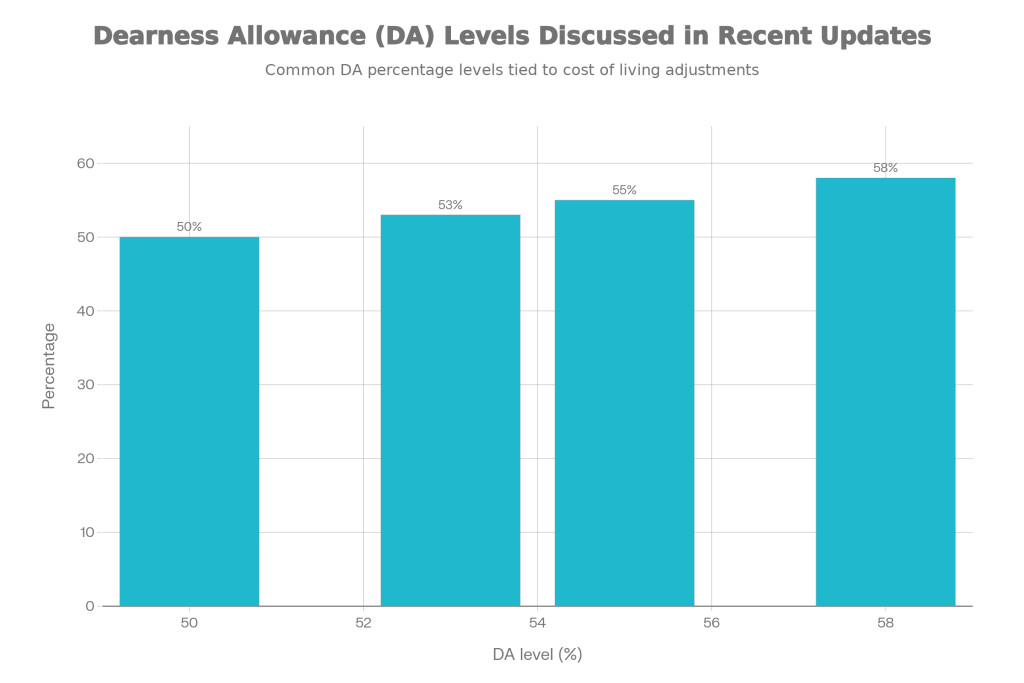
If you’ve been tracking government salary updates lately, you’ve probably seen the same question everywhere: will DA finally merge with Basic Pay now that the percentage has climbed so high? The short, practical answer is no. The government has clarified that there is no proposal under consideration to merge DA with basic pay at present, even though the DA level being discussed in recent reports has gone well beyond the 50% mark. This is exactly why the topic keeps trending among Central Government employees and pensioners. People aren’t just curious, they’re trying to calculate what happens next to monthly pay, future increments, and retirement benefits. And to be fair, the confusion is understandable, because the “50% DA merger” idea has been discussed for years whenever DA hits certain milestones. But as of the latest official clarity, there is no announcement, no order, and no approval for a DA merger right now.
This Dearness Allowance Update Will DA Merge with Basic Salary Latest Government Clarity for Employees matters for one simple reason: Basic Pay is the foundation of the salary structure, and any change to it can ripple into multiple components. When employees talk about a DA merger, they’re not just asking for a cosmetic restructuring of the payslip. They’re expecting a higher “revised basic” that becomes the new base for increments and other pay-linked calculations. At the same time, the latest clarity also helps employees plan realistically. If you were expecting that DA would “reset” after being merged into Basic Pay, the current update suggests you should not budget for that scenario yet. The system, for now, remains what it has been: DA continues separately and is revised through the regular mechanism rather than being absorbed into Basic Pay.
Dearness Allowance Update
Why Da Merger Is Being Discussed Again
The DA merger discussion typically returns whenever DA crosses a major threshold, and the 50% mark is the one that triggers the most noise. In recent months, the conversation has grown louder because DA has moved higher than that threshold, and many employees assume that the “next logical step” is merging part of it into the Basic Pay.
There’s also a timing factor. The moment people start talking about a new pay commission cycle, the expectation of structural changes rises sharply. Many employees connect the dots like this: if a new pay revision is coming (or being discussed), then the government might offer interim relief by merging DA into Basic Pay. But the current government clarification does not support that expectation.
What A Da Merger Would Mean For Salary
Understanding the attraction of a DA merger is important, because it explains why the demand doesn’t die even after repeated clarifications.
- If DA is merged into Basic Pay, the basic component increases. Once the basic increases, future calculations that use Basic Pay as a base may also rise, depending on the rule for each component. For example, increments are calculated on Basic Pay, so a higher Basic Pay can mean a higher increment amount over time.
- That’s the heart of the demand: employees aren’t only looking at today’s salary, they’re looking at the compounding effect of a higher base. However, it’s equally true that such restructuring can raise long-term government expenditure because it increases the recurring base on which multiple payouts are calculated.
What The Government Said About Da Merger
This is where the latest update becomes decisive.
- As reported, the government’s position is that there is no proposal under consideration to merge Dearness Allowance with basic pay at present. That single line matters because it answers the question employees are asking in the most direct way possible. It does not leave room for “maybe next month” assumptions unless a fresh policy decision is taken later.
- In other words, the 50% threshold is not functioning as an automatic trigger for merger in the current framework. So even if DA remains elevated, the present structure continues unless the government announces a change.
DA And The 8th Pay Commission Buzz
A major reason this issue continues to trend is the 8th Pay Commission chatter. When pay commissions come into the picture, employees naturally start expecting bigger structural reforms instead of only incremental revisions.
But it’s important to separate two things:
- First, DA is a running allowance under the existing framework.
Second, pay commission recommendations are a separate route, involving proposals, evaluation, and acceptance by the government before any structural change is implemented. - Right now, what’s on record is the government’s statement that there is no proposal to merge DA into Basic Pay at present. So, the 8th Pay Commission discussion may keep hopes alive, but it does not change today’s official status.
What Employees Should Do Practically
Instead of planning your finances around a possible DA merger, it’s smarter to plan around what is confirmed.
Here’s what the latest clarity suggests for practical planning:
- Treat DA as a separate component that may change with the regular revision cycle rather than being “absorbed” into Basic Pay.
- Avoid counting on a “reset” of DA due to merger in the near term because the government has explicitly said no proposal is under consideration.
- Keep an eye on formal announcements rather than social media claims, because the merger story often circulates without an official order backing it.
Also, if your main concern is take-home pay, remember that take-home changes depend not just on DA, but also on deductions and the exact structure of allowances you receive. A DA merger is only one possible lever, and it isn’t active right now.
PM Surya Ghar Yojana 2025 – Free Solar Panels Installed in 6,000+ Homes, See Who Can Apply Next
Common Misunderstandings About DA Merger
A few myths keep repeating in WhatsApp forwards and casual conversations at workplaces.
- Myth 1: DA automatically merges after 50%.
The latest clarification indicates that there is no automatic merger rule being applied now, because the government has stated no proposal is under consideration for merger. - Myth 2: If DA is high, merger must happen to “reset” it.
Not necessarily. The current approach allows DA to remain a separate component; it does not require a reset through merger. - Myth 3: Merger is already approved but not implemented.
The update being reported is the opposite: the government says there is no proposal under consideration at present.