
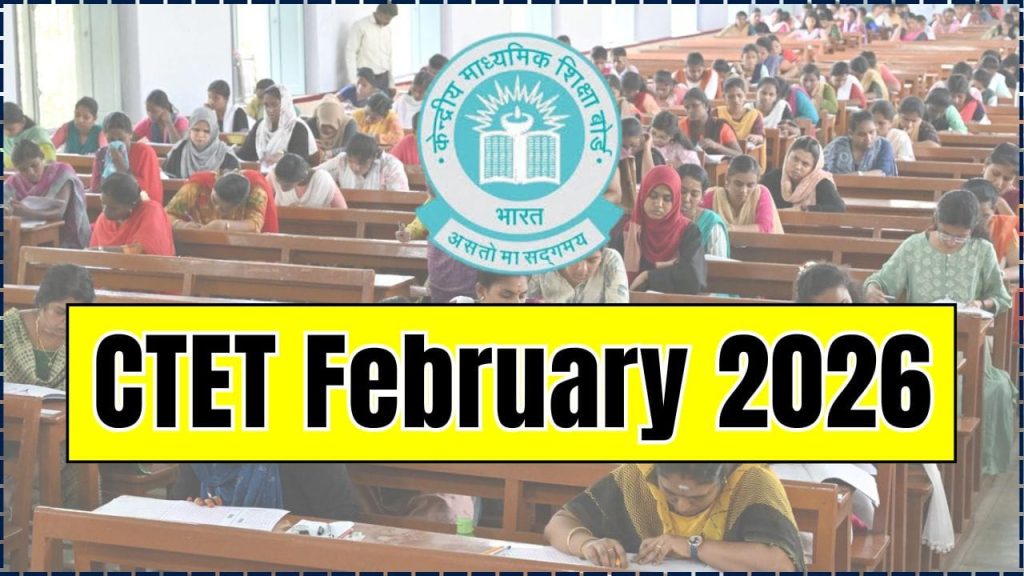
The CTET February 2026 examination will be held on 8 February 2026, according to the Central Board of Secondary Education (CBSE). The national-level test is a mandatory qualification for teachers seeking positions in central schools, and candidates are now preparing for the upcoming registration window, expected to open in early November.
A National-Level Test with High Stakes
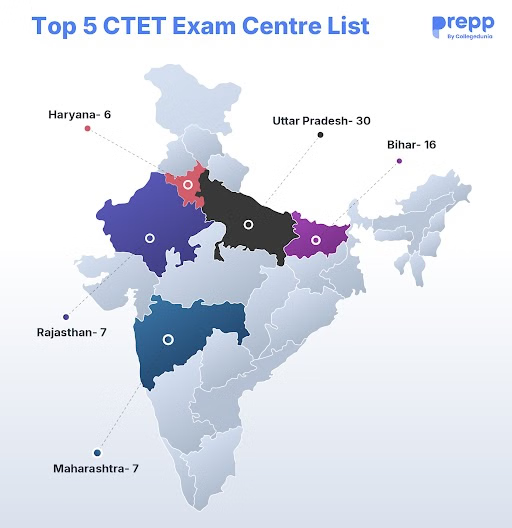
The Central Teacher Eligibility Test (CTET) is conducted twice a year and remains one of India’s most important exams for aspiring educators. According to CBSE’s public notice issued on 24 October 2025, the February 2026 session will be conducted offline across 132 cities in 20 languages.
Education policy analysts say the February session often attracts large participation because it falls before major recruitment cycles in Kendriya Vidyalayas (KVS) and Navodaya Vidyalayas (NVS). “CTET serves as the foundational eligibility benchmark for India’s teacher workforce,” said Dr. R. Sen, an education researcher at the National University of Educational Planning and Administration.
Key Dates for CTET February 2026
Important Timelines
- Exam Date: 8 February 2026 (Sunday)
- Application Window: Expected in early November 2025, tentatively ending in the last week of November
- Admit Card Release: First week of February 2026
- Result Declaration: Likely in March 2026
While CBSE has confirmed the exam date, detailed instructions will be published in the Information Bulletin on the official portal.
Understanding Eligibility Requirements
Eligibility differs for Paper 1 and Paper 2, and candidates must ensure compliance as on the last date of application.
Eligibility for Paper 1 (Classes I–V)
Candidates must meet any one of the following:
- Senior Secondary (Class 12) with at least 50% marks and a 2-year Diploma in Elementary Education (D.El.Ed)
- Senior Secondary with 50% marks and a 4-year Bachelor of Elementary Education (B.El.Ed)
- Graduation with 50% marks and B.Ed, subject to certain training conditions
Eligibility for Paper 2 (Classes VI–VIII)
Any one of the following:
- Graduation with at least 50% marks and B.Ed
- Graduation with D.El.Ed (2-year programme)
- Senior Secondary with 50% marks plus 4-year B.A.Ed/B.Sc.Ed/B.El.Ed
There is no upper age limit, and candidates must be Indian citizens.
How the Exam is Structured
Paper Format
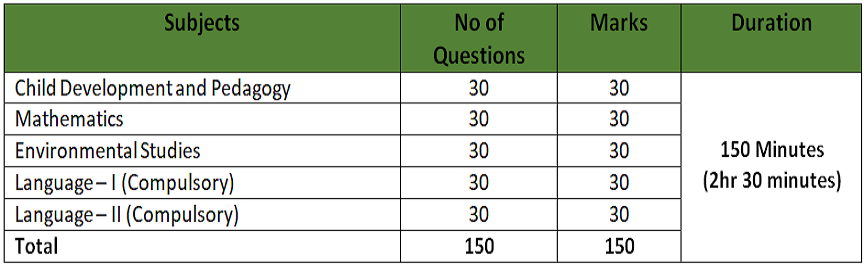
Both Paper 1 and Paper 2 consist of 150 multiple-choice questions, carrying one mark each. There is no negative marking, making informed guessing a viable strategy.
Subject Breakdown
Paper 1
- Child Development and Pedagogy
- Language I
- Language II
- Mathematics
- Environmental Studies
Paper 2
- Child Development and Pedagogy
- Language I
- Language II
- Mathematics & Science OR Social Studies/Social Science
Certificate Validity
The CTET qualifying certificate is valid for a lifetime, as per the 2021 policy revision by the Ministry of Education.
Registration and Application Steps for CTET February 2026
The application process involves:
- New Registration on the CTET website
- Filling the online application form
- Uploading photo and signature in prescribed dimensions
- Paying the application fee
- Downloading the confirmation page
Expected Fee Structure
- General/OBC: ₹1,000 for one paper; ₹1,200 for both
- SC/ST/PwD: ₹500 for one paper; ₹600 for both
CBSE will confirm the final fee in the information bulletin.
Exam Day Guidelines: What Candidates Should Prepare For
Mandatory Documents
Candidates must carry:
- Printed admit card
- Valid photo identity proof (Aadhaar, PAN, Passport)
- Two passport-size photographs
Prohibited Items
Electronic gadgets, watches, calculators, and written notes are not allowed. Centres use metal detectors to ensure compliance.
Why CTET February 2026 Is Significant for Aspiring Teachers
The February cycle often serves as the gateway for teacher recruitment because several government institutions conduct hiring in mid-year.
“A strong CTET score signals readiness for classroom challenges,” said Prof. Meera Kulkarni from Delhi University’s Faculty of Education. She noted that although CTET does not guarantee employment, it is “a minimum eligibility that schools, especially central institutions, take very seriously.”
The exam also holds weight in private schools, many of which have aligned hiring practices with CBSE’s standards.
Historical Trends and Expected Competitiveness
In recent years, CTET has seen high participation, with around 20–25 lakh candidates appearing per session.
Pass Rates Over Time
- 2021: ~17%
- 2022: ~14%
- 2023: ~15%
- 2024–25: Expected to remain similar
Experts attribute the moderate pass rate to the exam’s focus on pedagogical understanding rather than rote knowledge.
Preparation Insights from Experts
Teacher-training educators suggest a three-month structured plan for CTET February 2026.
Recommended Strategy
- Prioritise Child Development and Pedagogy, often considered the most conceptual section
- Solve previous year question papers
- Read NCERT textbooks for Classes I–VIII
- Build speed and accuracy using mock tests
“CTET rewards conceptual clarity over memorisation,” said Anil Sahu, a senior CTET coach and author of pedagogy preparation books.
Potential Scheduling Challenges
Some states have reported overlaps with regional examinations. For example, officials in Maharashtra noted that a government scholarship test is scheduled on the same day, raising concerns for teachers assigned as invigilators.
Education ministries at the state level may adjust local arrangements to reduce disruptions, though no official changes have been announced yet.
EPS-95 Pension Update – 2025 Highlights New Limits and Ongoing Concerns
Conclusion
With the CTET February 2026 exam date confirmed, candidates now have clarity to organise their study plan, verify eligibility, and prepare documents for registration. As the information bulletin is awaited, aspirants should rely only on official updates from CBSE and maintain readiness for a tightly scheduled application window. The exam remains a crucial step for thousands of future educators aiming to secure positions in India’s central and state-affiliated schools.