
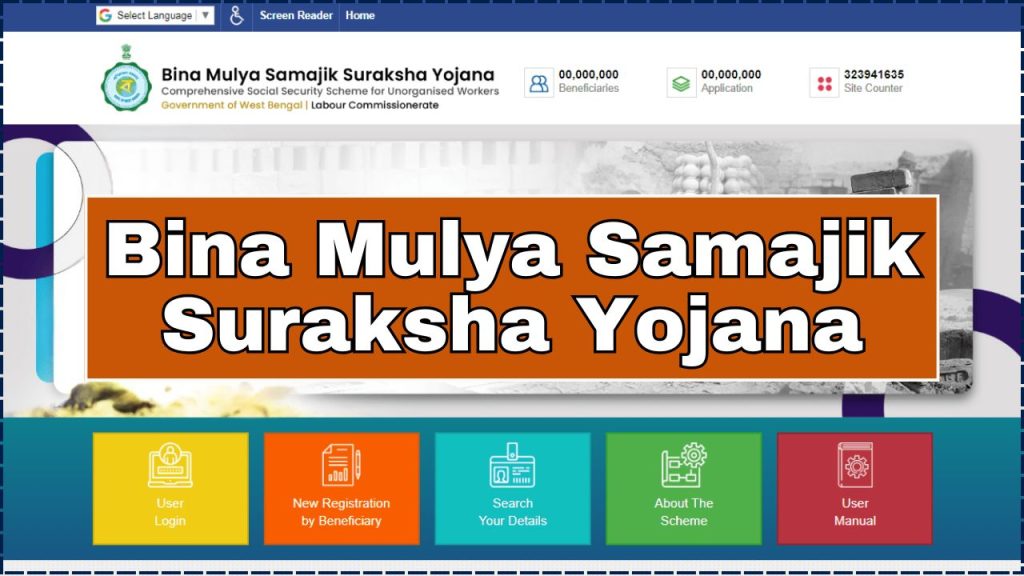
West Bengal has expanded the Bina Mulya Samajik Suraksha Yojana, a statewide social security scheme designed to support millions of unorganised workers with healthcare, financial assistance, and provident fund coverage. Announced by the Labour Department, the reforms aim to streamline fragmented welfare initiatives and ensure more equitable access to basic protections across diverse economic sectors.
Understanding the Bina Mulya Samajik Suraksha Yojana
The Bina Mulya Samajik Suraksha Yojana (BMSSY) is the flagship labour welfare scheme introduced by the West Bengal Labour Department. It consolidates a range of earlier, occupation-specific welfare programmes into a single framework. The department reports that over 1.5 crore workers across construction, transport, domestic work, agriculture-adjacent activities, and small manufacturing are eligible.
According to an official statement released by the department, the state covers the entire provident fund contribution. The original version of the scheme required workers to contribute a small amount each month, but officials say the decision to fully subsidise contributions “ensures that no worker is excluded due to financial constraints.”
Historical Background and Policy Evolution of BMSSY Scheme
Labour analysts say West Bengal has long experimented with sector-based welfare boards, especially for beedi workers, construction labour, transport workers, and artisans. However, these boards operated independently and often produced uneven outcomes.
A 2019 report by the Institute of Development Studies Kolkata noted that workers in smaller or less organised sectors benefited less from earlier schemes. When the state announced BMSSY in 2020, it sought to eliminate duplication and extend uniform benefits across all unorganised occupations.
Professor Anita Ghosh from the University of Calcutta explains that this unified approach “marks an important shift towards inclusive state-led social protection,” adding that it aligns better with international standards for labour welfare.
Major Benefits Offered Under BMSSY Scheme
Healthcare Support
Workers registered under the scheme can access financial assistance for medical treatment, hospitalisation, and surgical procedures. The Labour Department’s guideline document states that workers can receive support for both outpatient and inpatient care, with amounts varying depending on the severity and type of treatment.
Provident Fund Contributions
The provident fund component helps workers save for old age. Unlike earlier versions, the state now pays the entire contribution, allowing workers to accumulate savings at no personal cost.
Education Assistance
Children of registered workers can apply for scholarships covering secondary school, higher secondary school, and professional courses. According to government advisories, some professional and technical courses may qualify for annual support of up to ₹30,000.
Death and Disability Support
The scheme provides compensation for accidental and natural death, as well as assistance for partial or complete disability. Officials say the benefits aim to protect families during emergencies that often push unorganised workers into debt.
Who the BMSSY Scheme Serves — The Unorganised Workforce
Government data shows that over 93 percent of the state’s labour force works in the unorganised sector. This includes domestic workers, hawkers, small transport workers, tailors, artisans, rickshaw pullers, and workers associated with small service establishments.
Labour economist Dr. Raghav Sen from the Centre for Policy Research says the scheme “fills a gap in India’s social protection landscape by targeting the largest and most economically vulnerable category of workers.”
Worker Perspectives and Real-World Experiences
Case Study 1 — Construction Worker
Arun Halder, a 43-year-old construction labourer in Howrah, said that the scheme helped him cover part of his medical expenses after he suffered a workplace injury. “Earlier it was difficult to manage hospital bills,” he said. “Now the assistance reduces some of the pressure.”
Case Study 2 — Domestic Worker
In the North 24 Parganas district, Mita Roy, a domestic worker, has applied for education support for her daughter. She said the application process was “relatively simpler this year” due to help from the local facilitation centre.
While these experiences reflect positive outcomes, worker groups say benefits do not always reach households quickly. A union representative from the Construction Workers’ Association said delays often occur because of incomplete documents or mismatches in application records.
Enrolment Trends and District-Wise Participation
The Labour Department reports steady growth in enrolment since 2020. Officials attribute the rise to regular outreach drives and mobile camps organised in both urban and rural districts.
Districts such as Kolkata, Howrah, and Nadia show high enrolment levels, while some northern districts still lag due to limited digital access and fewer facilitation centres.
Administrative and Operational Challenges for BMSSY Scheme
While the state promotes the initiative as inclusive, implementation challenges remain.
Digital Divide
A study by the Institute of Rural Management Anand found that many applicants rely on community centres for online submissions. Low digital literacy and inconsistent internet connectivity slow down the process.
Awareness Gaps
Experts note that a significant portion of the unorganised workforce is still unaware of the scheme. Awareness drives conducted through panchayats and labour offices are helping, but officials acknowledge more needs to be done.
Administrative Delays
Unions cite occasional delays in fund disbursement. Labour officials say improvements to the automated tracking system should reduce wait times.
How the BMSSY Scheme Is Funded and Monitored
The programme is funded through the state budget and allocated annually. According to labour department officials, funds are disbursed to district welfare offices, which verify claims and process payments.
Labour Minister Becharam Manna recently said the digital monitoring platform “enhances transparency and accountability” by allowing real-time tracking of applications and payouts.
Annual audits, conducted jointly by the Finance Department and independent agencies, evaluate compliance and administrative efficiency.
Technology and Card-Based Access
Beneficiaries receive a digital Samajik Mukti Card. This card allows them to access benefits, verify their status, and apply for new assistance. Officials say over one crore cards have been issued.
Comparison with Other Indian Welfare Schemes
Analysts note that while states such as Kerala and Tamil Nadu operate sector-specific boards, West Bengal’s consolidated model under BMSSY is distinct.
Dr. Sen observes that central schemes like the e-Shram portal focus mainly on creating unified worker databases, whereas BMSSY places stronger emphasis on direct financial assistance.
Future Outlook — What Comes Next
Officials say the state is considering several enhancements, including:
- expanding digital kiosks for on-ground support;
- improving integration with the central e-Shram database;
- increasing the upper limit for education scholarships in technical fields;
- regular awareness campaigns targeting migrant workers.
Labour policy experts emphasise that long-term sustainability will depend on consistent budget allocations and administrative simplification.
PM-Kisan 2025: New Rules, Payment Dates & Secrets to Get ₹6,000 Without Delay!
Concluding Paragraph
The Bina Mulya Samajik Suraksha Yojana remains one of India’s largest state-level welfare programmes dedicated to unorganised workers. As West Bengal expands its digital systems, strengthens financial support, and increases outreach, the scheme has the potential to provide long-term security for millions. Analysts say sustained investment and continuous administrative refinement will determine its lasting impact.