

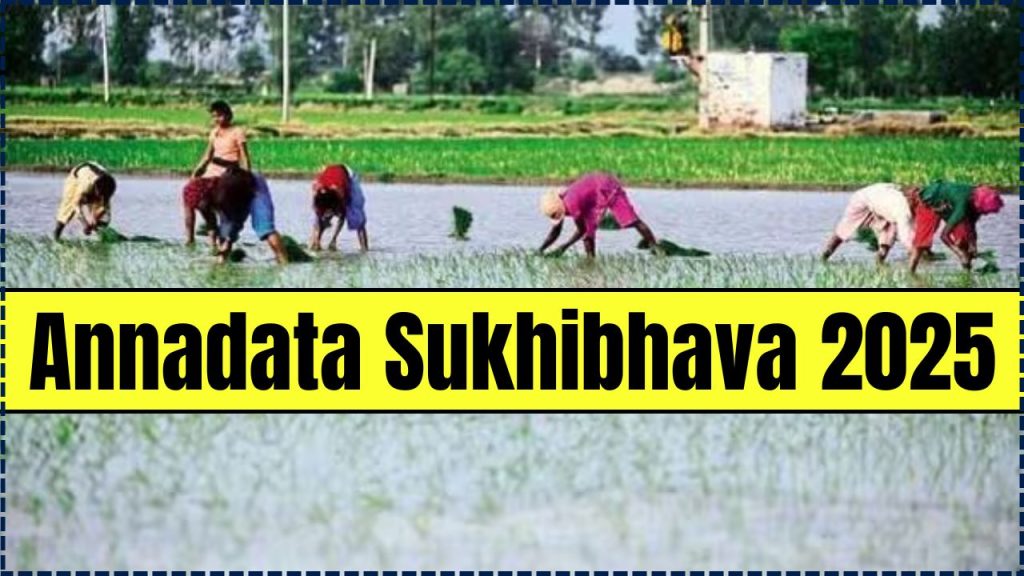
The Andhra Pradesh government launched the Annadata Sukhibhava 2025 scheme on 2 August, offering direct annual financial assistance of ₹20,000 to more than 46 lakh farmers. The updated programme includes new verification, banking, and documentation requirements designed to improve accuracy and speed of payments ahead of the agricultural season.
Background and Purpose of the Scheme
Annadata Sukhibhava 2025 is a flagship welfare programme designed to provide stable income support to farmers across Andhra Pradesh. Introduced by the new state administration, the scheme complements the central government’s Pradhan Mantri Kisan Samman Nidhi (PM-Kisan) by adding a state-funded component to increase total annual support.
Chief Minister N. Chandrababu Naidu, speaking during the launch event in Prakasam district, said the initiative aims to “restore confidence among cultivators and ensure they have predictable financial support during the agricultural cycle.” His comments were circulated through the state’s press release and covered across regional media.
By offering combined support of ₹20,000 annually, the programme seeks to reduce the financial uncertainty often faced by small and marginal farmers during the sowing and procurement seasons.
Revised Payment Structure for 2025
The programme follows a three-stage instalment system aligned with seasonal agricultural needs:
- First instalment: ₹7,000
- Second instalment: ₹7,000
- Third instalment: ₹6,000
The first instalment was released on 2 August through Direct Benefit Transfer. Officials from the Finance Department confirmed that district-level banking teams monitored payment failures in real time and communicated corrections to local agriculture offices.
Officials estimate that 46.85 lakh beneficiaries qualified for the first round. Additional names may be added after appeals, corrections, and a second verification cycle scheduled for September.
Verification Requirements and Administrative Process for Annadata Sukhibhava 2025
Before releasing payments, the state carried out a large-scale verification drive across all districts. The checks focused on:
- Aadhaar-bank account linkage
- Active bank account status (non-dormant)
- NPCI mapping
- Updated land ownership records
- Tenant farmer verification
- Joint ownership documentation
Officials said failures in Aadhaar-bank linkage and dormant bank accounts were the most common reasons for payment delays.
District collectors reported that teams had to conduct door-to-door outreach in some villages to help senior citizens, tenant farmers, and land-sharing households complete e-KYC and bank updates. Several districts set up mobile verification booths in weekly markets and panchayat centres.
Eligibility Criteria and Categories of Beneficiaries in Annadata Sukhibhava 2025
Under the 2025 guidelines, beneficiaries include:
- Small and marginal land-owning farmers
- Tenant farmers registered with local authorities
- Joint landholders listed on updated ownership records
- Farmers with valid Aadhaar-based KYC
The government has also indicated that special provisions may be considered for women farmers and elderly cultivators, though details are expected in subsequent phases.
Comparison with Previous Welfare Schemes
Annadata Sukhibhava 2025 differs from earlier state-level schemes in several ways:
YSR Rythu Bharosa (Previous Government)
- Provided ₹13,500 per year.
- Included separate provisions for tenant farmers.
- Payments were sometimes delayed due to administrative bottlenecks.
PM-Kisan (Central Scheme)
- Provides ₹6,000 annually in three instalments.
- Requires strict KYC compliance.
- Payments are dependent on national-level banking and verification.
Annadata Sukhibhava 2025
- Offers a higher total: ₹20,000 annually.
- Introduces stricter verification to reduce leakages.
- Merges central and state payments into a unified financial support cycle.
Policy researchers say the new scheme attempts to balance fiscal responsibility with targeted social support.
On-Ground Challenges During Implementation
Field reports indicate several difficulties during the rollout:
Banking Barriers
- Thousands of accounts were found dormant.
- Aadhaar details mismatched with bank records.
- Mobile numbers required for OTP-based e-KYC were outdated.
Documentation Issues
- Joint landowners often lacked updated land records.
- Tenant farmers struggled with outdated tenancy certificates.
- Widows and elderly single farmers lacked access to digital verification.
Technical Glitches
- High server load during the first week of the verification drive.
- Slow database syncing between revenue, agriculture, and banking departments.
Local officials said most issues are expected to stabilise by the second instalment cycle.
Perspectives from Farmers
Across districts, farmer experiences varied:
Case Study: Prakasam District
Ravi, a small groundnut farmer from Martur mandal, said the first instalment arrived “without delay,” helping him buy seeds before the monsoon. He added that the verification officers were “clear and helpful.”
Case Study: Anantapur District
Lakshmi, a tenant farmer, said her payment did not arrive because her tenancy certificate was “pending update.” She visited the local Rythu Seva Kendra twice before completing the correction. Her payment is now expected in the second cycle.
Case Study: East Godavari
A group of paddy farmers reported that bank linkage updates required multiple visits, but acknowledged that mobile verification booths helped reduce delays.
These mixed experiences highlight the importance of simplified documentation and continued field support.
Expert Analysis and Economic Impact
Agriculture experts have offered various insights into the programme’s potential impact.
Cash Flow for Seasonal Inputs
Economist Dr. R. Mahesh of Acharya N. G. Ranga Agricultural University said the scheme provides “a predictable financial buffer” that can help farmers meet early-season expenses such as seeds, fertilisers, and irrigation.
Reduced Dependence on Informal Lending
Analyst Sudhir Reddy from the Centre for Rural Policy Studies noted that predictable payments may lower reliance on informal credit sources, which often charge high interest rates.
Potential Fiscal Implications
Public finance expert K. Srinivas cautioned that while the scheme supports farmers, “sustained long-term funding will require careful budgeting,” especially if beneficiary numbers rise.
Government Response to Operational Issues
The government has set up a multi-level grievance system that includes:
- Toll-free helpline: 155251
- Grievance counters at every Rythu Seva Kendra
- Online status-check portal
- Village-level secretariat desks
- Mobile verification teams in rural and tribal belts
Officials say these mechanisms are meant to avoid delays that affected earlier welfare schemes.
Future Improvements and Digital Upgrades
According to senior government sources, the following enhancements are being considered:
- A real-time beneficiary dashboard
- SMS notifications before each instalment
- Linkage of land records with GIS-based mapping
- Faster integration between revenue and agriculture departments
- Additional support for tenant farmers through a simplified registration system
- A unified agricultural welfare ID for each farmer household
These upgrades aim to reduce administrative delays and improve transparency.
What Farmers Should Do to Avoid Delays
Authorities recommend that farmers:
- Ensure bank accounts are active and Aadhaar-linked
- Complete e-KYC and NPCI mapping
- Update land and tenancy documents
- Visit local agriculture officers if payments fail
- Use the grievance helpline for immediate assistance
- Keep mobile numbers linked with bank accounts up to date
Officials say following these steps will ensure timely release of the upcoming instalments.
Work-From-Home Scheme 2025 — 4,525 New Jobs Announced for Women, Apply Online
Conclusion
Annadata Sukhibhava 2025 marks a major step toward strengthening Andhra Pradesh’s agricultural support system. The scheme is more ambitious and data-driven than earlier welfare programmes, and it has already reached millions of farmers in its first phase. However, its long-term success will depend on streamlined verification, ongoing digital upgrades, and strong coordination between state departments and banking institutions.
While early beneficiaries welcomed the financial relief, the government continues to address documentation hurdles and payment delays. As the next instalment schedule approaches, authorities are working to stabilise the system and ensure that every eligible farmer receives timely support.