

The RBI 2025 credit card rules are designed to put cardholders first by making every fee crystal clear, simplifying billing, and tightening consent for any charge that touches your wallet. In plain terms: fewer surprises on statements, easier comparisons between cards, and cleaner, faster dispute resolution when something goes wrong. If you’ve ever struggled to decode a statement or been stung by a fee you didn’t expect, this update is built to fix exactly that. RBI 2025 credit card rules ensure issuers present a standardized fee sheet, give advance notice before changing charges, and apply interest only to unpaid amounts after the due date. They also bring stronger timelines for complaint handling, a more predictable path to close or deactivate cards, and transparent EMI conversions so you always know the real cost of paying overtime.

RBI 2025 credit card rules push transparency through standardized MITC/Key Fact Statements, clear fee lists (joining/annual, late payment, cash withdrawal, forex markup, processing, taxes), and mandatory advance notice before any price change. This framework stops hidden add-ons, requires explicit opt-in for any new paid feature, and tightens billing logic so interest and penalties hit only the unpaid balance after the due date not amounts you already cleared. The result: cleaner statements, better control, and fewer disputes. This makes the whole experience more consistent across banks and far more user-friendly.
RBI 2025 Credit Card Rules
| Area | What’s New | Why It Matters |
|---|---|---|
| Fees & Disclosures | Standardized, prominent fee display; advance notice before changes | Easier card comparison; fewer hidden costs |
| Consent for Charges | Explicit opt-in required before new charges/services | No unauthorized add-ons |
| Billing & Interest | Interest/late charges only on unpaid amounts post due date | Prevents snowballing charges on cleared amounts |
| “Past Due” Reporting | Short grace window before bureau reporting | Reduces harsh outcomes from small delays |
| EMI Conversion | Full disclosure of rate, tenure, fees, total cost | Informed decisions vs paying in full |
| Card Closure & Inactivity | Time-bound closure; dormant cards closed with notice | Cleaner exits; lower dormant risk |
| Dispute Handling | Stronger timelines and processes | Faster, trackable complaint resolution |
RBI 2025 credit card rules are a decisive shift toward transparency and control for consumers. With standardized fee sheets, advance notice on pricing changes, consent-first add-ons, clean interest calculations, clearer EMI disclosures, and tighter dispute timelines, the playing field gets fairer and easier to navigate. Use these improvements proactively read the Key Fact Statement, enable only the services you need, set auto-pay, and compare total costs across cards and you’ll feel the difference in fewer surprises, lower friction, and better long-term outcomes for your credit health.
Clearer Fees, Fewer Surprises
At the heart of the change is transparency. Every issuer must show a standardized fee lineup that’s easy to read and compare across cards. Expect a single coherent view covering joining and annual charges, late fees, cash advance fees, foreign currency markups, processing fees on EMI conversions, and applicable taxes. No fine‑print tricks, no burying crucial details in marketing copy. If a bank wants to change a fee, it must give you advance notice, allowing you to continue, renegotiate, or close the card after clearing dues if the new terms don’t work for you. This is how competitive pricing and informed choice finally become real for consumers.
Billing Made Simple
RBI 2025 credit card rules clean up billing math. Interest and late payment charges can apply only to the unpaid portion after the due date, not the entire original statement amount. If you’ve already paid most of your bill on time, you won’t get hit with compounding charges on amounts you cleared. Refunds and reversals received before the due date should be promptly adjusted against the amount due and clearly communicated. If a refund lands after you’ve paid the bill, handling of any excess credit must be transparent and subject to your consent where policy requires it. This clarity curbs accidental interest charges and restores trust in statements.
Consent-First Charges And Services
Nothing should be added without your say-so. Issuers now need clear, explicit consent before levying new charges or activating value‑added features that carry a cost. This includes commonly toggled card capabilities like certain international, e‑commerce, or recurring transaction settings that might otherwise trigger fees. You choose what to enable. You also choose whether to accept any new cost structure. This simple shift dramatically reduces billing disputes and protects you from fee creep.
EMI Conversion Transparency
EMIs are helpful, but only when their total cost is visible. Under the new approach, issuers must show the interest rate, tenure, processing fee (if any), and total cost of credit at the point of conversion. That stops “no-cost EMI” confusion where discounts or embedded charges were unclear. Now you can stack EMI against paying in full, using a different card, or opting for merchant financing and do it with eyes open. For frequent EMI users, this change alone can save meaningful money over a year.
A Fairer Reporting Window
Minor payment timing issues shouldn’t wreck your credit file. A short grace window before reporting “past due” gives breathing room for operational hiccups, weekend/holiday overlaps, or delays outside your control. It’s not a pass to pay late, but it does recognize the reality of billing cycles and payment rails. Pair that with auto-debit of at least the minimum due, and your risk of late fees and bureau hits drops sharply.
Closing Cards Should Be Easy
RBI 2025 credit card rules make exits smoother. Once dues are cleared and a closure request is raised, banks must complete it within a defined, time‑bound window and acknowledge the steps transparently. Dormant cards those unused for a long period—should be proactively managed with prior notice, helping you avoid accidental fees on accounts you don’t use, and reducing exposure from forgotten plastics. For consumers who periodically prune their wallets, this is overdue housekeeping support.
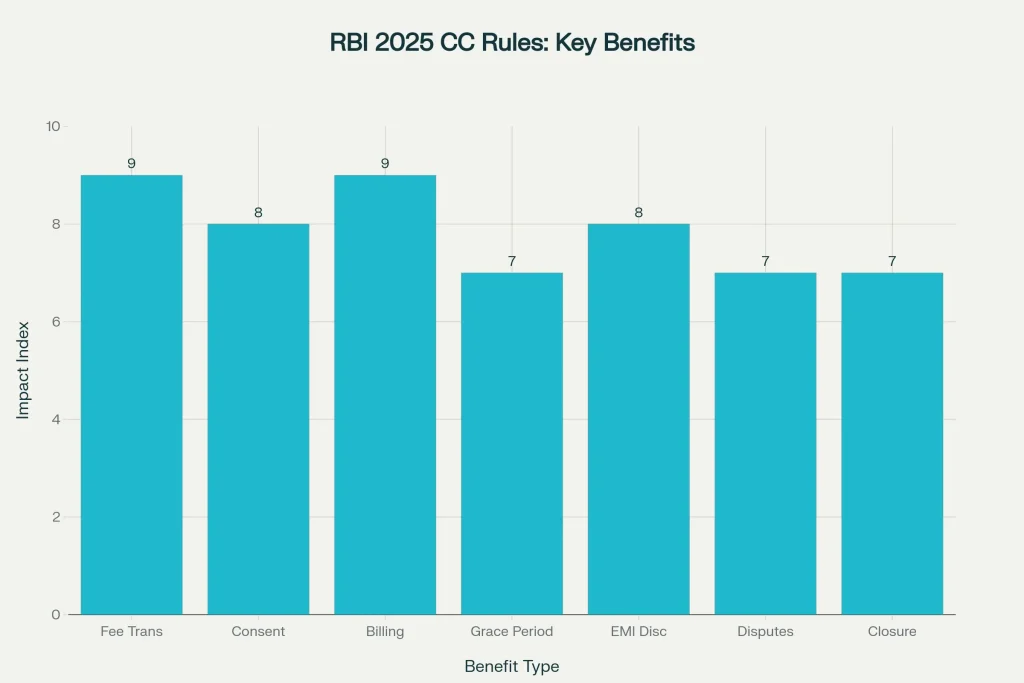
What This Means for You in Practice
- Read the Key Fact Statement and MITC for your card. Use the standardized layout to compare fees, interest tables, billing cycles, and payment allocation rules across issuers quickly.
- Set up auto-pay for at least the minimum due. It’s the simplest safety net against avoidable late fees and negative bureau reporting.
- Treat fee-change notices as action items. If the update isn’t in your favor, consider switching cards or closing after clearing dues.
- Before converting to EMI, calculate the all-in cost. Compare against cash-back deals, merchant discounts, or a shorter tenure to minimize interest.
- Keep a buffer for due dates. Payments can slip on weekends or bank holidays schedule a couple of days ahead to stay in the clear.
- Audit recurring subscriptions and international settings. Enable only what you need, and disable what you don’t to prevent unintended charges.
Expect issuers to roll out redesigned statements that follow a more uniform structure, with nested sections for interest computation examples, fee tables, and payment allocation logic. EMI conversion screens will become more explicit about total costs, and mobile app consent flows will evolve to show clearer toggles for features that impact pricing. Dispute submission, tracking, and closure update cadence should be more predictable, with acknowledgments and timelines that you can rely on. Together, these shifts move the market toward trust and comparability.
Earn ₹39,750 from ₹1 Lakh — The Senior Citizen FD Plan Everyone’s Talking About
How To Optimize Your Costs Under the New RBI 2025 Credit Card Rules
- Choose cards by total cost of ownership, not headline rewards. A transparent fee table makes it easy to quantify annualized costs.
- Align card usage with category strengths. If a card excludes rewards on utilities or rent, use it where it shines and route excluded spends through alternatives.
- Pay in full whenever possible. The new billing logic is fairer, but interest is still interest; avoiding it is the best savings.
- Use EMI only for large, planned purchases. Keep tenures short and check for processing fees that can offset discounts.
- Monitor refunds and reversals. Ensure they are adjusted against dues before the due date to prevent accidental interest.
- Keep credit utilization moderate. A cleaner reporting regime still rewards prudent utilization and steady on-time payments.
FAQs on RBI 2025 Credit Card Rules
Do the new rules eliminate hidden credit card fees entirely?
They make hidden fees far harder by enforcing standardized disclosures and advance notices. Still, the best defense is reading the Key Fact Statement and MITC before applying, upgrading, or accepting any change.
Will a short payment delay still hurt my credit score?
A brief grace before “past due” reporting helps, but it’s not a license to pay late. Set auto-pay and schedule payments a couple of days early to stay completely safe.
Can banks add paid services to my card without permission?
No. Any chargeable add-on needs explicit, prior consent. You control activations that could trigger fees.
Are EMIs cheaper after these changes?
They’re clearer, not automatically cheaper. You’ll see interest, fees, and total cost up front so you can decide whether EMI beats paying in full or using a different financing route.