

India’s proposed 8th Pay Commission is expected to recommend a major revision of salaries, allowances, and pensions for central government employees from 2026. Early projections suggest the minimum basic pay could rise by nearly 92%, driven by changes to the fitment factor. The proposal has generated significant national interest among employees and pensioners.
Understanding the 8th Pay Commission and Its Role
The 8th Pay Commission is a statutory mechanism designed to revise the pay structure of central government employees roughly every decade. The previous revision occurred under the 7th Pay Commission in 2016. The new commission will consider inflation, fiscal capacity, and workforce requirements before finalising its recommendations.
At the centre of every pay revision is the fitment factor—a multiplier applied to the existing basic pay to calculate the new basic salary. A higher fitment factor results in a larger overall increase.
How a 92% Minimum Pay Hike Fits Into the 8th Pay Commission Structure
The 8th Pay Commission is examining multiple fitment factor scenarios. A frequently cited estimate suggests that if a factor of around 1.92 is adopted, the minimum basic pay will increase from ₹18,000 to approximately ₹34,560 — a rise of nearly 92%.
Economist Dr. Raghav Varma from the National Institute of Public Finance and Policy said, “A revision on this scale would strengthen purchasing power for lower-grade employees, but it must be balanced against fiscal realities.”
Salary Scenarios at Different Fitment Factors
| Projected Fitment Factor | New Minimum Basic Pay | Percentage Increase |
|---|---|---|
| 1.83 | ₹32,940 | 83% |
| 1.92 (8th CPC proposal) | ₹34,560 | 92% |
| 2.46 | ₹44,280 | 146% |
| 2.86 | ₹51,480 | 186% |
The 8th Pay Commission has not confirmed a number, and higher figures are considered less likely due to budgetary constraints.
Impact on Allowances, Dearness Allowance, and Pensions
The 8th Pay Commission will revise more than just basic salaries. Key allowances such as House Rent Allowance (HRA), Travel Allowance (TA), medical benefits, and risk allowances are also likely to be adjusted.
A major structural change could involve merging the Dearness Allowance (DA) with basic pay at the time of implementation.
For pensioners, whose benefits depend on the last drawn basic pay, the 8th CPC could lead to a substantial rise in pension amounts. Retired audit service officer Meera Khanna stated, “A higher fitment factor in the 8th Pay Commission will have a compounding effect on pension revisions.”
Historical Context — How Earlier Pay Commissions Shaped Salaries
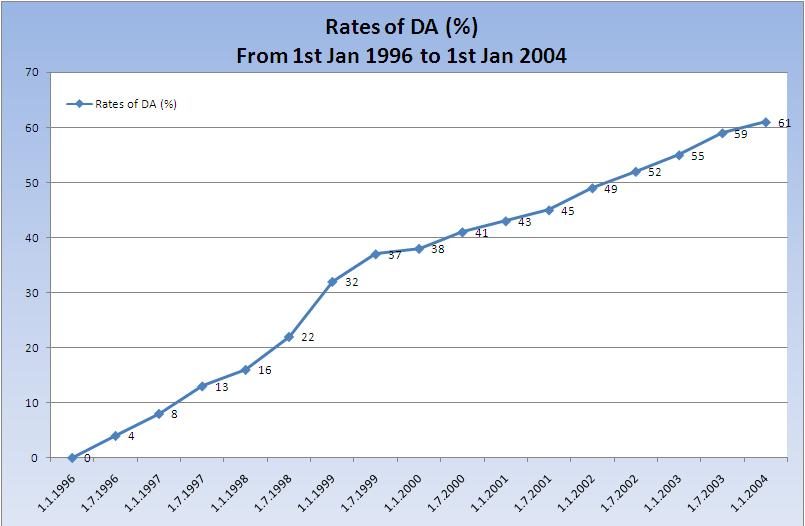
Understanding the 8th Pay Commission requires examining past commissions:
- 5th Pay Commission (1996): Moderate increases averaging 20–30%.
- 6th Pay Commission (2006): Introduction of Pay Bands; hikes between 30–40%.
- 7th Pay Commission (2016): Minimum pay increased from ₹7,000 to ₹18,000 — over 150%.
The 8th CPC follows a decade marked by rising inflation, higher urban living expenses, and digital expansion in public services.
Fiscal Impact of the 8th Pay Commission on Government Finances
Implementing the 8th Pay Commission will require substantial expenditure.
Public finance experts estimate that a mid-range fitment factor could increase the central government’s annual salary and pension outlay by ₹1–1.5 lakh crore. If states adopt similar revisions, the nationwide expenditure could rise even further.
Dr. Varma added, “The government must balance the need to support employees with the need to maintain fiscal discipline. Large hikes may affect spending priorities.”
What Employee Unions Expect From the 8th Pay Commission
Employee unions are pushing for a fitment factor not lower than 2.57, the benchmark set by the 7th CPC. They argue that the cost of living has increased dramatically since 2016.
Union leader Sushil Tiwari stated, “A higher fitment factor under the 8th Pay Commission is necessary to ensure employees are not left behind by rising costs.”
Unions are also demanding:
- Restoring the Old Pension Scheme (OPS)
- Revising HRA categories for smaller cities
- Special allowances for field-level and defence personnel
How India’s Pay Revision System Compares Globally
The 8th Pay Commission reflects India’s unique system of decadal pay revisions. Other countries follow different models:
- United States: Annual federal pay adjustments tied to cost indices.
- United Kingdom: Annual pay review bodies instead of a single commission.
- Japan: Annual adjustments to both salary and bonus structures.
India’s once-in-ten-years model leads to larger, but less frequent, salary jumps.
Implementation Timeline — What Happens Next
The 8th Pay Commission is expected to take effect on 1 January 2026, aligning with global economic projections and government budget cycles.
The Terms of Reference (ToR) will define:
- Scope of salary and pension revisions
- Rationalisation of allowances
- Cadre restructuring considerations
- Digital HR reforms
Once the Commission submits its report, the Union Cabinet will approve the final structure before rollout.
E-Shram Card 2025 — Check Your Payment Status Online at eshram.gov.in
What Employees Should Expect in the Coming Months
Until the 8th Pay Commission finalises its fitment factor and allowance structure, projections should be considered indicative, not final. Nevertheless, employees can expect:
- A substantial rise in entry-level basic pay
- Improved pension payouts
- Revisions across key allowances
- Increased digitisation of HR systems
Conclusion
The 8th Pay Commission will shape the financial future of millions of central government employees and pensioners. While projections such as a 92% rise in minimum pay have raised expectations, the final outcomes will depend on the government’s decisions and prevailing economic conditions. As the Commission works toward its recommendations, employees await clearer guidelines in 2025–26.