

The 8th Pay Commission is set to reshape central government compensation with a cleaner pay matrix, a higher minimum basic pay, and a fresh start for allowances and pensions that aligns pay with today’s inflation and living costs. Employees and pensioners should plan around a likely effective date of January 1, 2026, with revised basic pay cascading into HRA, TA, and future DA growth. The headline watch-point is the fitment factor, because that multiplier determines how the current 7th CPC basic translates into the 8th CPC basic and, by extension, the entire compensation stack.

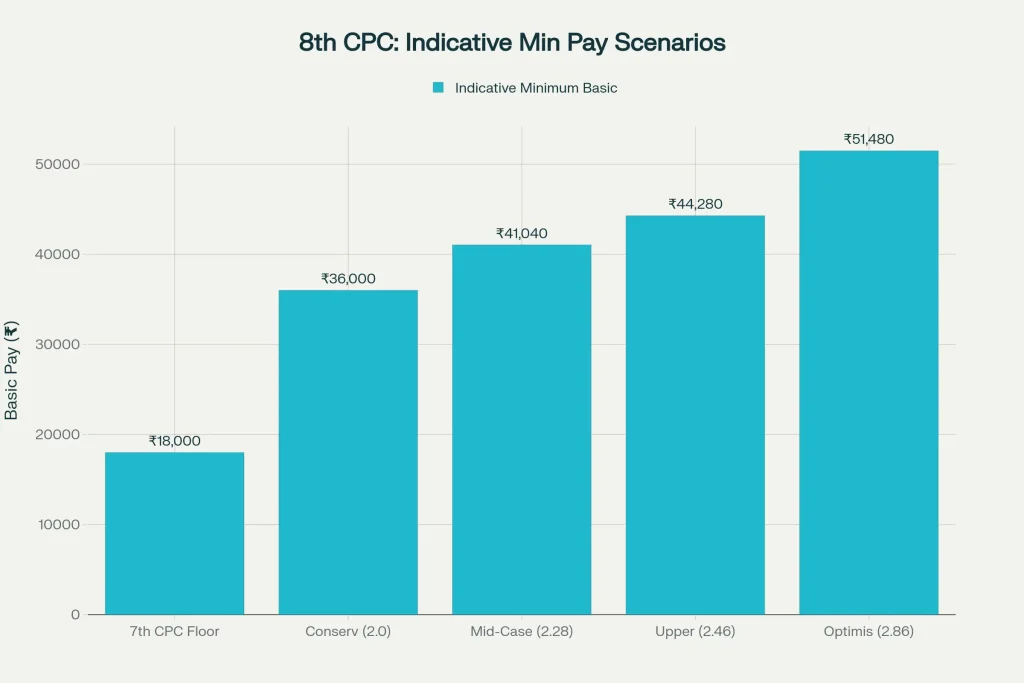
The 8th Pay Commission proposed minimum pay range is expected to lift Level‑1 basic meaningfully above the 7th CPC floor of ₹18,000, with mid‑case scenarios clustering around the low‑₹40,000s when a fitment near the 2.2–2.3 mark is applied. Several explainer models demonstrate calculations at 2.28 as a planning anchor, while upper‑band illustrations extend toward a ~2.86 factor that would pull the minimum into the ₹50,000-plus zone. Until the final report and notification, use a conservative baseline, an upside case, and a downside guardrail to budget realistically and avoid overcommitting on expectations.
8th Pay Commission
| Key Aspect | Details |
|---|---|
| Commission status | Terms of Reference approved; panel formed with an 18‑month window to submit recommendations |
| Expected effective date | January 1, 2026 (with implementation and arrears alignment typical if formal notification lands later) |
| Proposed minimum pay range | Baseline illustrations in the low‑₹40,000s; optimistic scenarios reach the ₹50,000+ band depending on fitment |
| Fitment factor band (illustrative) | Common planning scenarios: ~1.83–2.46; mid‑case examples around 2.2–2.3; optimistic ~2.86 used in some models |
| DA/DR handling | Reset to zero at rollout; accrues thereafter on the revised base |
| Coverage | Roughly 49–50 lakh employees and about 65–69 lakh pensioners impacted |
| Pension baseline | Minimum pension rises from ₹9,000 in line with the new fitment; many models indicate a ~₹20,500–₹25,700 corridor |
The 8th Pay Commission proposed minimum pay range should be treated as a mid‑case in the low‑₹40,000s for Level‑1, with conservative and optimistic boundaries used for planning until the official matrices are notified. Recalculated HRA, TA, and DA on the new base will lift take‑home beyond the headline fitment alone, while pensioners benefit from a stronger starting pension and DR that rebuilds on a higher foundation. Track the fitment factor, DA at switchover, and any HRA/city slab changes these determine how the new architecture translates into monthly cash flow and long‑term retirement adequacy from 2026 onward.
What’s Changing and Why It Matters
The Commission’s mandate is a full-spectrum review of pay, allowances, and pensions to ensure parity, transparency, and fiscal prudence. For serving employees, the 8th CPC will primarily be felt through a higher basic pay and the subsequent recomputation of HRA, TA, and future DA cycles. For pensioners, the recalculation on the revised base, DR reset, and parity measures are designed to improve adequacy and clarity while recognizing inflation realities.
Minimum Pay Math And Fitment Scenarios
- Conservative guardrail: A 1.83–2.13 fitment gives a measured lift to basic and is a useful assumption for cautious financial planning.
- Mid‑case baseline: A 2.2–2.3 fitment is widely used in calculators and explainers; it typically takes Level‑1 basic into the low‑₹40,000s and scales proportionally across the matrix.
- Optimistic edge: A ~2.86 factor pushes the minimum above ₹50,000, helpful for upside modeling but not guaranteed until the matrices are notified.
A practical approach is to run three budgets conservative, mid‑case, and optimistic so you can gauge rent, commute, EMI, insurance, and savings impacts across scenarios without being surprised by the final notification.
Allowances: DA, HRA And TA
Dearness Allowance will reset to zero at transition, then resume its periodic revisions on the revised basic, which increases the rupee value of each DA step. HRA, tied to city class and expressed as a share of basic, automatically scales up once the new basic takes effect. Transport and special allowances are also recomputed off the revised base, meaning the fitment factor’s impact extends well beyond the headline minimum pay figure.
Pensions And Retirement Benefits
Pensions are expected to be recalculated using the accepted fitment factor, bringing the minimum pension meaningfully above the 7th CPC’s ₹9,000 floor. Many indicative models show a corridor around ₹20,500–₹25,700 depending on the factor finally adopted, with DR resetting at rollout and rebuilding thereafter. Expect efforts at rationalization and parity pathways to continue, improving transparency across cohorts and service periods.
Terms Of Reference Highlights
- Wide scope: Pay structures, allowances, incentive/bonus frameworks, and retirement benefits are within remit for data‑driven rationalization.
- Process cadence: With ToR cleared and composition notified, the Commission gathers evidence, consults stakeholders, and drafts recommendations typically within about 12–18 months.
- Economic lens: Recommendations are structured to be implementable within fiscal constraints while updating pay architecture to current job demands and cost‑of‑living dynamics.
Planning Takeaways
- Use mid‑case planning: Treat the 8th Pay Commission proposed minimum pay range as a low‑₹40,000s baseline for Level‑1 with a fitment near 2.2–2.3, then sensitivity‑test your budget at a lower 2.0 and a higher 2.46–2.86.
- Track DA at switchover: A higher pre‑rollout DA affects merger mechanics and the optics of the reset; once reset to zero, DA growth on a higher base produces bigger rupee gains.
- Watch HRA slabs and city classification: Any slab revision or reclassification interacts with the higher basic to lift take‑home.
- Pensioners: Anchor expectations to the corridor noted above and follow any parity clarifications that accompany implementation.
Expected Benefits For Employees
- Higher floor, broader lift: The jump in minimum basic raises not just the starting point but also every allowance linked to basic, which compounds into a healthier gross.
- Faster DA compounding: With DA rebuilding on the revised base, each percentage point packs more punch in rupee terms for future cycles.
- Cleaner progression: An updated matrix better matches today’s skills and cost dynamics, improving career‑long earnings visibility.
Expected Benefits for Pensioners
- Stronger minimum pension: A higher starting pension improves baseline adequacy from day one of the new regime.
- DR reset and rebuild: Protection against inflation is restored on a larger base, improving purchasing power over time.
- Parity and transparency: Methodological clarity and rationalization across batches reduce anomalies and increase trust in outcomes.
Implementation Window And Process
Once the Commission submits its report, the government examines and notifies accepted recommendations, issues revised pay matrices and instructions, and departments execute payroll and pension changes in stages. Even if the formal rollout happens later, effective dates commonly align to January 1, 2026, with arrears and adjustments bridging the gap.
Students Get a Boost in 2025 — A New Laptop Scheme Opens for Online Applications
What To Watch Next
- Fitment factor: This is the single biggest lever for minimum pay, pension recalculation, and all downstream allowance math.
- DA position at transition: Influences merger optics and early‑cycle take‑home.
- ToR‑linked methodology: Any explicit changes to assumptions (e.g., family unit, inflation normalization) can nudge the factor up or down at the margins.
FAQs on 8th Pay Commission
What is the likely minimum basic under the 8th CPC?
A prudent planning anchor is the low‑₹40,000s for Level‑1 if a mid‑case fitment near 2.2–2.3 is adopted; keep an upside case toward the ₹50,000+ zone for sensitivity testing.
When will new salaries take effect?
Plan around an effective date of January 1, 2026, with implementation and arrears adjustments following formal notification.
What happens to DA and DR at rollout?
Both reset to zero and then resume periodic revisions on the revised base, raising the rupee value of each future increase.
Will pensioners see proportional gains?
Yes, pensions are recalculated on the accepted fitment factor, DR resets, and parity measures typically improve adequacy and transparency.