

Starlink internet pricing revealed a clear lineup of plans that keeps things simple on paper but very different in practice. Residential plans are designed for fixed homes and small offices, Roam plans serve those who are on the move, and Business or Priority plans focus on organisations that cannot afford unreliable connectivity. Each of these categories has its own balance of speed, stability, and cost.
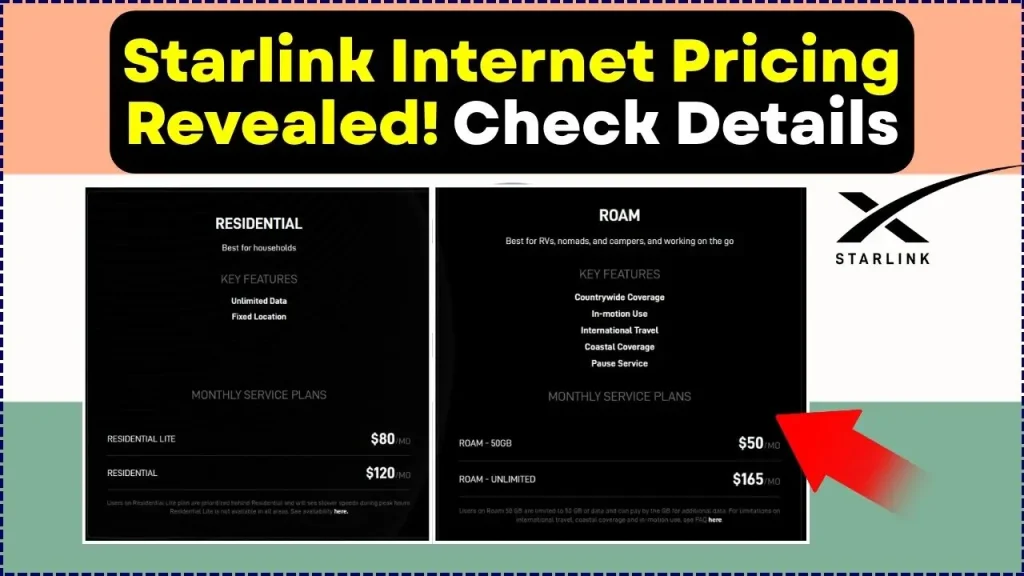
The most important thing to understand is that your actual cost is a combination of a monthly subscription and a one-time hardware investment. The dish and router are usually paid upfront, which makes the first-year cost higher than the monthly price alone might suggest. When comparing Starlink with other options, it helps to calculate what you will spend over 12 or 24 months, not just in a single billing cycle.
Starlink Internet Pricing Revealed
| Plan / Region | Typical Monthly Cost* | Speeds (Up To) | Data Policy / Notes | Hardware Kit (One-Time) |
|---|---|---|---|---|
| Residential (US / Global) | Mid to high local tier | 25–220 Mbps | Unlimited, may slow during congestion | Standard consumer kit |
| Residential Lite | Slightly lower than standard | Mid-range Mbps | Fair-use, lower priority than main plans | Same residential hardware |
| Roam 50 GB | Entry roaming tier | High Mbps potential | Limited roaming data bundle | Shares residential kit |
| Roam Unlimited | Premium roaming tier | High Mbps potential | Unlimited roaming in supported regions | Standard or portable dish |
| Business / Priority | Higher commercial tier | 100–220 Mbps | Priority data blocks, throttling afterward | Larger, enterprise-grade dish |
| India Residential (Leak) | Premium vs local broadband | Multi‑Mbps satellite | Unlimited with trial period indicated | Higher upfront equipment cost |
| India Expected Pricing | Mid-to-premium local range | Multi‑Mbps satellite | Focus on rural / remote connectivity | One-time user terminal charge |
Monthly Costs and What You Get
When you look only at the monthly fee, Starlink usually sits in the mid to upper end of home internet pricing in many regions. A standard residential plan is rarely the cheapest option in a big city, but it offers something that many rural and remote areas have never had: modern broadband speeds with reasonably low latency. For a typical household, this means streaming, online classes, work-from-home tasks, and gaming can all happen at once without the network collapsing.
Where Starlink becomes especially interesting is when there is no fibre or stable 4G/5G in sight. In those cases, the question is not “Is it cheaper than my current fibre plan?” but “Is it better than barely loading a web page?” For such users, the monthly cost can feel justified because it directly translates into real productivity, access to services, and quality of life. Starlink internet pricing revealed that the service is built to serve exactly these gaps, even if it looks expensive when compared only to urban rates.
Service Details: Speeds, Latency and Hardware
On paper, Starlink delivers speeds that generally sit in the same range as mid-tier wired broadband. Download speeds typically fall between a few dozen and a couple of hundred Mbps, depending on your plan, network congestion, and how clear the dish’s view of the sky is. Upload speeds are lower but still comfortable for video calls, cloud storage, and everyday communication. Latency is much better than traditional satellite services, often low enough to support online gaming and real-time collaboration tools.
The hardware kit is the backbone of the entire experience. A standard consumer kit includes a satellite dish, mounting stand or bracket, and a Wi‑Fi router. Business kits tend to be larger, weather‑resistant and more capable, especially in harsh environments or mission‑critical locations. Once the dish is installed and properly aligned, the connection behaves much like a normal broadband service inside your home or office, feeding your existing devices through Wi‑Fi or Ethernet.
Plans and Starlink Internet Pricing in India
- One of the most discussed developments in recent months is Starlink internet pricing revealed for India. A brief appearance of test figures on the Indian portal, along with multiple media reports, showed a relatively high monthly fee paired with a significant upfront equipment charge. Even though some of these numbers were later called non-final or part of a glitch, they still made it clear that Starlink is entering India as a premium service rather than a low-budget alternative.
- Alongside these leaks, earlier discussions and analyses suggested a structure where the one-time hardware cost might land in the range of a mid-tier smartphone or entry-level laptop, with monthly tariffs positioned above most basic fibre and mobile broadband plans. That sets expectations: urban users with affordable fibre may not be the primary target, while rural households, border regions, islands, and hilly areas are more likely to be the key focus. For these communities, the ability to access stable, modern internet can outweigh the higher price.
Data Caps, Throttling and Fair Use
A crucial part of understanding Starlink internet pricing revealed in 2025 is how data policies differ by plan. Residential and Roam offers are advertised as unlimited, which means you are not given a strict monthly data cap that cuts off or charges extra once you cross a threshold. However, these plans do follow fair‑use rules: your connection might slow down somewhat during peak congestion, especially if you are a very heavy user in a crowded area.
Business and Priority plans use a different model. They come with a certain amount of “priority data” each month, during which your traffic is treated as higher priority on the network. Once you exhaust that allotment, your speeds can be reduced significantly unless you purchase additional priority data. This structure forces organisations that move large volumes of data to plan ahead, monitor their usage and potentially adjust how and when they transfer big files or backups.
How Starlink Compares to Traditional Broadband
In dense urban areas where fibre, cable, and strong 5G home broadband are common, Starlink often looks like a niche product. There, traditional ISPs can deliver faster or similar speeds at lower prices, sometimes bundled with TV and phone services. In such cases, Starlink is more likely to be used as a backup connection for critical work, events, or disaster situations, rather than as the primary home line.
In rural or remote environments, the picture changes completely. When your main alternative is an old copper line, a patchy mobile hotspot, or nothing at all, the value of Starlink is not just in raw speed but in reliability and availability. Starlink internet pricing revealed that the company is deliberately aiming at those who are under-served by the existing infrastructure. For farmers, small-town entrepreneurs, remote schools, and clinics, a stable connection can transform operations, education, and access to services.
PM Surya Ghar Yojana: Get a Free Solar Panel on Your Roof with Subsidy Up to ₹78,000
Who Should Consider Starlink Internet
Starlink makes the most sense if you fit into one or more of these categories:
- You live in an area with no fibre or reliable cable, and mobile data is unstable or capped too tightly.
- You work remotely from locations that change often, such as RV parks, campgrounds, or seasonal sites.
- Your business runs critical systems like online payments, security cameras, or cloud-based tools from a remote or hard‑to‑reach location.
- You need a resilient backup connection because downtime on your primary line is very costly.
If you already enjoy fast, stable and affordable fibre, Starlink is unlikely to replace your main connection on price or speed alone. However, Starlink internet pricing revealed that for those beyond the reach of traditional infrastructure, it can effectively act as the “fibre of the sky,” closing the digital gap that has persisted for years.
FAQs on Starlink Internet Pricing Revealed
1. Is Starlink faster than regular broadband?
In major cities with modern fibre or high-end cable, regular broadband is often faster, cheaper, or both. In rural and remote regions, Starlink usually beats legacy options like DSL or basic wireless, making it effectively “faster” where it matters most.
2. Is Starlink internet unlimited?
Residential and Roam plans are marketed as unlimited, meaning there is no simple monthly data cap that cuts you off. However, speeds can slow during busy periods as part of fair‑use management, and heavy users may notice more variation than light users.
3. How much does Starlink cost in India?
Exact final tariffs for India are still being refined, but early information points to a relatively high upfront hardware cost and a monthly fee positioned above typical entry-level fibre plans.
4. Can Starlink replace my home Wi‑Fi?
Yes. Once you install the dish and router, Starlink works like any other broadband source. The router broadcasts Wi‑Fi across your home, and you can connect phones, laptops, TVs, and smart devices as usual. You can also integrate your own mesh system if you want better coverage.