
Muft Bijli Yojana (Rooftop Solar Subsidy Scheme) allows eligible households to install grid-connected rooftop solar and receive financial support of up to ₹78,000, depending on the system size. This support is calculated based on approved benchmarks and is capped at 3 kW for subsidy purposes.Switching to rooftop solar is no longer just an environmental choice—it’s a practical way for homeowners to take control of rising electricity costs. Under the PM Surya Ghar: Muft Bijli Yojana, the government is encouraging households to install grid-connected solar panels by offering direct financial support, making the upfront investment significantly easier for many families.
With subsidy benefits that can go up to ₹78,000 (calculated on benchmark costs and capped up to 3 kW), the scheme is aimed at accelerating residential rooftop solar adoption across India and helping homes generate a part of their own power requirement. The Solar Rooftop Subsidy Scheme is designed to help residential consumers reduce their electricity bills by installing rooftop solar panels and receiving subsidy support directly as per the scheme rules. The government has positioned this initiative to accelerate rooftop solar adoption among households, and it is planned to run through FY 2026–27 (implementation up to 31 March 2027).
Solar Rooftop Subsidy Scheme
Installing rooftop solar under PM Surya Ghar: Muft Bijli Yojana can meaningfully cut monthly electricity bills while offering government support up to ₹78,000 for eligible residential households (subsidy capped up to 3 kW). Since the subsidy is linked to proper installation, DISCOM inspection, and portal completion, following the official process step-by-step is essential to receive the benefit smoothly. Overall, this scheme makes rooftop solar more affordable for homeowners and encourages clean-energy adoption at the household level.
How the Solar Rooftop Subsidy Scheme Works
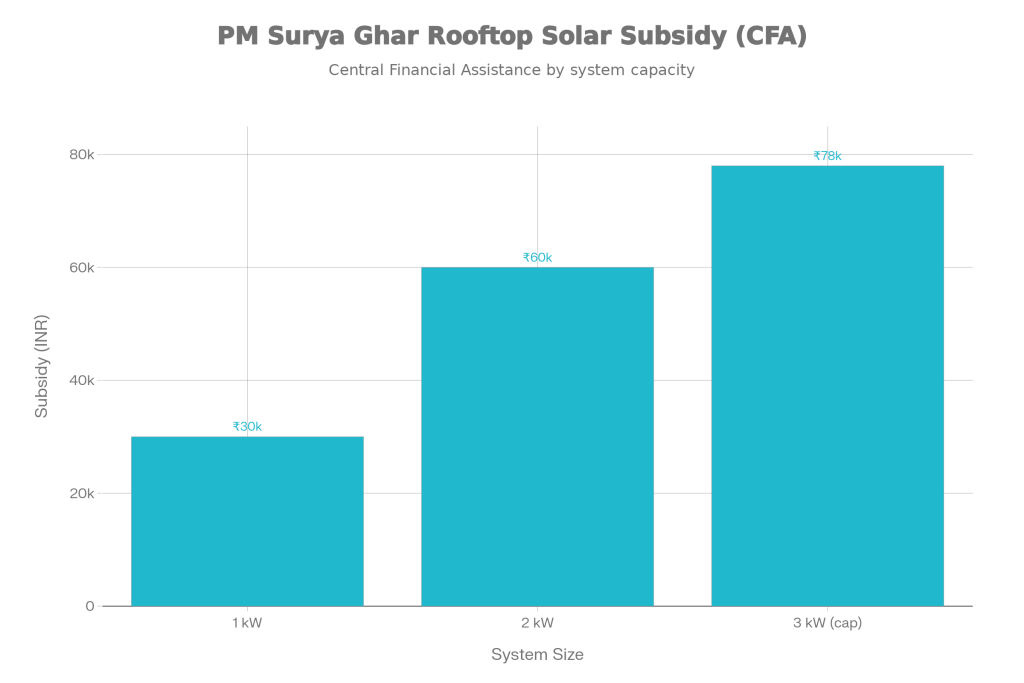
- Under this scheme, the subsidy (Central Financial Assistance/CFA) is calculated on a benchmark cost method—60% support up to 2 kW and 40% support for the portion between 2 kW and 3 kW. The scheme clearly states that CFA is limited up to 3 kW, meaning you won’t get additional central subsidy even if you install a larger system.
- Based on the benchmark-linked structure, the commonly stated support works out to ₹30,000 for 1 kW, ₹60,000 for 2 kW, and up to ₹78,000 for 3 kW (and above, but capped). For example, if a household installs 5–6 kW, the subsidy calculation still stops at the 3 kW maximum limit.
Who Can Apply For Solar Rooftop Subsidy Scheme
- To apply, the applicant must be an Indian citizen. The home should have a suitable rooftop/terrace space for installation, and the applicant must have a valid electricity connection.
- Another important condition is that the household should not have previously received any other rooftop solar subsidy benefit for the same connection/house. As per the guidelines, the CFA benefit is meant for residential consumers; non-residential categories such as commercial and industrial installations are not covered under this residential CFA structure.
How to Apply Online For Solar Rooftop Subsidy Scheme
- The process begins with registration on the national portal, where the applicant selects the State/UT and the relevant DISCOM to continue the application journey. The portal is intended to guide users with system sizing and other essential information required for a smoother application and installation process.
- As per scheme guidelines, consumers are expected to choose a portal-listed (registered) vendor, while the final pricing and installation terms are mutually agreed between the consumer and the vendor. After installation, the system details and required uploads are submitted on the portal, and the application moves to the DISCOM for verification and approval.
DISCOM Inspection, Metering, and Subsidy Release
- After the rooftop solar system is installed, the DISCOM conducts a physical inspection and completes the necessary steps related to approvals and metering arrangements. The scheme guidelines indicate that subsidy processing is linked to DISCOM’s physical verification and successful completion of the portal process.
- Metering arrangements (net metering, gross metering, net billing, virtual/group mechanisms, etc.) are allowed as per the State regulator’s applicable regulations, and the scheme accommodates permitted metering modes. Once DISCOM approval is completed, the guidelines provide for CFA processing generally within about 15 days, provided all portal steps and documentation are properly completed.
Free Laptop Yojana 2025: Documents Needed, Official Website Check, and How to Verify Any Scheme
The PM Surya Ghar: Muft Bijli Yojana is designed at a national scale, with the government stating a target of bringing rooftop solar to one crore households. Along with the central subsidy support, official communication also highlights collateral-free, low-interest loans (around 7%) to help families manage the upfront cost of installing residential rooftop solar systems up to 3 kW. The scheme is also promoted as enabling “free electricity up to 300 units per month” for households, depending on solar generation, consumption, and the applicable state-level rules. In practice, DISCOM approvals remain a key part of the process because inspection/verification and completion of the portal steps are needed before subsidy processing can move forward.