

India’s journey toward becoming a knowledge-driven and innovation-led economy depends not just on talent or ideas, but on how effectively those ideas are funded, nurtured, and scaled. For years, the country has produced high-quality research and a growing startup ecosystem, yet the transition from research to market-ready innovation has remained slow and uneven.
One of the biggest reasons has been the lack of long-term, risk-tolerant funding for research and development. The RDI Scheme 2026 comes into the picture as a response to this exact challenge. The RDI Scheme 2026 is built to change how India approaches research funding by focusing on patient capital, private sector participation, and strategic technologies. Instead of treating research as an isolated academic activity, the scheme views it as a critical economic driver that can strengthen competitiveness, generate jobs, and reduce dependence on imported technologies.
The RDI Scheme 2026 is a comprehensive framework designed to strengthen India’s research, development, and innovation ecosystem through structured financial support. It moves away from short-term, grant-heavy models and instead emphasizes long-term, affordable financing that supports high-risk and high-impact innovation. This shift reflects a deeper understanding that breakthrough technologies take time, resources, and sustained investment to succeed. What makes the scheme distinct is its strong focus on applied research and commercialization. While basic research remains important, the scheme prioritizes projects that can translate scientific knowledge into products, processes, and services with real economic and societal value. By aligning innovation with market needs, the scheme aims to ensure that research outcomes do not remain confined to institutions but reach industry and consumers.
RDI Scheme 2026
| Parameter | Details |
|---|---|
| Scheme Name | Research Development And Innovation Scheme |
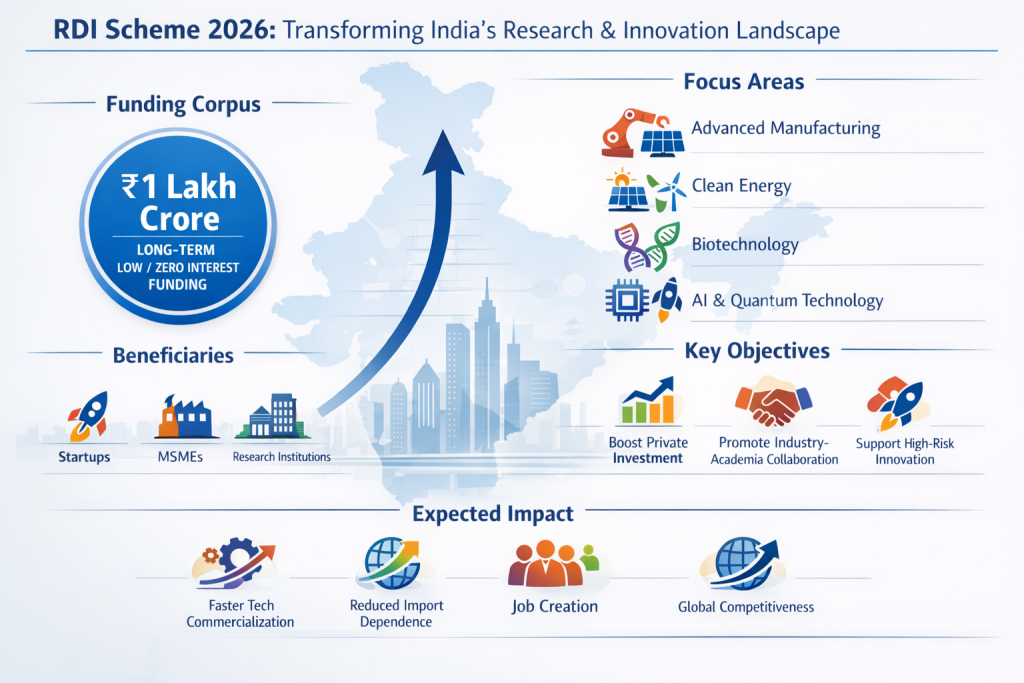
| Total Financial Outlay | ₹1 Lakh Crore |
| Time Horizon | Up To 2026 |
| Nature Of Support | Long-Term, Low Or Zero-Interest Funding |
| Primary Focus | Private Sector-Led Research And Innovation |
| Key Beneficiaries | Startups, MSMEs, Industry, Research Institutions |
| Target Areas | Strategic And Sunrise Technologies |
| Core Approach | Risk Sharing And Crowd-In Of Private Investment |
The RDI Scheme 2026 represents a decisive shift in India’s approach to research, development, and innovation. By combining patient capital with private initiative and strategic focus, it addresses long-standing gaps in the innovation ecosystem. If implemented effectively, the scheme has the potential to transform India into a globally competitive, innovation-led economy over the coming decade.
Need For RDI Scheme
India’s spending on research and development has historically remained below one percent of GDP, significantly lower than many innovation-led economies. Another persistent issue has been the dominance of public funding, with private sector investment remaining limited and cautious. This imbalance has restricted innovation scale and slowed down the commercialization of research outcomes. The RDI Scheme 2026 addresses these structural gaps by providing patient capital for projects that typically struggle to attract conventional funding. Research-intensive and deep-tech projects often involve long gestation periods and uncertain returns, making them unattractive to traditional lenders. By absorbing part of this risk, the scheme encourages companies and startups to invest in ambitious and transformative ideas.
Objectives Of The RDI Scheme 2026
- One of the primary objectives of the scheme is to significantly increase private sector participation in research and development. The scheme aims to reduce the financial risks associated with innovation, making it easier for businesses to invest in new technologies and processes.
- Another key objective is to strengthen collaboration across the innovation ecosystem. The RDI Scheme 2026 encourages partnerships between academia, industry, and startups so that research efforts are aligned with real-world challenges and market demands. The scheme also seeks to improve the overall quality and impact of research by focusing on outcomes rather than just inputs.
Funding Mechanism
- The funding mechanism is one of the most defining features of the scheme. Instead of relying solely on grants, the scheme offers long-term financing at concessional or zero interest rates. This ensures financial discipline while giving innovators the flexibility and time required to develop complex technologies.
- Funds are expected to be managed through a professionally run structure with clear eligibility norms and transparent evaluation criteria. By sharing risks with private players, the RDI Scheme 2026 aims to attract additional investment and create a multiplier effect, where public funds catalyze much larger private investments.
Focus Areas
The scheme prioritizes sectors that are critical to India’s long-term economic and strategic interests. These include advanced manufacturing, clean and renewable energy, biotechnology, artificial intelligence, quantum technologies, and space-related research. By focusing on these sunrise sectors, the RDI Scheme 2026 seeks to position India at the forefront of emerging technologies. The emphasis is on breakthrough innovation rather than incremental improvements, enabling the creation of new markets and strengthening India’s role in global value chains.
Role Of Private Sector And Startups
- A major shift introduced by the scheme is the central role given to the private sector. Startups, MSMEs, and large companies are seen as key drivers of innovation rather than just beneficiaries of public funding. The scheme encourages industry-led research while ensuring that public funds reduce entry barriers and risks.
- For startups working in deep-tech and frontier areas, access to affordable long-term capital can be transformative. The RDI Scheme 2026 allows young firms to focus on technology development and scaling instead of short-term survival, thereby strengthening India’s startup ecosystem.
Implementation Framework
Effective implementation is critical for a scheme of this scale. The framework proposes a dedicated institutional mechanism responsible for fund allocation, monitoring, and evaluation. Decisions are expected to be driven by technical merit, innovation potential, and expected impact rather than administrative considerations. Professional fund managers and domain experts play a central role in this process. This approach helps reduce delays, improve accountability, and ensure that resources are directed toward projects with the highest potential under the RDI Scheme 2026.
Expected Impact of RDI Scheme 2026
If implemented efficiently, the scheme can significantly raise India’s research and development intensity. Increased private investment can lead to faster commercialization of technologies, stronger industry-academia collaboration, and a more vibrant innovation ecosystem. Over the long term, the RDI Scheme 2026 can help India reduce its dependence on imported technologies, enhance export competitiveness, and create high-quality employment in knowledge-intensive sectors. It also supports national goals related to self-reliance, sustainability, and digital transformation.
Bakri Palan Yojana 2026 – Farmers Can Get ₹50,000 to ₹10 Lakh Goat Farming Loan, Apply Fast
Challenges And Way Forward
- Despite its strong design, the success of the scheme will depend on execution. Clear guidelines, timely fund disbursement, and robust monitoring systems are essential. There is also a need to ensure that smaller startups and regional institutions can access funds without facing excessive compliance burdens.
- Going forward, continuous policy support, regulatory clarity, and coordination across stakeholders will be crucial. With consistent implementation and feedback-driven improvements, the RDI Scheme 2026 can evolve into a long-term pillar of India’s innovation strategy.
FAQs on RDI Scheme 2026
What Is the RDI Scheme 2026
It is a government-backed framework aimed at strengthening research, development, and innovation through long-term, affordable financing and private sector participation.
How Is This Scheme Different from Earlier R&D Programs
Unlike grant-based schemes, it focuses on risk sharing and patient capital to support high-risk, high-impact innovation.
Why Is Private Sector Participation Important
Private participation helps scale innovation, improve commercialization, and reduce over-reliance on public funding.
Can The RDI Scheme Improve India’s Innovation Ecosystem
Yes, by increasing investment, encouraging collaboration, and supporting advanced technologies, it can significantly strengthen India’s innovation capacity.