

RBI’s new minimum balance rules do not impose a single, uniform balance for every bank starting December 1. Instead, banks set their own minimum average balance (MAB) and charges, while RBI requires clear disclosure and proportionate, customer-friendly treatment. For you, this means reviewing your bank’s tariff guide, account type, and branch category before December 1, and noting that basic accounts like BSBDA and PMJDY don’t need any minimum balance.
If you’re hearing about “new minimum balance rules,” remember this: there’s no universal RBI-mandated MAB from December 1. What’s changing for you depends on your bank’s updated tariff schedule and any notices sent via email or SMS. Focus on four things: your account type (regular, premium, salary, NRI, BSBDA/PMJDY), your branch category (metro/urban vs semi-urban/rural), whether your bank levies penalties or restricts services for shortfalls, and whether you can switch to a zero-balance option that suits your usage.
RBI’s New Minimum Balance Rules
| Key Point | What It Means For You |
|---|---|
| No uniform RBI minimum | Your bank sets MAB and any shortfall charges. |
| Transparency required | Banks must disclose rules at account opening and before changes. |
| Proportionate charges | Fees for shortfalls should be reasonable; some banks limit services instead. |
| Exempt accounts | BSBDA and PMJDY require no minimum balance. |
| Bank-wise differences | PSBs often waive penalties; many private banks still levy charges. |
| Branch category impact | MAB can be higher in metro/urban than semi-urban/rural. |
| Stay updated | Check bank tariff guides, website notices, and SMS/email alerts. |
What Actually Changes for Account Holders
There isn’t a regulator-imposed switch on December 1. What you may see are bank-specific updates to MAB, how shortfalls are charged, or a move toward temporary service restrictions instead of blanket penalties. Your next step: check your bank’s latest tariff circular and verify which slab applies to your account variant and branch type.
Why Banks Differ On Minimum Balance
RBI leaves MAB decisions to banks as part of their commercial policy. This creates a spectrum: some public sector banks have removed non-maintenance penalties for savings accounts, while private banks often maintain higher MAB thresholds and apply fees. The trade-off is product flexibility versus cost: more features and premium variants typically come with higher MAB.
Accounts Exempt from Minimum Balance
Basic Savings Bank Deposit Accounts (BSBDA) and PMJDY accounts don’t require any minimum balance. They’re designed for inclusion and essential banking. Do note that small-account variants can carry caps on total credits, monthly withdrawals, or maximum balance; exceeding those limits may trigger conversion to a regular account with MAB.
Penalties Vs. Restricted Services
Banks increasingly use proportionate approaches: either a reasonable fee tied to the shortfall or temporary limits on non-essential services until the average balance is restored. You should receive advance notice before charges apply, and fees shouldn’t push your account negative solely due to non-maintenance penalties.
What To Check Before December 1
- Account type and variant: Regular, premium, salary, NRI, BSBDA/PMJDY all have different rules and fee treatments.
- Branch category: Metro/urban accounts often require higher MAB than semi-urban/rural.
- Fee computation: Many banks charge a percentage of the shortfall or a capped monthly/quarterly fee; others may limit services temporarily.
- Waivers: Several public sector banks currently do not levy non-maintenance penalties on standard savings accounts.
- Official communications: Review your bank’s tariff schedule, website notices, and any SMS/email updates you’ve received.
How To Avoid Charges or Restrictions
- Choose an exempt account: If your usage is light and within caps, BSBDA/PMJDY eliminates MAB altogether.
- Match variant to usage: If you don’t need premium features, switch to a lower-MAB or zero-balance variant.
- Automate top-ups: Set standing instructions or reminders to maintain the average balance before the cycle ends.
- Use fixed deposits in lieu of MAB: Some banks allow an FD relationship (for a specified tenure/amount) as an alternative to maintaining MAB in the savings account.
- Consolidate funds: Keep fewer, well-funded accounts rather than many low-balance ones that risk shortfalls.
Bank-Wise Divergence: What You Might See In Practice
Public sector banks: Many regular savings accounts come with no penalties for non-maintenance, improving predictability for fee-sensitive users. Private sector banks: Expect tiered MAB linked to account variants and branch categories; fees may be computed as a percentage of shortfall with a cap. Salary account: Typically, zero-balance, but can convert to regular accounts—and inherit MAB if salary credits stop for a defined period. Special segments: Women-focused, senior citizen, youth, or premium accounts may carry distinct MAB and benefit structures; review each variant’s fine print.
What Happens If You Fall Short
Typically, you’ll get a notification and a window to restore the average balance. If you don’t correct it in time, a proportionate fee may be applied, or certain services may be curtailed until the balance meets requirements. Once you restore the MAB, charges stop and services resume.
Viksit Bharat Rozgar Scheme 2025: How the New Initiative Aims to Create More Jobs
Actionable Checklist For December 1
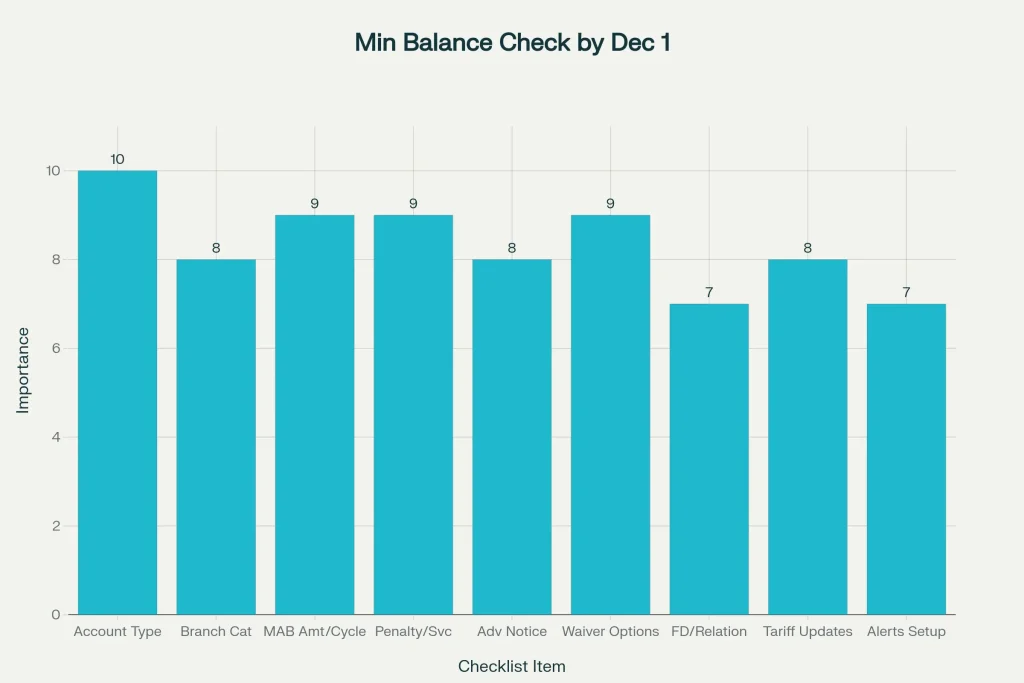
- Confirm your account’s MAB requirement and cycle (monthly/quarterly).
- Check if your bank has recently revised MAB or switched from penalties to service restrictions.
- Verify whether an FD linkage can substitute for MAB.
- If you’re fee-sensitive, consider migrating to a zero-balance or lower-MAB variant.
- Set balance alerts to avoid end-of-cycle surprises.
Use this date as a practical reminder: verify your bank’s MAB, understand how shortfalls are treated, and switch to a product that matches your usage. There’s no single RBI-mandated number for everyone—your bank’s policy governs the details. If in doubt, opt for exempt accounts or banks that waive non-maintenance penalties, and keep your account aligned with transparent, predictable rules.
FAQs on RBI’s New Minimum Balance Rules
Do all banks have the same minimum balance from December 1?
No. Each bank sets its own MAB. December 1 is a good moment to re-check your bank’s current policy and any updates.
Are zero-balance accounts really free from MAB?
Yes. BSBDA and PMJDY do not require a minimum balance, though small-account variants may have usage/balance caps.
Can my bank penalize me without warning?
Banks are expected to provide clear disclosure and advance notice, and fees should be proportionate rather than punitive.
Is MAB higher in metro branches?
Often yes. Many banks set higher MAB for metro/urban branches than semi-urban/rural.