
If you are a ration card holder, this update is directly linked to your kitchen and monthly budget. In the middle of rising LPG prices, the latest initiatives from the government and some states aim to give eligible families a free or heavily subsidised LPG cylinder along with ₹1,000 financial support so that gas refills and essential household expenses become a bit easier to manage. This scheme has been designed mainly for families living below the poverty line and those registered under the National Food Security Act.
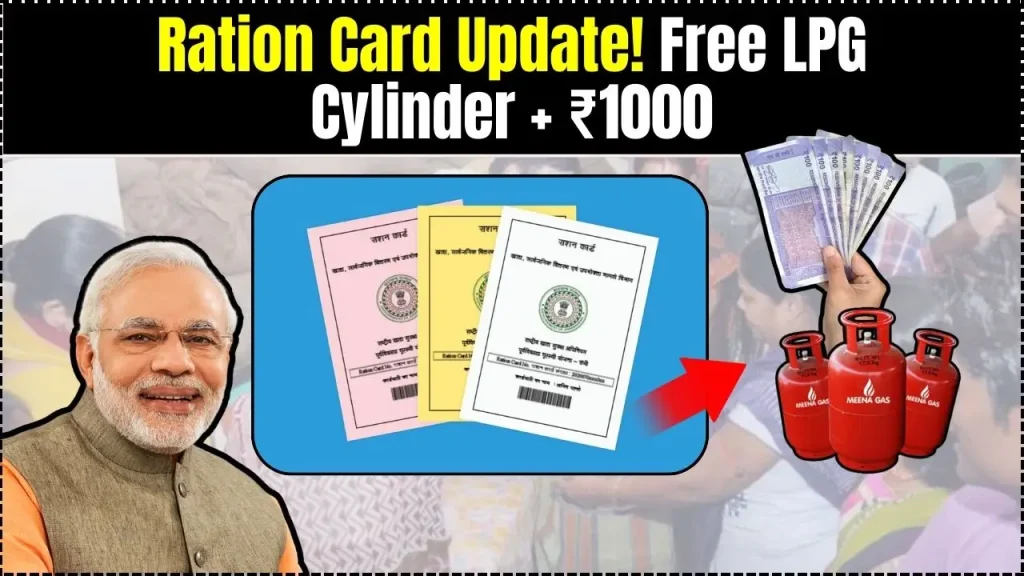
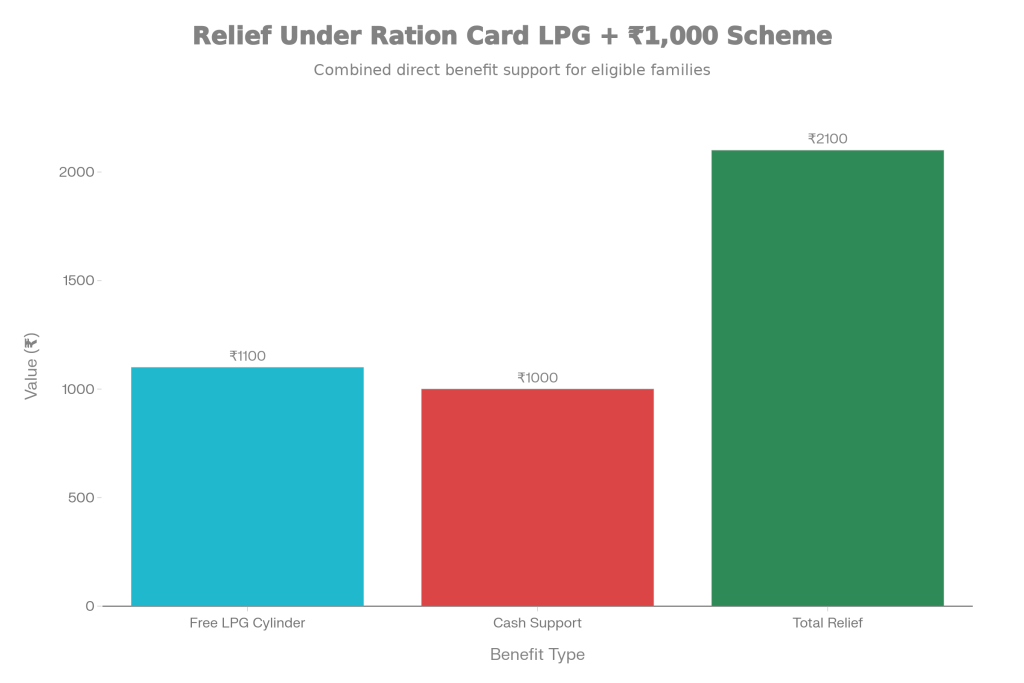
This new facility works on two levels first, it provides substantial relief on cooking gas for eligible ration card families, and second, it sends direct cash support to their bank accounts to ease monthly cash flow pressure. In this model, the effective cost of the LPG cylinder reduces and, at the same time, ₹1,000 is credited to the bank account of the woman or head of the household, which can be used for gas refills, groceries or other urgent needs. For families that were forced to cook on firewood, coal or dung cakes, this combined package can make a real difference.
Ration Card Update
| Point | Details |
|---|---|
| Scheme focus | Provide free or subsidised LPG cylinder and ₹1,000 cash support to eligible ration card holders |
| Target beneficiaries | BPL families, households registered under NFSA, Ujjwala scheme beneficiary women |
| Form of support | One free or heavily subsidised LPG cylinder + ₹1,000 credited via DBT to bank account |
| Main objective | Reduce kitchen expenses, promote clean fuel, cut smoke-related health risks from solid fuels |
| Key conditions | Valid ration card, LPG connection (mostly under PMUY), Aadhaar–bank linkage, completed KYC |
| Payment mechanism | Direct Benefit Transfer to the Aadhaar-linked bank account of the beneficiary |
| Applicable period | As per the officially notified time window and instalments, varies by state and centre |
| Primary focus group | Poor and low-income families, especially women in rural and urban slum households |
Purpose Of The Scheme And Why It Matters
Due to higher LPG prices, it has become difficult for poor and low-income families to book refills regularly. Many households either keep the cylinder empty for months or shift back to firewood, coal and other traditional fuels, which have serious health and environmental consequences. The aim of this scheme is to reassure such families that at least one cylinder and some additional cash support will help them continue using LPG.
The second major goal is to promote clean cooking fuel in the kitchen. When smoke in the cooking area reduces, the eyes, lungs and overall health of women and children improve noticeably. Cooking on LPG is also faster and more convenient, saving valuable time for women who often juggle wage work, farm work and housework together.
Which Ration Card Holders Are Eligible
Not every ration card holder automatically gets this benefit; beneficiaries are selected on the basis of clear criteria. Typically, the focus is on households that have a Below Poverty Line ration card or are covered under the NFSA framework, with their names appearing as active on the relevant government portals. In many cases, there is also a condition that the family must be listed as a beneficiary under the Pradhan Mantri Ujjwala Yojana.
Aadhaar linkage and completed KYC are now non‑negotiable requirements. Families whose bank accounts are not linked with Aadhaar often face delays or rejection in DBT transfers. In some states, government employees, income tax payers or those owning certain assets like four‑wheelers or pucca houses may be excluded so that the scheme remains targeted towards genuinely vulnerable households.
How The Free LPG Cylinder Is Provided
The free LPG cylinder component can work in two practical ways. In some places, the government directly bears the entire cost of a cylinder, so the beneficiary does not have to pay at the time of booking. In other cases, the beneficiary books the cylinder at the market price and the subsidy or full relief amount is later credited to their bank account via DBT. In both models, the intent is the same – to make at least one or more refills effectively free or very cheap for the family.
A large number of families were already connected earlier through the Ujjwala scheme, under which new LPG connections, the first refill and a stove were provided free or without security deposit. With this new update, existing beneficiaries can receive fresh relief, especially in months when gas consumption rises due to festivals or winter.
Why The ₹1,000 Support Is Important
₹1,000 may look like a small amount on paper, but for a low-income household it can be extremely useful. The money can go towards monthly groceries, school supplies for children, payment of small bills or directly for the next gas refill. Since the amount comes straight into the bank account, the beneficiary has the flexibility to decide which immediate need it should address first.
Another important aspect is that when the money is credited to the woman’s account, her role in financial decisions at home becomes stronger. This is not just a gas subsidy; it also supports women’s economic empowerment and household financial security. When the ration card, LPG connection and bank account are all properly aligned within the same family unit, this benefit package works much more smoothly.
Documentation And Step By Step Process for Ration Card Update
To receive the benefits of this scheme, keeping the documentation in order is essential. An active ration card, Aadhaar card, bank passbook and LPG connection details should always be readily available. If any family member is still not added to the ration card, it is better to get their name included at the local office so that no one is left out of current or future subsidies.
In most states, applications are submitted either on the official online portal or through common service centres, panchayat offices or municipal counters. While applying, it is crucial to enter the Aadhaar number, ration card number, LPG consumer ID and bank account details accurately. After applying, beneficiaries should periodically check their status in the official lists or dashboards to ensure their name appears and to correct any error promptly.
Practical Tips For Ration Card Holders
For ration card holders, the most important habit is to trust official information rather than social media rumours. Forwarded messages often claim that “everyone will get a free cylinder and ₹1,000 every month,” while in reality the rules may apply only for a limited period, in selected areas or to specific categories. Always verify with your state’s food and civil supplies department or official notice.
Timely gas booking and regular monitoring of your bank account are also essential. If the subsidy or ₹1,000 support is delayed, you should contact the helpline or local office and keep the complaint or reference number safe. Linking your mobile number with both the ration card system and bank account ensures you receive OTPs and SMS alerts for every important transaction.
Train Ticket Booking Change from December 11 — Here Are the New Timings and Rules
Long Term Impact Of This Scheme
- In the long run, this model is not just about short‑term relief; it can also change fuel choices and health patterns in households. When families realise that shifting to LPG does not permanently damage their budget, and that support comes periodically, they are more likely to stay away from smoky traditional fuels. This reduces pressure on forests, lowers indoor pollution and gives children a cleaner environment at home.
- From the government’s perspective, targeted support through cash transfers and fuel subsidies is easier to monitor and fine‑tune. Data shows which households are actually using LPG regularly, where leakages may be happening and what kind of improvements are needed. That makes the entire welfare system more accountable and efficient.
FAQs on Ration Card Update
1. Who is eligible for the free LPG cylinder and ₹1,000 support?
Families that hold a valid BPL or NFSA ration card, have an active LPG connection (often under the Ujjwala scheme), and have their Aadhaar correctly linked to a bank account are typically eligible for this benefit.
2. How will I receive the ₹1,000 assistance in my account?
3. Will I get a completely free LPG cylinder or only a subsidy?
In some schemes, the entire cost of one cylinder is covered, making it effectively free for the beneficiary, while in others you pay the market price first and receive the relief later as a subsidy credited to your bank account.
4. What documents do I need to apply for these benefits?
You generally need an Aadhaar card, ration card, bank passbook or account details, an active LPG consumer number, and a working mobile number to complete application and verification.