

If you are looking for a safe and dependable way to grow your savings without worrying about market ups and downs, the Post Office FD Scheme is one of the most trusted options available in India. The Post Office FD Scheme has been a preferred choice for decades, especially among people who value capital protection and assured returns over high-risk investments. In 2025, with economic uncertainty and fluctuating markets, interest in fixed-income and government-backed savings plans has increased once again. Investing a lump sum such as ₹2.5 lakh is a big financial decision, and most investors want to know exactly how much they will earn before locking in their money. This article explains everything you need to know about the scheme, including interest rates, tenure options, tax rules, and the maturity amount you can expect from a ₹2.5 lakh investment.

The Post Office FD Scheme is a fixed deposit program offered by India Post under the government’s small savings initiatives. It is designed for individuals who want predictable and stable returns without exposure to stock market risks. The scheme allows you to deposit a fixed amount for a fixed period and earn guaranteed interest. What makes this scheme especially attractive is its accessibility and simplicity. With thousands of post office branches across the country, even people in rural and semi-urban areas can easily invest. In 2025, many investors are choosing the Post Office FD Scheme as a safe alternative to volatile investment options, especially for short- and medium-term financial goals.
Post Office FD Scheme
| Feature | Details |
|---|---|
| Scheme Name | Post Office Fixed Deposit Scheme |
| Minimum Investment | ₹1,000 |
| Maximum Investment | No upper limit |
| Example Investment | ₹2.5 Lakh |
| Tenure Options | 1 year, 2 years, 3 years, 5 years |
| Interest Rate 2025 | Up to 7.5 percent per annum |
| Compounding | Annually |
| Risk Level | Very low |
| Government Guarantee | Yes |
| Tax Benefit | Available on 5-year FD |
The Post Office FD Scheme continues to be a dependable investment option in 2025 for those who value safety and guaranteed returns. Investing ₹2.5 lakh can provide a predictable maturity amount without exposing your money to market risks. While it may not offer aggressive growth, the peace of mind and financial stability it delivers make it a strong choice for conservative investors. Before investing, always align the tenure with your financial goals to make the most of this trusted savings scheme.
What Is the Post Office Fixed Deposit Scheme
- The Post Office Fixed Deposit Scheme works in a similar way to a bank fixed deposit, but with the added confidence of government backing. When you invest, you choose a tenure and deposit a fixed amount. The interest rate applicable at the time of opening the FD remains locked in for the entire period.
- Interest under the Post Office FD Scheme is compounded annually, which helps your money grow steadily over time. However, the interest is not paid out every year. Instead, both the principal and interest are paid together when the deposit matures. This makes the scheme suitable for investors who do not need regular income and are comfortable waiting until maturity.
Interest Rates Offered Under the Post Office FD Scheme
- Interest rates for the Post Office FD Scheme are decided by the government and are reviewed every quarter. In 2025, the rates range from approximately 6.9 percent to 7.5 percent per annum, depending on the tenure selected.
- Longer tenures generally offer higher interest rates, which is why the five-year fixed deposit is the most popular option. One major advantage is that once you invest, the interest rate remains unchanged throughout the tenure, even if rates rise or fall later.
Tenure Options Available
- The Post Office FD Scheme offers four tenure options, allowing investors to choose based on their financial needs.
- The one-year FD is suitable for short-term parking of funds when you want safety with modest returns. The two-year FD works well for investors with near-term financial goals. The three-year FD offers a balance between liquidity and better returns. The five-year FD is ideal for long-term savers who want higher interest and tax benefits.
- Choosing the right tenure depends entirely on when you might need the money and how long you can keep it invested without withdrawals.
Maturity Amount on Investing ₹2.5 Lakh
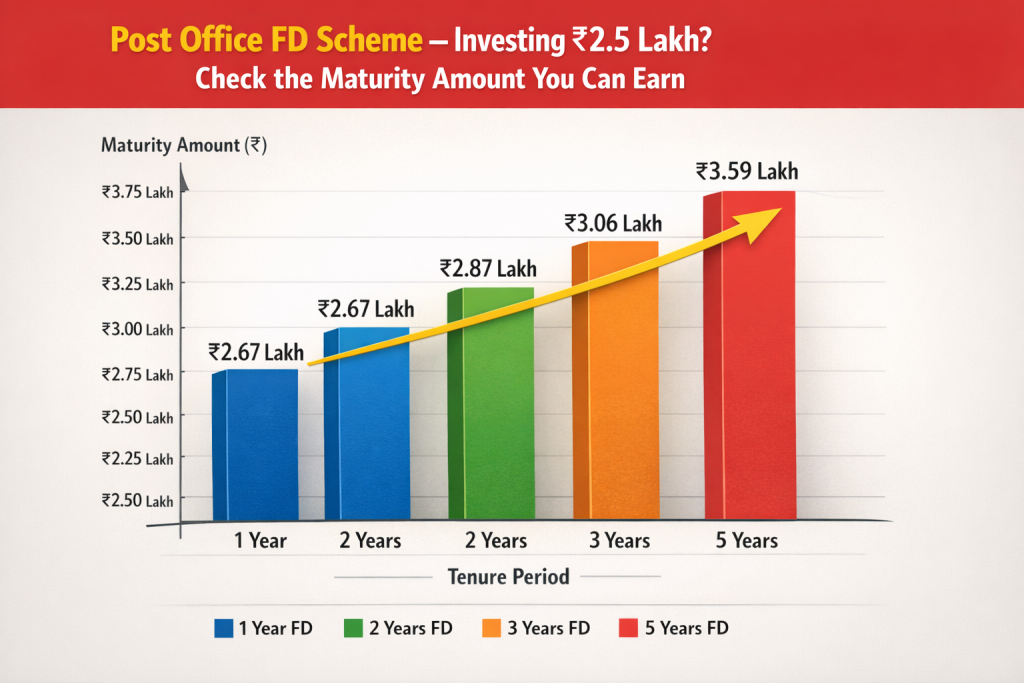
- One of the most common questions investors ask is how much they will receive at maturity. If you invest ₹2.5 lakh under the Post Office FD Scheme, the maturity amount depends on the tenure you select.
- For a one-year FD, the maturity amount is approximately ₹2.67 lakh. For a two-year FD, the amount grows to around ₹2.87 lakh. With a three-year tenure, the maturity amount can reach close to ₹3.06 lakh. If you choose the five-year FD, which offers the highest interest rate, the maturity value can be nearly ₹3.59 lakh.
- These figures are approximate and may vary slightly depending on the exact interest rate at the time of investment.
Taxation Rules You Should Know
- Understanding taxation is crucial before investing in the Post Office FD Scheme. The interest earned from this scheme is fully taxable as per your income tax slab. Unlike bank fixed deposits, post offices do not deduct tax at source automatically, but investors are still required to declare the interest income when filing their tax returns.
- The five-year Post Office FD qualifies for tax deduction under Section 80C of the Income Tax Act, up to a maximum limit of ₹1.5 lakh. However, it is important to remember that only the invested amount gets the deduction, not the interest earned. The interest remains taxable every year.
Who Should Invest In This Scheme
- The Post Office FD Scheme is ideal for conservative investors who prioritize safety over high returns. It is particularly suitable for senior citizens, salaried individuals, homemakers, and anyone looking to preserve capital while earning steady interest.
- If you are planning for short- or medium-term goals such as education expenses, travel, or emergency funds, this scheme can be a reliable option. However, investors seeking high growth or inflation-beating returns may find better alternatives in equity-linked investments.
How To Open a Post Office FD Account
- Opening a fixed deposit account under the Post Office FD Scheme is a simple process. You need to visit your nearest post office branch with valid identity proof, address proof, and passport-size photographs. If you already have a post office savings account, opening an FD becomes even easier.
- Most branches follow an offline process, though some digital services are available in select locations. Once the account is opened, you will receive a deposit certificate that mentions the invested amount, tenure, and maturity value.
Key Advantages Of The Post Office FD Scheme
- One of the biggest advantages of the Post Office FD Scheme is its government guarantee, which makes it extremely safe. The scheme offers predictable returns, multiple tenure options, and a low minimum investment requirement.
- It is also accessible across the country and does not require advanced financial knowledge to understand or manage. The five-year FD additionally provides tax benefits, making it attractive for tax-saving purposes.
Indira Gandhi Smartphone Yojana 2026: Eligibility, Benefits & Latest Updates
Limitations You Should Consider
- While the scheme offers safety and stability, it also has certain limitations. The returns may not be sufficient to beat inflation over the long term. There is also limited liquidity, as premature withdrawals may attract penalties.
- Additionally, since the interest is taxable, the post-tax returns may be lower for investors in higher tax brackets. These factors should be carefully evaluated before investing.
FAQs on Post Office FD Scheme
Is The Post Office FD Scheme Safe In 2025
Yes, it is one of the safest investment options available as it is backed by the Government of India.
Can I Invest More Than ₹2.5 Lakh
Yes, there is no maximum investment limit under the Post Office FD Scheme.
Can Senior Citizens Invest In This Scheme
Yes, senior citizens frequently invest in this scheme for stable and secure returns.
Is The Five-Year FD Completely Tax-Free
No, only the invested amount qualifies for tax deduction under Section 80C. The interest earned is taxable.