

India’s fight against malnutrition has entered a decisive and more accountable phase. With nutrition indicators now closely linked to data, technology, and community action, Poshan Abhiyaan 2026 has become one of the most important government missions for children, women, and adolescent health. Unlike earlier years where awareness alone was the focus, the current phase demands measurable outcomes, active participation, and accurate reporting from the ground level. What makes Poshan Abhiyaan 2026 especially significant is its strong digital backbone. The introduction of tools like the Jan Andolan Tracker and the Poshan Abhiyaan mobile app ensures that every nutrition activity conducted in villages, wards, and urban settlements is recorded in real time. This not only improves transparency but also helps policymakers understand what is working and where improvements are needed.

Poshan Abhiyaan 2026 is the outcome focused phase of India’s National Nutrition Mission. The goal is clear: reduce malnutrition, stunting, wasting, and anemia among children, pregnant women, lactating mothers, and adolescent girls by strengthening systems at the grassroots level. This phase places equal importance on service delivery and community behavior change. One of the biggest shifts under Poshan Abhiyaan 2026 is accountability through digital monitoring. Nutrition activities are no longer informal events. Each rally, awareness drive, or health session must be properly documented and uploaded. This structured approach ensures that planning is based on real data rather than estimates. It also empowers local workers by giving visibility to their efforts and impact.
Poshan Abhiyaan 2026
| Particular | Details |
|---|---|
| Scheme Name | Poshan Abhiyaan |
| Focus Year | 2026 |
| Core Strategy | Jan Andolan |
| Monitoring System | Jan Andolan Tracker |
| Reporting Method | Mobile App and Online Portal |
| Target Beneficiaries | Children, Women, Adolescents |
| Field Implementers | Anganwadi Workers and Supervisors |
| Main Objective | Reduce Malnutrition Through Community Action |
Poshan Abhiyaan 2026 marks a critical milestone in India’s journey toward better nutrition. By integrating Jan Andolan with digital tracking, the mission ensures that every effort counts and every activity is visible. Accurate data entry, active community participation, and strong supervision are the pillars that support this mission. For field workers, Poshan Abhiyaan 2026 offers an opportunity to make a measurable difference. For communities, it provides knowledge and empowerment. Together, these efforts bring the nation closer to a healthier and more nourished future.
What Is Jan Andolan in Poshan Abhiyaan
- Jan Andolan literally means a people’s movement. Under Poshan Abhiyaan, it represents the idea that nutrition cannot improve unless communities are actively involved. Instead of treating nutrition as a government only responsibility, Jan Andolan brings families, local leaders, schools, and self-help groups together.
- Activities under Jan Andolan include nutrition awareness meetings, healthy cooking demonstrations, growth monitoring drives, anemia awareness campaigns, and sanitation related sessions. These activities aim to change everyday habits related to food, hygiene, and childcare. Poshan Abhiyaan 2026 depends heavily on Jan Andolan because lasting nutrition improvement comes from informed choices made at the household level.
Jan Andolan Tracker Purpose and Importance
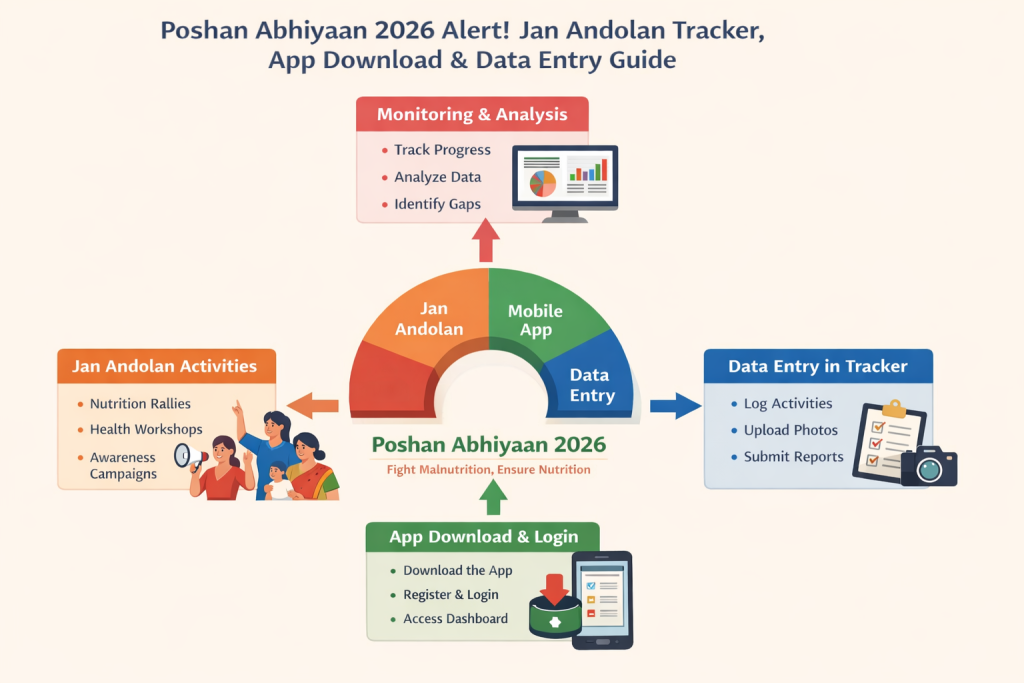
- The Jan Andolan Tracker is a digital platform designed to monitor all nutrition related activities conducted under Poshan Abhiyaan. Its main purpose is to ensure that activities are properly documented, verified, and reviewed.
- The tracker helps in multiple ways. It provides real time visibility of activities happening across states and districts. It helps authorities identify areas with strong participation and regions that need additional support. Most importantly, it promotes accountability. Since each entry is linked to a specific user, the quality and accuracy of reporting improves significantly.
- For Poshan Abhiyaan 2026, the tracker is not just a reporting tool. It is a planning instrument that shapes future nutrition strategies.
Poshan Abhiyaan App Download Guide
- To make reporting simple and accessible, the government has introduced a dedicated mobile application linked to the Jan Andolan Tracker. This app allows field workers to upload activity details directly from their smartphones.
- The app can be downloaded from the official app store on Android devices. Once installed, users need to allow basic permissions such as camera access and location, which are required for uploading photos and verifying activity locations. The app reduces paperwork and ensures faster submission of data, making the entire reporting process more efficient under Poshan Abhiyaan 2026.
Login And User Access Process
- Access to the Poshan Abhiyaan app and Jan Andolan Tracker is role based. Anganwadi workers, supervisors, and department officials are provided login credentials through their respective offices. Generally, login requires a registered mobile number and an OTP or password.
- Once logged in, users can view dashboards, submit new activity entries, and track the status of previously submitted data. This system ensures that only authorized users contribute to the Poshan Abhiyaan 2026 database, maintaining data integrity and security.
Data Entry Process in Jan Andolan Tracker
- Data entry is one of the most critical responsibilities under Poshan Abhiyaan 2026. Each activity conducted must be recorded accurately to reflect real progress on the ground.
- The process involves selecting the activity type, entering the date and location, mentioning participant details, and uploading clear photographs as proof. After reviewing all details, the entry is submitted for verification. Accurate data entry ensures that the efforts of field workers are recognized and included in official reports.
Common Mistakes to Avoid During Data Entry
- Despite clear guidelines, some common mistakes can affect data quality. These include uploading unclear photographs, entering incorrect dates, submitting duplicate activities, or leaving mandatory fields blank.
- Such errors can lead to rejection or delay in approval. To avoid this, workers should double check entries before submission and ensure that photos are relevant and clearly show the activity. Proper training and regular practice play a key role in improving data accuracy under Poshan Abhiyaan 2026.
Role Of Anganwadi Workers and Supervisors
- Anganwadi workers are the backbone of Poshan Abhiyaan 2026. They are responsible for organizing nutrition activities, mobilizing the community, educating families, and recording data accurately. Their role directly impacts how effectively the mission performs at the grassroots level.
- Supervisors support and guide Anganwadi workers by reviewing entries, resolving errors, and ensuring that reporting standards are maintained. Together, they form a strong implementation structure that connects national policy with local action.
Why Poshan Abhiyaan 2026 is Important
- Malnutrition affects not just health but also education, productivity, and economic growth. Poshan Abhiyaan 2026 addresses this challenge through a comprehensive approach that combines nutrition services, behavior change communication, and digital monitoring.
- The focus on Jan Andolan ensures that nutrition awareness reaches every household. The use of digital tools ensures transparency and data driven decision making. This integrated approach makes Poshan Abhiyaan 2026 more effective than traditional schemes.
Impact Of Digital Monitoring on Nutrition Programs
- Digital monitoring has transformed how nutrition programs are implemented and evaluated. With real time data available, authorities can respond quickly to gaps and challenges. Trends can be analyzed to improve planning and resource allocation.
- For field workers, digital tools reduce paperwork and improve efficiency. For administrators, they provide a clear picture of progress. Poshan Abhiyaan 2026 benefits immensely from this shift toward technology based governance.
Challenges In Implementation and How to Overcome Them
- Despite its strengths, Poshan Abhiyaan 2026 faces challenges such as limited digital literacy, connectivity issues in remote areas, and workload pressure on field staff. Addressing these challenges requires regular training, technical support, and simplified reporting processes.
- Encouraging peer learning, providing refresher sessions, and ensuring timely technical assistance can significantly improve implementation quality and outcomes.
RajSSP Pension 2026 Explained: New Benefits, Eligibility & Payment Details
Future Outlook of Poshan Abhiyaan 2026
- As the mission progresses toward 2026, the focus will increasingly shift toward outcome measurement and sustainability. Data collected through the Jan Andolan Tracker will guide future nutrition policies and interventions.
- Community ownership, supported by strong digital systems, will play a decisive role in achieving long term nutrition goals. Poshan Abhiyaan 2026 is expected to set a benchmark for how large scale public health missions can be managed effectively.
FAQs on Poshan Abhiyaan 2026
What Is Poshan Abhiyaan 2026?
Poshan Abhiyaan 2026 is the outcome focused phase of India’s National Nutrition Mission. It aims to reduce malnutrition, stunting, wasting, and anemia by combining community participation with digital monitoring and accountability.
What Is Jan Andolan In Poshan Abhiyaan?
Jan Andolan is the community driven approach under Poshan Abhiyaan where nutrition becomes a people’s movement. It involves awareness activities, local events, and behavior change initiatives at the grassroots level.
Who Should Use the Jan Andolan Tracker?
The Jan Andolan Tracker is primarily used by Anganwadi workers, supervisors, and authorized officials to record and monitor nutrition related activities conducted under Poshan Abhiyaan 2026.
Why Is Data Entry Important in Poshan Abhiyaan 2026?
Accurate data entry ensures transparency, helps measure real progress, supports better planning, and allows authorities to identify gaps and improve nutrition strategies effectively.