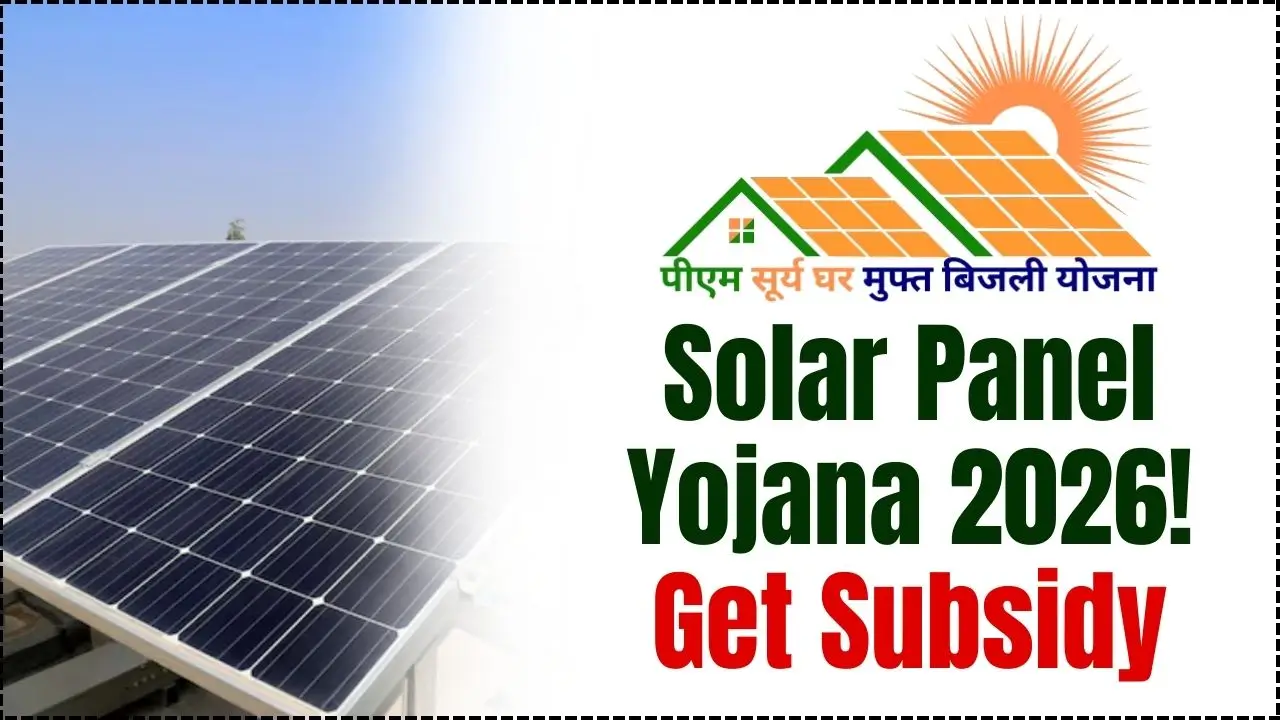

PM Surya Ghar Yojana: Get a Free Solar Panel on Your Roof with Subsidy Up to ₹78,000 was launched in 2024 and, by 2025, it has become one of the most talked‑about solar subsidy schemes in the country. The intention is not just to hand out subsidies but to change the mindset, so people start looking at electricity as an investment opportunity, not just a fixed expense. Under this scheme, the government provides a fixed subsidy on systems of 1 kW to 3 kW and above, which is transferred directly to your bank account after installation and verification. This makes your net cost much lower and speeds up your return on investment.

A big advantage of PM Surya Ghar Yojana: Get a Free Solar Panel on Your Roof with Subsidy Up to ₹78,000 is that it is not limited to big cities. It is equally beneficial for homes in small towns and rural areas. In regions where power cuts are frequent or bills feel too heavy, a rooftop solar system becomes even more attractive. With the right system size and proper net metering, many families are now able to meet almost their entire household power needs from solar itself.
PM Surya Ghar Yojana
| Point | Details |
|---|---|
| Scheme Name | PM – Surya Ghar: Muft Bijli Yojana |
| Main Title / Focus | PM Surya Ghar Yojana: Get a Free Solar Panel on Your Roof with Subsidy Up to ₹78,000 |
| Launch Year | Announced in 2024, active and ongoing in 2025 |
| Main Benefit | Rooftop solar system + up to around 300 units free/offset electricity per month |
| Subsidy Range | Around ₹30,000 to ₹78,000 (for 1–3 kW and above, with a capped subsidy) |
| Subsidy Structure | Higher percentage subsidy up to 2 kW, lower rate from 2–3 kW, capped at ₹78,000 |
| Target Households | Poor and middle‑income families with their own roof and domestic power connection |
| Total Government Outlay | Roughly ₹75,000 crore approved for the scheme period |
| Official Portal | National Rooftop Solar Portal (central government solar rooftop portal) |
| Core Objective | Reduce home electricity bills, promote solar energy, cut carbon emissions |
What This PM Surya Ghar Yojana Is and Why It Matters
In simple terms, this scheme gives you the chance to build your own “home power station”. The solar panels on your rooftop convert sunlight into electricity during the day, which can run your lights, fans, TV, fridge and other appliances. This directly reduces the amount of electricity you draw from the grid, so your bill goes down automatically. In many homes where monthly usage is around 300 units, the bill almost feels like it has disappeared.
Another big reason why PM Surya Ghar Yojana: Get a Free Solar Panel on Your Roof with Subsidy Up to ₹78,000 is getting so much attention is its national‑level vision. The scheme aims to reach not just a few lakh homes but crores of consumers. This will help increase solar capacity across India, reduce dependence on coal and fossil fuels and, over time, make a positive impact on pollution and carbon emissions.
Subsidy Structure: How Much Discount You Actually Get
- The subsidy structure has been designed so that systems in the 1–3 kW range are the most attractive for typical households. In general, a 1 kW system gets a subsidy of about ₹30,000, a 2 kW system gets around ₹60,000 and installations of 3 kW or more get a maximum total subsidy of up to ₹78,000. This amount is paid directly into your bank account once the installation is completed and successfully verified.
- In this model, the percentage of subsidy is usually higher up to 2 kW, and then slightly lower between 2–3 kW, but still enough to significantly reduce the overall system cost. That is why, under PM Surya Ghar Yojana: Get a Free Solar Panel on Your Roof with Subsidy Up to ₹78,000, 2–3 kW systems are becoming the most popular choice. For most Indian households, this capacity comfortably covers regular daily consumption.
Eligibility: Who Can Apply For PM Surya Ghar Yojana
To benefit from this scheme, you must meet some basic eligibility conditions. First, the applicant should be an Indian citizen and must own a house or flat with a rooftop that has enough space and structural strength to support solar panels. There must be an active domestic electricity connection on that property as well. Typically, having no major outstanding dues on that connection is also expected.
Another key point is that PM Surya Ghar Yojana: Get a Free Solar Panel on Your Roof with Subsidy Up to ₹78,000 targets poor and middle‑income families. In many guidelines, you will also find that if a consumer number has already availed a subsidy for another rooftop solar scheme earlier, it may not be eligible for a fresh subsidy under this scheme. Additionally, some states may add minor conditions through their local DISCOM rules, so checking local guidelines before applying is always wise.
Online Application Process For PM Surya Ghar Yojana
- The scheme has been designed as digital‑first, with the entire application process available online so that users from cities as well as remote areas can apply easily. You need to visit the national rooftop solar portal, select your state and DISCOM, and enter your consumer number, mobile number and email ID to register. After OTP verification, a login is created for you, which you can use for all further steps.
- Next, you need to click on “Apply for Rooftop Solar” (or a similar option) and fill out a detailed application form. Here you specify the proposed system capacity (for example, 2 kW or 3 kW), installation address, connection type and basic details about the site. Once the form is submitted, your application goes to the concerned DISCOM, which issues a technical approval after checking feasibility. After receiving this approval, you can choose an empanelled vendor from the official list, get the system installed, and complete net metering formalities. Once net metering is active and the system passes final checks, the subsidy is released.
What Happens After Installation
Once the solar system is installed on your rooftop, your work is not completely over. You need to upload certain documents on the portal such as installation photographs, invoices, warranty documents and technical details. After that, a representative from the DISCOM or an authorised agency may conduct a site visit to verify that the system has been installed properly and meets all safety and quality standards.

After all verifications are cleared, the subsidy amount is transferred to your bank account, usually linked with your Aadhaar. In practice, this process can take a few weeks to around a month or slightly more. Under PM Surya Ghar Yojana: Get a Free Solar Panel on Your Roof with Subsidy Up to ₹78,000, most systems come with a total life of around 20–25 years for the panels, while inverters and other components have their own warranty periods. Periodic cleaning of the panels and basic maintenance help keep power generation stable and efficient.
Documents And Smart Tips Before You Go Solar
Keeping your documents ready before you apply makes the process smoother. Commonly required documents include Aadhaar card, PAN card, latest electricity bill, bank passbook or cancelled cheque, property ownership documents and passport‑size photographs. In some states, income proof or a self‑declaration may also be required, especially where the scheme strongly targets lower‑income households.
Apart from paperwork, you should keep some practical tips in mind. Always choose authorised, empanelled vendors only. Cheap but unauthorised installations can create serious issues later in terms of safety, performance, warranty claims and even subsidy release. When deciding your system size, check your last 12 months of electricity bills and calculate the average units you use. Also consider future needs like more ACs, an EV charging point or additional appliances. Based on that, you can decide whether 2 kW or 3 kW (or more) is the right fit for you.
MNSSBY Bihar Student Credit Card 2025: Get ₹4 Lakh Education Loan & Monthly Allowance – Full Guide
Financial Angle: Understanding Return On Investment
- Many people wonder whether investing in solar is truly worth it. This is where PM Surya Ghar Yojana: Get a Free Solar Panel on Your Roof with Subsidy Up to ₹78,000 plays the most important role, because the subsidy cuts down your initial cost drastically. Suppose a 3 kW system has a certain total market cost; if you get up to around ₹78,000 as subsidy on that, your net out‑of‑pocket expense becomes much more manageable.
- If your home’s monthly consumption is around 250–350 units and you use a good amount of electricity during daytime, rooftop solar can save you thousands of rupees every month. In such cases, the system often recovers its cost within about 4–6 years. After that, for many more years, you are mostly in the profit zone in the form of reduced bills. You can also choose to finance the system through a bank loan at a relatively low interest rate, so you do not have to pay a large amount upfront and the savings from solar can help you comfortably handle the EMIs.
FAQs on PM Surya Ghar Yojana
1. Do you really get a “free” solar panel in this scheme?
You do not get a completely free system; instead, the government gives you a fixed cash subsidy up to a certain limit.
2. Does every home get 300 units of free electricity?
You can reach a near‑free zone of up to about 300 units only if your solar system’s capacity and your actual usage are in that range and net metering is working properly.
3. Is it easy to get a loan under this scheme?
Many banks and NBFCs offer special loans for rooftop solar. These are often categorised as home‑improvement or green loans with competitive interest rates, so the monthly EMI is manageable,
4. Can tenants living in a rented house benefit from this scheme?
Generally, the benefit goes to the property where the owner or owner’s consent exists and where the domestic connection is in the owner’s or joint holder’s name.