
Looking to cut your power bills and lock in free electricity every month? The PM Surya Ghar: Muft Bijli Yojana is designed to help households install rooftop solar with a straightforward online process, transparent eligibility rules, and a direct subsidy transfer that can significantly reduce your upfront cost. Under the central subsidy slabs, homeowners typically receive up to ₹78,000 for a 3-kW system (with subsidy computation capped at 3 kW), alongside the program’s core promise of enabling up to 300 units of free electricity per month where applicable through grid-connected, net-metered systems.
The PM Surya Ghar Muft Bijli Yojana puts everything on one guided pathway: register on the national portal, get feasibility from your DISCOM, install via an empanelled vendor, complete net metering and inspection, and receive subsidy directly to your bank after commissioning. The scheme’s outlay supports 1 crore rooftop systems through FY 2026–27, with a clear focus on residential consumers, standardized subsidy slabs, and faster turnaround via DISCOM-led approvals.
PM Surya Ghar Muft Bijli Yojana
| Item | Details |
|---|---|
| Scheme Name | PM Surya Ghar: Muft Bijli Yojana |
| Implementing Ministry | Ministry of New and Renewable Energy (MNRE) |
| Scheme Period | Applications via national portal; implementation targeted through FY 2026–27 |
| Financial Outlay | Total ₹75,021 crore; CFA to households forms the largest share |
| Primary Target | 1 crore residential rooftop systems; enable up to 300 units/month free electricity benefit |
| Eligibility | Residential consumers with valid electricity connection and suitable rooftop |
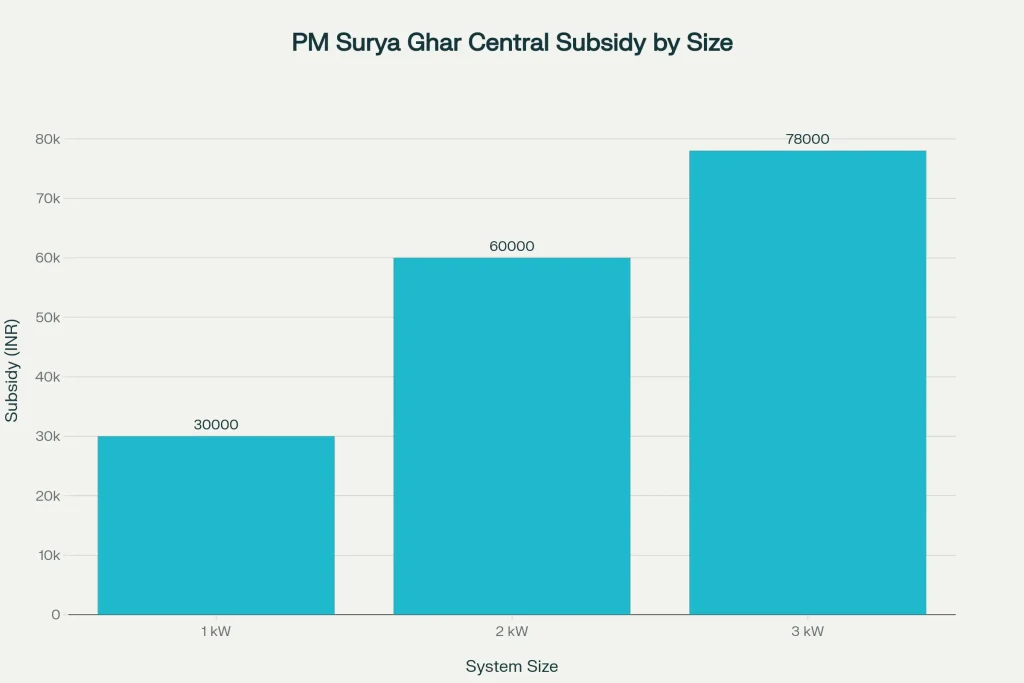
| Subsidy Slabs | ~₹30,000 for 1 kW, ~₹60,000 for 2 kW, ~₹78,000 for 3 kW and above (CFA slab capped at 3 kW) |
| Application Mode | Online via National Portal; mobile app also available |
| Status Tracking | Consumer dashboard on the national portal; state/DISCOM trackers where available |
Eligibility Criteria And Key Conditions for PM Surya Ghar Muft Bijli Yojana
- The scheme is for residential consumers with an active electricity connection and a suitable rooftop at their owned premises.
- Installations must be grid-connected and net-metered to qualify for Central Financial Assistance (CFA).
- Work must be executed by an MNRE-empanelled vendor as listed for your DISCOM to ensure standards and subsidy eligibility.
- Only one rooftop solar subsidy is permitted per household under central norms; commercial/industrial connections are outside this residential CFA scope.
Subsidy Details Explained
- Central subsidy is computed using standard slabs and capped at 3 kW for CFA calculation, even if you install a higher-capacity system.
- Indicative CFA mapping frequently used in public guidance: about ₹30,000 (1 kW), ₹60,000 (2 kW), and ₹78,000 (3 kW or higher).
- Some states or urban programs may add top-up incentives periodically; verify locally, as add-ons vary by location and policy cycles.
- Subsidy is disbursed post-commissioning directly to your bank account once the portal reflects commissioning and DISCOM verification.
Step-By-Step Registration and Application Process for PM Surya Ghar Muft Bijli Yojana
- Create your consumer account on the National Portal by selecting state and DISCOM, then verify via OTP.
- Complete your profile with address and contact details, then choose “Apply for Rooftop Solar.”
- You may allow a registered vendor to assist with the application, or proceed independently and select a vendor later.
- Wait for DISCOM feasibility approval before any installation work. Feasibility confirms grid readiness and site suitability.
- After feasibility, select an MNRE-empanelled vendor from the DISCOM list and proceed with installation as per standards.
- Post-installation, submit plant details on the portal and apply for net-metering through your DISCOM.
- DISCOM will install the net meter, inspect the system, and record commissioning on the portal.
- Upload bank details and supporting documents for direct subsidy transfer, typically processed within a few weeks after commissioning.
Installation, Net Metering, And Commissioning
- The vendor installs the rooftop solar system to conform with MNRE and DISCOM technical standards.
- Net metering is essential for energy accounting and is applied via your DISCOM; timelines vary by state.
- Once inspection is complete and the meter is installed, commissioning is registered on the portal, which triggers the subsidy workflow.
- Keep all documentation handy, including a cancelled cheque, for seamless subsidy transfer.
Online Status Check and Tracking
- Use the consumer dashboard on the National Portal to monitor each stage: feasibility, installation completion, meter application, inspection, and commissioning.
- Many state DISCOM portals offer rooftop solar status pages searchable by application or consumer number—handy for cross-checking progress.
- The official mobile app mirrors portal functionality, sending alerts for action items and status changes so you can respond quickly to any queries.
Benefits You Can Expect
- Lower electricity bills and protection from future tariff hikes by generating a portion (or more) of your home’s consumption.
- Up to 300 units/month free electricity benefit where applicable, thanks to net-metered, grid-connected production offsetting your usage.
- Standardized CFA slabs and a transparent online journey minimize paperwork and enhance predictability of timelines.
- DISCOM incentives and national targets align the ecosystem to improve approvals, metering, and vendor availability.
Consumer Tips to Speed Up Approval
- Right-size capacity based on your average monthly units and roof area; oversizing beyond 3 kW won’t increase central CFA, so model payback carefully.
- Choose an MNRE-empanelled vendor listed for your DISCOM; verify credentials, workmanship warranty, service terms, and component standards.
- Keep documents ready: recent electricity bill, identity/address proof, property/roof ownership proof, and bank details.
- Track progress weekly on the portal, and respond promptly to DISCOM or vendor clarifications to avoid delays in feasibility or metering.
- Clarify timelines for meter availability and inspection windows with your vendor early in the process.
Document Checklist
- Consumer number and recent electricity bill.
- Aadhaar or other identity proof and address proof.
- Property ownership proof or NOC if applicable.
- Bank account details and cancelled cheque for subsidy transfer.
- Passport-size photograph as required on the portal.
Compliance And Technical Notes
- Use BIS-compliant modules and inverters meeting DISCOM and MNRE standards; ask your vendor to share datasheets and test certificates.
- Ensure proper string sizing, earthing, DC/AC protection, and adherence to local net metering regulations.
- Keep performance ratio, warranty terms (module, inverter, workmanship), and maintenance plan in writing.
- Ask the vendor to provide a single-line diagram, installation report, and O&M handbook for your records.
Payback And Savings Snapshot
- A 1–3 kW system typically offsets a significant share of an average household’s monthly units, depending on location and usage patterns.
- With central CFA up to the 3 kW cap and potential local add-ons, upfront cost reduces materially, improving payback.
- Net metering export credits and rising retail tariffs further enhance lifetime savings, while you hedge against volatility.
Common Mistakes to Avoid
- Starting installation before feasibility approval this risks subsidy ineligibility.
- Choosing non-empanelled vendors this can void your CFA claim.
- Missing documentation or errors in bank details this can delay subsidy transfer.
- Ignoring roof shading analysis this hits generation and stretches payback.
- Overlooking local rules on inverter limits, meter specs, or safety clearances.
CPF Withdrawal Rules 2025 — Simplified Process Makes Access Easier for Account Holders
How To Start Today
- Visit the National Portal for PM Surya Ghar and create your consumer login.
- Review the empanelled vendor list for your DISCOM, check ratings and service terms, and shortlist two to three providers.
- Submit your application, confirm feasibility timelines, and align installation dates with meter availability to avoid idle time.
- Keep an eye on the portal and your registered email/SMS for any action items, and respond quickly to maintain momentum.
- Revisit official guidelines periodically to catch any updates on slabs, add-on incentives, or process refinements.
FAQs on PM Surya Ghar Muft Bijli Yojana
How much subsidy can a typical 3 kW system receive under PM Surya Ghar?
The central subsidy is commonly indicated at about ₹78,000 for a 3 kW system, with CFA calculations capped at 3 kW even if you install higher capacity.
How do I check my application status online?
Login to the National Portal with your consumer credentials to view live stage updates feasibility, installation, meter, inspection, and commissioning. Some DISCOMs also provide separate status trackers by application or consumer number.
When is the subsidy paid to my account?
After commissioning is recorded on the portal and DISCOM verification is complete, the subsidy is transferred directly to your registered bank account, typically within a few weeks.
Do I need to apply before installation?
Yes. First register and submit your application on the National Portal, await DISCOM feasibility, and only then proceed with installation to remain eligible for CFA.