

If you are a farmer tired of rising diesel and erratic electricity, the PM-KUSUM Solar Pump scheme can completely change how you irrigate your fields. With a PM-KUSUM Solar Pump, most of the system cost is covered through government subsidy and easy finance, so you get reliable daytime power with almost zero fuel bill and far fewer breakdown worries. This guide walks you through eligibility, paperwork, online application and practical tips, exactly the way an on-ground consultant would explain it at your village meeting.
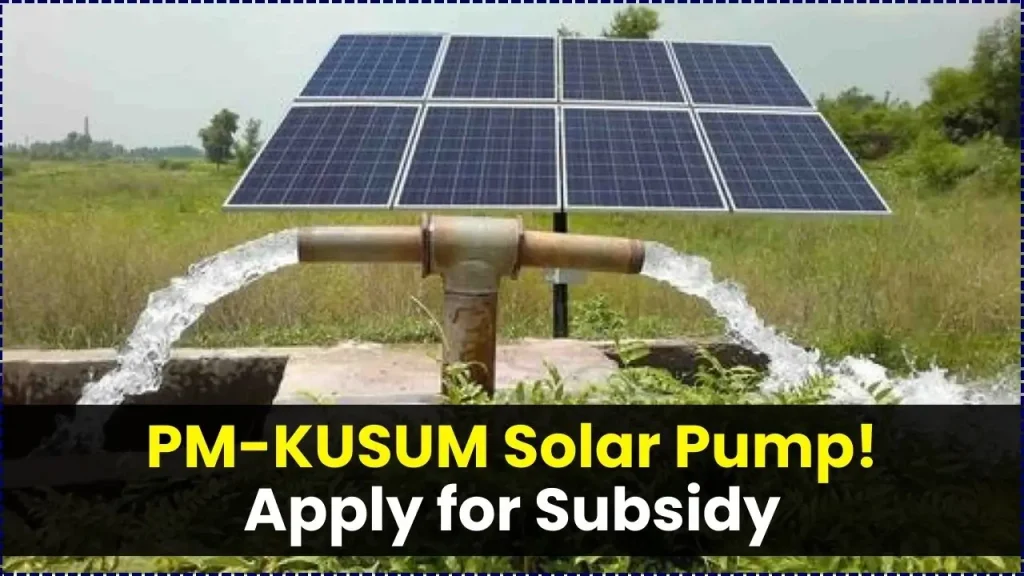
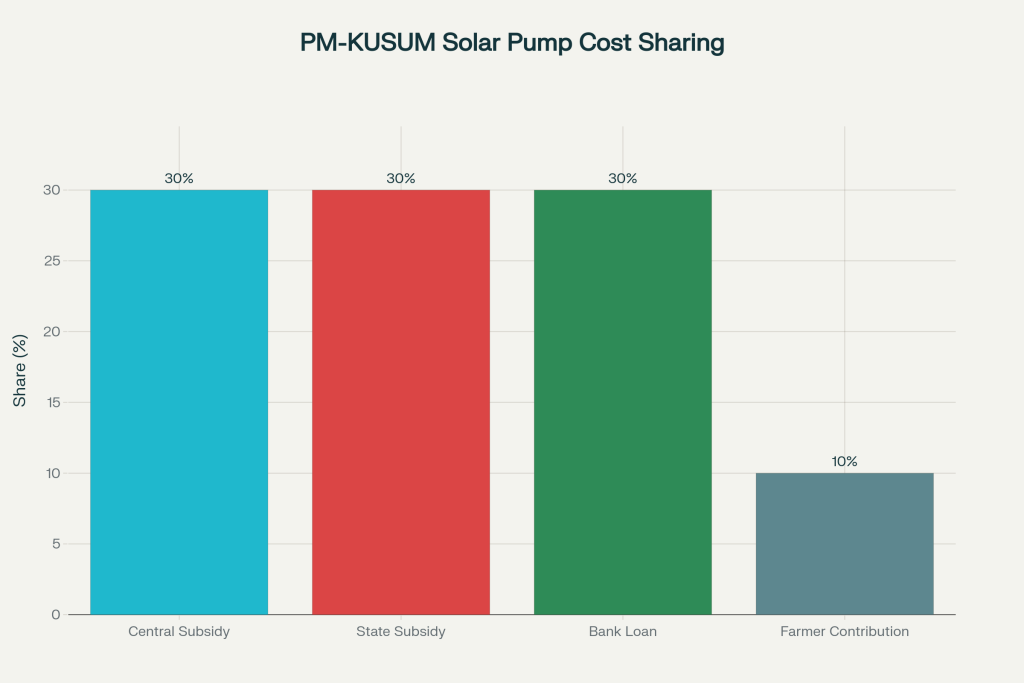
Before you fill any online form, it helps to clearly understand what the PM-KUSUM Solar Pump Yojana actually offers and where you fit into it. The scheme is run by the Ministry of New and Renewable Energy and mainly supports standalone solar irrigation pumps under Component B and solarisation of grid-connected pumps under Component C. When you apply for a PM-KUSUM Solar Pump, the typical model is around 60% combined subsidy, 30% bank loan and about 10% farmer share, though exact numbers vary state to state. In simple words, the government and the bank shoulder most of the cost so that you can shift your irrigation to clean solar power without blocking a big chunk of your working capital.
PM-KUSUM Solar Pump
| Feature | Details |
|---|---|
| Scheme Name | Pradhan Mantri Kisan Urja Suraksha evam Utthaan Mahabhiyan (PM-KUSUM) |
| Main Implementing Ministry | Ministry of New and Renewable Energy (MNRE), Government of India |
| Key Components | Component A: Decentralised solar plants; Component B: Standalone solar agri pumps; Component C: Solarisation of existing grid-connected pumps |
| Primary Objective | Provide reliable daytime solar power for irrigation, reduce diesel use, cut power subsidy burden and support farmer incomes |
| Target Capacity By 2026 | Around 34,800 MW of solar capacity plus installation/solarisation of several lakh agriculture pumps across components |
| Typical Subsidy Pattern | About 30% Central subsidy + 30% State subsidy, 30% loan and around 10% farmer margin (varies by state/category) |
| Eligible Beneficiaries | Individual farmers, groups of farmers, cooperatives, FPOs, panchayats and similar entities with cultivable land and water source |
| Application Mode | Online only, through national or state-level PM-KUSUM / solar pump portals |
| Focus For Pumps | Replacement of diesel pumps and support for off-grid / low-supply rural areas, plus efficient irrigation users |
Eligibility And Subsidy Structure for PM-KUSUM Solar Pump
Most genuine confusion among farmers is about “Am I even eligible?” and “Kitna percent subsidy milega?” The scheme broadly targets farmers who own or lease cultivable land and have a dependable water source like a borewell, dug well or canal outlet. Priority is usually given to small and marginal farmers, diesel pump users and farmers in areas with poor or irregular power supply, but the final cut-off and quotas are notified by each state.
The typical structure under the scheme is simple once you strip away the jargon. The Centre provides about 30% subsidy on the benchmark cost, the state adds another 30%, and the remaining 40% is split between bank loan and your own contribution. Many states design it so that for a PM-KUSUM Solar Pump you pay only around 10% upfront, with about 30% financed as a loan repayable over several years. For special category states and certain regions, the total subsidy can go even higher, which further reduces the burden on the farmer.
Online Application Process for PM-KUSUM Solar Pump
The entire process is online, but if you approach it step by step, it is far less scary than it sounds. The golden rule is: always start from the official MNRE or state energy/renewable department website and then click the PM-KUSUM or “State Solar Water Pumping System” link from there. This simple habit protects you from fake websites that try to collect “registration money” in the scheme’s name.
A typical application flow looks like this:
- Beneficiary Registration
- Visit your state’s official PM-KUSUM or solar pump portal.
- Click on “Beneficiary Registration” or “Apply For Solar Pump” option.
- Enter your basic details: name, mobile number, Aadhaar, district, block, and basic land information.
- Verify your mobile with OTP and create a login ID if the portal asks for it.
- Filling The Application Form
- Log in and select the relevant component (for a standalone irrigation system, this will usually be Component B).
- Enter land survey or plot numbers, area, source of water, present pump details (diesel or electric, HP) and desired solar pump capacity.
- If you plan to install micro-irrigation like drip or sprinkler, mention it clearly – many states treat this as a positive factor.
- Uploading Documents And Paying Fee
- Scan and upload your Aadhaar card, land records (7/12, Khasra/Khatauni or equivalent), bank passbook, passport photo and any category certificate.
- Check file size and format; many rejections happen because documents are unreadable or in the wrong format.
- Pay the small registration or processing fee online if the portal demands it; keep the receipt safely.
- Verification And Shortlisting
- After submission, your application goes to the state nodal agency or DISCOM for verification of land, category and eligibility.
- Once verified, shortlisted names are usually displayed on the portal and you also get an SMS or email.
- If your PM-KUSUM Solar Pump application is approved, the message will tell you how much you must deposit and by what last date.
- Payment Of Farmer Share And Installation
- Pay your share only through the official payment mode or directly to an empanelled vendor listed on the portal.
- The vendor then visits your field, finalises the exact design, installs and commissions the solar pump system.
- Government subsidy is released directly to the vendor or through the agency based on benchmark costs and inspection reports, so it does not pass through your personal bank account.
Documents And Bank Finance
A smooth PM-KUSUM Solar Pump journey starts with a strong document file. Keep at least one clear, recent land record not older than the limit fixed by your state, an Aadhaar card with correct spelling, and a bank account in your own name or joint name that you actively use. If the land is jointly owned, be prepared with consent or authorisation from other co-owners as per the portal format.
On the banking side, many states sign MoUs with public sector banks, regional rural banks and co-operative banks to provide loans under this scheme. This means that once you are selected, the bank is already familiar with the subsidy pattern and is usually faster in processing your loan. When you install a PM-KUSUM Solar Pump through this route, you effectively convert your diesel or high-tariff electricity expense into a manageable EMI that gets covered by your savings on fuel and repairs over the life of the system.
Benefits And Practical Tips for PM-KUSUM Solar Pump
From a farmer’s point of view, the biggest benefit is peace of mind. You get predictable daytime power without chasing the lineman, without running to the pump at midnight and without worrying about diesel price hikes every few months. Over a few years, the money you save on fuel, frequent motor rewinding and cable thefts often adds up to much more than your original contribution to the PM-KUSUM Solar Pump.
There are also long-term advantages beyond the individual farm. Solar pumps reduce the government’s subsidy burden on agricultural power, support India’s climate commitments and encourage more efficient water use when combined with drip or sprinkler systems. To make the most of it, plan your crop pattern and irrigation schedule around the solar window, maintain basic cleanliness around the panels, and report any fault promptly through the portal or vendor helpline so that your system downtime stays minimal.
YSR Cheyutha 2025 — How Women Can Receive the ₹75,000 Financial Support
Common Mistakes To Avoid
Even good applications get stuck because of small, avoidable errors. Some of the most common mistakes are:
- Entering land details that do not exactly match the latest land record.
- Uploading blurred or incomplete scans, especially of the bank passbook and land documents.
- Applying for a pump capacity that is not suited to the land size or water source, just because someone said “bada pump le lo.”
- Paying money to agents or on unofficial websites that are not linked from any government portal.
If you treat the process like a bank loan application careful, document-driven and step-by-step your chances of getting a PM-KUSUM Solar Pump approved go up sharply.
FAQs on PM-KUSUM Solar Pump
Who Can Apply For A PM-KUSUM Solar Pump?
Individual farmers with cultivable land and a reliable water source can apply, as well as groups like farmer producer organisations, co-operatives and panchayats where the scheme is open to them.
How Much Subsidy Will I Actually Get?
In the standard model, about 60% of the pump cost is covered by combined central and state subsidy, 30% is covered by a bank loan, and only around 10% comes from your pocket. However, this ratio can change slightly based on your state, pump capacity, category and whether you fall into a special region where higher subsidy is allowed.
How Long Does the Process Take After Applying Online?
Time can vary widely by state and by the number of applications received in a particular round. As a rough idea, document verification and shortlisting can take a few weeks, after which you usually get a fixed window to deposit your share and complete bank formalities.
How Do I Avoid Fake Websites and Agents?
Always start your journey from the official MNRE or state renewable energy department website and click through to the PM-KUSUM or solar pump portal from there. Do not pay any fee on websites that are not linked from a government domain and be extremely cautious of social media ads or WhatsApp forwards promising instant approval.