

The Government of India will release the 21st instalment of the Pradhan Mantri Kisan Samman Nidhi (PM-KISAN) on 19 November 2025, according to the Ministry of Agriculture. The ₹2,000 transfer forms part of the annual ₹6,000 income-support package designed to supplement small and marginal farmers’ earnings.
Understanding the PM-KISAN Programme
Launched in 2019, PM-KISAN remains India’s largest direct benefit transfer for cultivators, supporting more than 11 crore farming families every year. The scheme aims to stabilise rural incomes, reduce agricultural distress, and improve access to essential inputs such as seeds, fertilisers, and labour.
Over the past six years, policymakers say PM-KISAN has evolved from a basic cash-support initiative into a data-driven programme linked to digitised land records, Aadhaar verification, and financial inclusion efforts.
What the 21st Instalment Means for Farmers
The upcoming payment arrives ahead of the peak Rabi cropping season. Many farmers depend on the instalment for timely purchase of seeds, fertiliser, equipment rentals, and wage payments.
Agricultural economist Dr. Kavita Raghavan explains, “Direct transfers like PM-KISAN help reduce short-term financial stress. They provide liquidity exactly when farmers need it most. However, the impact varies by farm size, region, and overall market conditions.”
Farmers in rainfed regions often rely more heavily on such instalments due to weather-driven income uncertainty. In contrast, farmers in irrigated belts may use the funds for diversification or household needs.
Who Is Eligible for the PM Kisan 21st Installment 2025
Eligibility rules remain consistent with previous cycles. Beneficiaries must:
- Be Indian citizens who own cultivable land.
- Belong to a farmer family, defined as a husband, wife, and minor children.
- Have verified land records uploaded to the national PM-KISAN database.
- Ensure Aadhaar and bank account linkage.
- Complete mandatory e-KYC.
Families where multiple members claim the benefit, where ownership records are unclear, or where land was acquired after February 2019 may face delays until verification is completed.
PM Kisan 21st Installment 2025 Digital Verification Steps Required
Over the years, data accuracy has become a priority for the Ministry of Agriculture to ensure funds reach the correct beneficiaries.
Mandatory e-KYC
Farmers can complete e-KYC through:
- OTP-based authentication
- Biometric verification at Common Service Centres
- AI-enabled face authentication
Digital payments expert Rahul Menon notes, “Face authentication adds mobility and convenience, especially for elderly farmers and those far from service centres.”
Aadhaar-Bank Linkage
Payments are transferred directly into the beneficiary’s Aadhaar-seeded bank account using the Aadhaar Payment Bridge. This reduces delays and prevents duplication.
Digitised Land Seeding
States continue to upload and verify land data through online portals. The process is complex in states with fragmented land records or high tenancy rates.
How to Check the 21st Instalment Status
Farmers can check the status using the following steps:
- Visit the official PM-KISAN portal.
- Select “Beneficiary Status.”
- Enter Aadhaar number, mobile number, or bank account number.
- Review details such as approval status, last payment received, and upcoming instalment readiness.
The government also offers status checks through a mobile app, CSC centres, and the “Kisan-eMitra” chatbot.
Why Some Farmers May Not Receive the Payment Immediately
Payment delays typically occur due to:
- Incomplete e-KYC
- Errors in Aadhaar-bank linkage
- Demographic mismatches
- Unseeded or outdated land records
- Duplicate registrations in a family
District agriculture officers encourage farmers to rectify discrepancies early. Some states conduct special “Kisan Melas” to help with corrections.
State-Level Variations
Implementation efficiency varies across India:
- Southern states generally show higher completion rates due to better digital infrastructure.
- Eastern states face challenges in digitising land records.
- Hill states show faster grievance redressal but sometimes slower e-KYC.
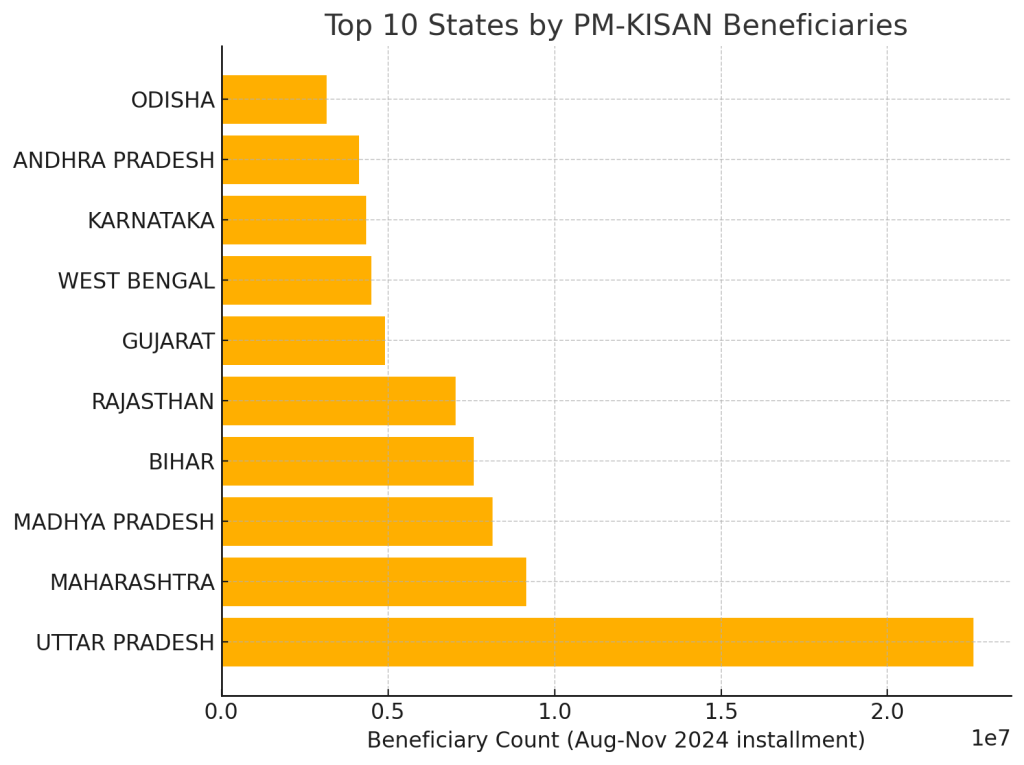
- Large agrarian states such as Uttar Pradesh and Maharashtra contribute the majority of beneficiaries.
State governments also run outreach campaigns through panchayats, farmer producer organisations, and local cooperatives.
How Farmers Use the PM-KISAN Funds
A 2024 independent study by agricultural policy researchers found:
- 42% used the instalment for agricultural inputs
- 28% spent it on household essentials
- 15% used it for debt repayment
- 10% invested in livestock or diversification
- 5% used it for emergencies
While small amounts, analysts say the scheme acts as a “shock absorber” during volatile weather cycles and rising input costs.
Criticisms and Challenges
Despite broad support, PM-KISAN faces several concerns:
Exclusion Errors
Tenants, sharecroppers, and informal cultivators often remain outside the scheme due to lack of formal land ownership.
Inclusion Errors
Cases have emerged where ineligible individuals received funds, prompting stricter verification.
Data Gaps
Differences in land digitisation across states impact uniform delivery.
Rising Input Costs
The ₹6,000 annual support has not been revised since 2019, despite inflation.
Agrarian sociologist Prof. Ramesh Venkataraman says, “PM-KISAN provides relief, but it does not replace the need for structural reforms in markets, irrigation, and risk management.”
International Perspective
India’s PM-KISAN is often compared to:
- China’s Agricultural Subsidy Scheme
- The United States’ Farm Bill Support Payments
- Brazil’s Family Agriculture Programme
Experts note that India’s model stands out for its scale and digital delivery infrastructure, and for the absence of crop or input restrictions.
Voices From the Ground
Farmers express mixed views:
- “The instalment helps during seed purchases,” says a small farmer from Madhya Pradesh.
- “More clarity on e-KYC would reduce delays,” notes a cultivator from Odisha.
- “Digital updates are helpful, but many villages need better internet access,” adds a farmer from Rajasthan.
These perspectives highlight both the programme’s importance and infrastructural gaps.
The Road Ahead
Policy experts anticipate the next phase of PM-KISAN may include:
- Improved integration with crop insurance and soil health data
- Stronger use of satellites and GIS for land verification
- Possible revision of the annual support amount
- Expanded AI-driven grievance resolution
- Enhanced local-level digital literacy campaigns
A senior agriculture official said the government is exploring “new ways to strengthen transparency and improve beneficiary experience.”
New ATM Fee Changes Ahead — What Every Bank Customer Should Know Before the Hike
Conclusion
As India prepares to release the 21st instalment of PM-KISAN, the focus remains on accuracy, timely delivery, and digital empowerment. While the scheme continues to play a crucial role in stabilising rural livelihoods, its long-term impact will depend on sustained reforms in agricultural infrastructure, data systems, and market access.