
If you live in a village and your family is still staying in a kutcha, weak, or unsafe house, you’ve probably asked the same two questions everyone asks: “How do we get our name in the list?” and “When will the survey happen in our village?” PM Awas Yojana Gramin Survey 2025 matters because it is the step where genuine, eligible rural households get identified and their details get captured for further verification. The key changes many people are noticing is that the survey process is becoming more digital and easier to standardize, because the AwaasPlus 2024 app supports both Self Survey and Assisted Survey modes. This guide explains the process in a practical way: what Self Survey is, what Assisted Survey looks like on the ground, why e-KYC becomes a bottleneck, and how the ₹1.20 lakh support is connected to eligibility and verification.

In simple terms, PM Awas Yojana Gramin Survey 2025 is about identifying eligible rural households under PMAY-G and updating records, so deserving families don’t get missed. The data capture is being done through the AwaasPlus 2024 mobile application, which includes Self Survey and Assisted Survey options. Just remember this clearly: doing a survey entry does not mean instant approval or instant money, because the process moves through corroboration at the Gram Panchayat level and additional verification layers before any final list is prepared.
PM Awas Yojana Gramin Survey 2025
Self-Survey
Think of Self Survey like raising your hand and saying: “Please consider our household too.” It helps especially when a family fears the surveyor might not reach their hamlet on time, or when they want their details captured early. As per the SOP, Self Survey is enabled in the app and allows login using Aadhaar details, and the application is designed for Android phones. The practical takeaway is that you should treat Self Survey as the first step of a longer pipeline, not as the final approval.
Here are five things that make Self Survey smoother in real life:
- Match your details with records. Names, ages, addresses, and Aadhaar-linked info should align with what is already on official documents.
- Describe your house honestly. Many rejections happen later because people overstated or understated their living conditions and verification did not match.
- Take clear photos. If images are unclear, it can slow down corroboration or create doubt during review.
- Don’t leave it half-done. Incomplete entries create confusion later and increase the chance of delays.
- Prioritize e-KYC. The SOP indicates surveys can be treated as incomplete without beneficiary e-KYC, and Self Survey finalization requires e-KYC.
Also, Self Survey entries are not meant to bypass field checks, because the SOP states Self Survey cases need to be corroborated by the designated Gram Panchayat surveyor.
Assisted Survey
Assisted Survey is the more familiar method for many villages: a registered surveyor visits households, asks questions, enters details, and captures required evidence on the spot. The benefit is simple: the process is more structured, and the chance of missing key fields is usually lower.
According to the SOP, Assisted Survey is conducted by registered and approved surveyors and comes with prerequisites such as mapping to the relevant Gram Panchayat and Aadhaar-based authentication steps. On the ground, the surveyor typically captures household details, answers to housing questions, and photos, because the SOP describes housing details capture, house-type questions, and photo capture within the application workflow.
Common mistakes households make during Assisted Survey:
- Giving information in a hurry and later realizing the year of birth or spelling is wrong.
- Getting confused in the “house condition” questions and choosing the wrong option.
- Skipping a family member’s detail, which can weaken household mapping.
- Telling the surveyor to “come later” and then missing the survey window.
A smart approach is to have one responsible family member present, keep core documents ready, and answer questions calmly and consistently.
Housing Typology Selection
Housing Typology Selection sounds technical, but it’s basically a structured way of classifying your current housing condition so eligibility screening becomes consistent across villages. The SOP lists Housing Typology Selection as a key feature in the AwaasPlus survey application.
This section matters because small errors here can create big problems later. If your home is genuinely weak, leaking, or unsafe, the survey should reflect that reality accurately. If the housing type is selected incorrectly, you may end up being reviewed under the wrong category, which can delay or weaken your case.
Face Authentication
Face Authentication is included to make identity and survey accountability stronger, so entries are less vulnerable to duplication or proxy submissions. The SOP mentions AI-enabled face authentication and notes that in Assisted Survey, the surveyor needs to complete face authentication before each new household survey. The SOP also describes that where connectivity is poor, face capture can be stored and processed later to keep field work moving.
If face authentication fails, it is often due to basic issues like low light, a poor camera, or unstable internet. The best fix is not repeated random attempts, but improving lighting, ensuring the camera is clean, and retrying with a stable connection.
Online & Offline Mode
Village connectivity is unpredictable, so offline capability is not a luxury, it’s necessary. The SOP lists Online & Offline Mode as a key app feature and describes how surveyors can conduct multiple surveys in offline mode and upload later. For households, this means one thing: if a surveyor says the entry will sync later because the network is weak, that alone is not suspicious. What matters is whether your core details were captured correctly and whether the process is completed properly after syncing.
e-KYC for PM Awas Yojana Gramin Survey 2025
e-KYC is where many genuine cases get stuck, so it deserves full attention. The SOP indicates Aadhaar-based face authentication is used for beneficiary e-KYC and that surveys may be treated as incomplete without completing e-KYC, with Self Survey finalization requiring e-KYC.
Four practical points to remember:
- Why e-KYC fails: network issues, Aadhaar mismatches, or poor face capture quality are common causes.
- Can it be completed later: the SOP describes handling constraints like connectivity and storing face capture for later processing in certain situations.
- How to reduce errors: use good lighting, keep the face centered, and avoid shaky camera movement.
- If Aadhaar photo is outdated: updating Aadhaar details can help long-term, especially for face-based steps.
If you take only one lesson from this section, make it this: don’t ignore pending e-KYC, because it can keep your survey from moving forward in the process pipeline.
₹1.20 Lakh Assistance And Eligibility Criteria For PM Awas Yojana Gramin Survey 2025
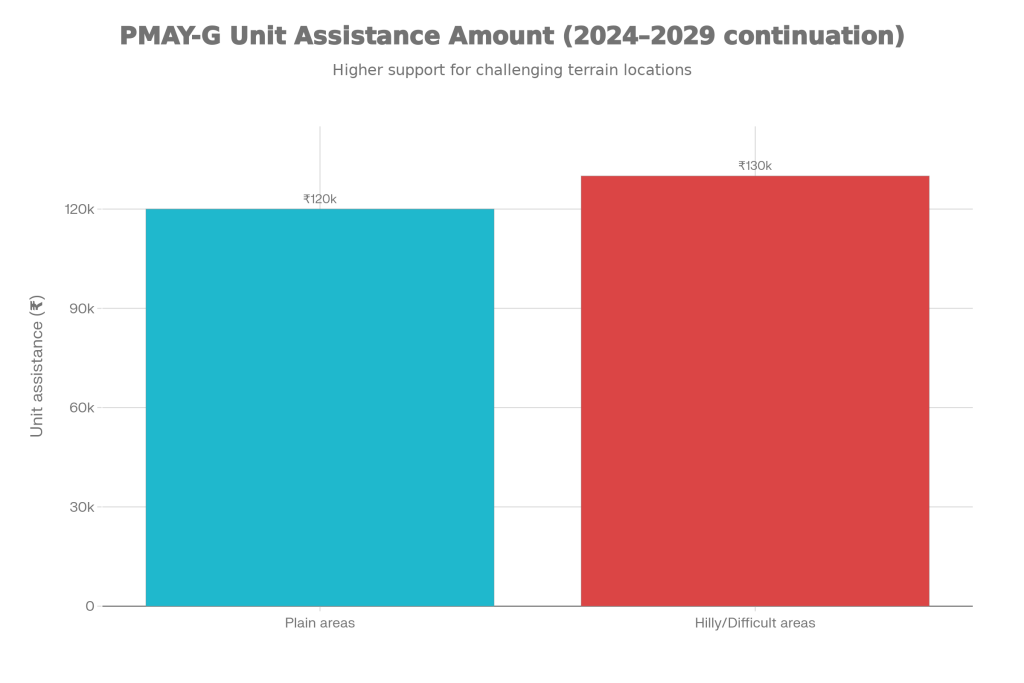
The most searched question is straightforward: how much support is available, and who gets it. As per the PIB information on PMAY-G, unit assistance continues at ₹1.20 lakh for plain areas and ₹1.30 lakh for hilly/difficult areas (including specified regions) as existing rates. But here’s the practical reality: the amount is linked to being found eligible and getting approved through the verification chain. So, if someone claims, “survey done means ₹1.20 lakh confirmed,” treat that as misinformation. Your goal should be to get your details captured accurately, complete e-KYC, and ensure your case survives Panchayat corroboration and subsequent checks.
A simple checklist that helps most households:
- Keep identity and household details consistent across documents.
- Provide accurate housing condition inputs.
- Ensure photos are clear and truthful.
- Complete e-KYC early.
- Follow up locally if corrections are needed.
Aadhaar Update 2025: How to Change Name, Address, Mobile Number, or DOB Online
Survey App Safety And Precautions
One clear warning: you should not have to pay anyone to “add your name.” The process involves survey capture, corroboration, and verification steps, so shortcut promises are often a sign of fraud.
Practical precautions:
- Do not share OTPs with anyone claiming to be an “agent.”
- Write down what details were provided during the survey so you can cross-check if something looks wrong later.
- If e-KYC is pending, don’t assume it will “auto-fix.” Follow up.
- If you need corrections, approach the Gram Panchayat/Block office as early as possible.
FAQs on PM Awas Yojana Gramin Survey 2025
Q1. What is PM Awas Yojana Gramin Survey 2025?
It is the process of identifying and updating records of eligible rural households under PMAY-G so that genuine beneficiaries can be considered in the updated list.