

India’s villages are changing quickly. Farming is no longer limited to traditional tools or manual pesticide spraying. Technology is entering the fields in practical ways, and this time rural women are leading the change. The government’s Namo Drone Didi Yojana is a strong example of how modern technology can create livelihood opportunities.
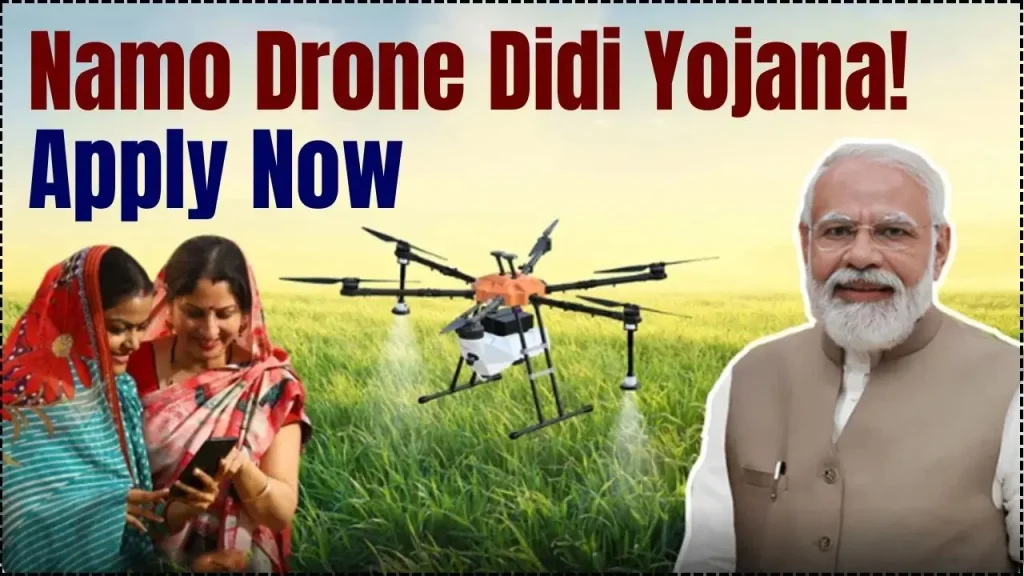
Through the Namo Drone Didi Yojana, women from self-help groups are being trained to operate agricultural drones and earn income by providing services to farmers in their own communities. At its core, the Namo Drone Didi Yojana is not just an agriculture initiative. It is a rural employment and women empowerment programme. Instead of depending only on seasonal farm wages, women now get a steady earning opportunity as trained drone operator. The scheme aims to transform rural women into service entrepreneurs who offer spraying services, crop monitoring, and precision farming support to nearby farmers. For many villages, this is the first time women are working directly with advanced technology and managing a business.
The Namo Drone Didi Yojana is a central government programme designed to provide agricultural drones to women Self-Help Groups (SHGs). Under the scheme, selected women receive structured training in drone operations, safety procedures, and basic maintenance. After training, the SHG is given a highly subsidized drone, which they use to offer pesticide and fertilizer spraying services to farmers. This creates a practical rural business model. Farmers save labor and time, and women earn income from service charges. The programme also supports precision agriculture, reduces chemical exposure, and improves crop productivity. By combining skill training, subsidy support, and technology adoption, the scheme promotes both agricultural efficiency and financial independence.
Namo Drone Didi Yojana
| Particular | Details |
|---|---|
| Scheme Name | Namo Drone Didi Yojana |
| Launched | 2023 |
| Ministry | Ministry of Agriculture & Farmers Welfare |
| Beneficiaries | Women Self-Help Groups |
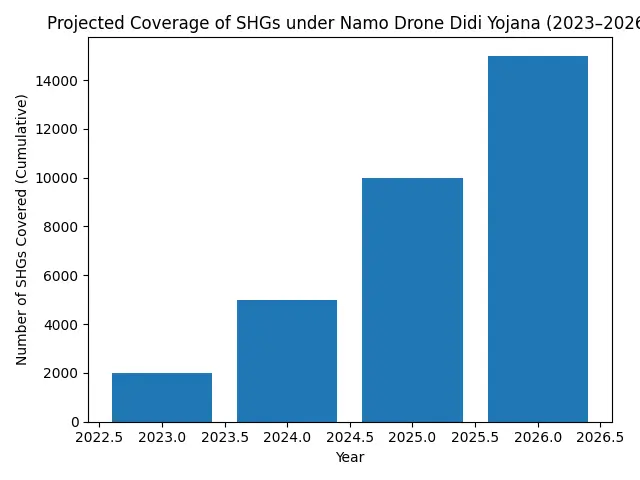
| Target Coverage | Around 15,000 SHGs by 2026 |
| Government Outlay | About ₹1,200 crore+ |
| Subsidy | Up to 80% of drone cost (approx ₹8 lakh cap) |
| Purpose | Drone spraying and rural livelihood |
| Training | Drone pilot and maintenance training |
| Income Source | Service charges from farmers |
The programme shows that rural empowerment and technology can move together. As more SHGs participate in the Namo Drone Didi Yojana, agriculture is becoming faster, safer, and more productive. Most importantly, it is changing social attitudes. Women are no longer just helping in agriculture. They are managing operations, operating drones, and running service businesses. The fields may still be the same, but the way they are managed has changed. In many villages today, crops are protected from the sky, and the operators controlling that technology are rural women building their own economic future.
What is the Namo Drone Didi Yojana?
- The Namo Drone Didi Yojana provides drones to women SHGs so they can operate agricultural spraying services in nearby villages. Traditionally, pesticide spraying is slow, physically demanding, and risky due to chemical exposure. A drone changes this completely. It sprays crops evenly within minutes and covers large areas quickly.
- The drone is owned collectively by the self-help group. Some women become trained pilots, others manage bookings, and a few handle accounts and coordination. This structure turns a simple rural group into a small service business.
- The drones are used for fertilizer spraying, pesticide spraying, crop monitoring, and precision agriculture support. Because spraying becomes more accurate, farmers use fewer chemicals and save money.
Objectives Of the Namo Drone Didi Yojana
- The programme was designed with both social and agricultural goals in mind.
- Women empowerment is the primary objective. Rural women gain technical skills and become financially independent.
- Employment generation is another key aim. The Namo Drone Didi Yojana creates non-farm rural jobs and reduces migration to cities.
- Safer agriculture is also important. Farmers avoid direct exposure to harmful chemicals because spraying is done by drones.
- Better productivity is achieved through uniform spraying and proper dosage of fertilizers.
- Technology adoption in villages increases, helping agriculture become modern and efficient.
Key Features of Namo Drone Didi Yojana
Subsidy Support
The government provides major financial assistance. Self-help groups receive up to 80 percent subsidy on drone purchase. This makes expensive technology affordable in rural areas.
Collective Ownership
The drone belongs to the entire SHG instead of a single person. This reduces financial risk and ensures that the income is shared among members.
Service Business Model
Women do not use the drone for their own fields alone. They offer services to other farmers and charge per acre. This makes the Namo Drone Didi Yojana a rural entrepreneurship opportunity rather than a simple welfare scheme.
Training And Implementation
- Training is the backbone of the programme because most beneficiaries have never handled advanced machinery before.
- Participants learn drone flying, navigation, battery management, and safety rules. They are also taught basic repair and maintenance so they can handle minor technical issues themselves. Agricultural experts guide them on proper spraying techniques and crop protection methods.
- Training is conducted by authorized drone companies and agricultural institutions. It usually lasts about two weeks. After completing the course, participants receive certification as drone operators.
- The Namo Drone Didi Yojana also ensures technical support so women feel confident using the equipment. This step is important because long-term success depends on proper usage and maintenance.
Eligibility Criteria for Namo Drone Didi Yojana
- Women cannot apply individually.
- To qualify, the applicant must be a member of a registered Self-Help Group.
- The SHG should be linked with a rural livelihood mission.
- Preference is often given to rural women from agricultural communities.
- Basic literacy helps in learning drone operations, although advanced education is not required.
- The focus on group participation ensures that multiple families benefit rather than a single household.
How Women Can Apply
The application process is straightforward.
- First, the woman must be part of a registered self-help group. The group then contacts the Block Development Office, Agriculture Department, or rural livelihood mission office. Authorities review the readiness of the group and shortlist eligible SHGs.
- Selected members are nominated for training. After successful training and certification, the government provides a subsidized drone to the group.
- Local officials and district agriculture departments usually guide the entire process, so applicants do not need to manage complicated paperwork.
Benefits For Women
The scheme offers real economic change in rural areas.
- Women earn regular income by charging farmers for spraying services. In many areas, annual earnings can reach around one lakh rupees or more depending on demand.
- They gain technical skills and become trained drone pilots, a rare skill in villages. This improves their confidence and decision-making role in families.
- Social status improves significantly. Women are recognized as professionals rather than laborers.
- Health safety is another major benefit because they no longer come into direct contact with harmful pesticides.
Benefits For Farmers
- Farmers also benefit greatly from the Namo Drone Didi Yojana.
- Spraying becomes faster and more efficient. Uniform application improves crop health. Labor costs are reduced because manual spraying requires multiple workers. Fertilizer wastage decreases and yields often improve.
- A drone can spray several acres within minutes, which normally takes hours by hand.
Economic and Social Impact
The impact of the programme goes beyond income.
- Self-help groups become rural service enterprises. Villages begin adopting digital and precision agriculture. Women start managing finances, bookings, and technical operations.
- The scheme also encourages environmental protection because controlled spraying reduces excessive chemical use. Rural youth and farmers become more open to modern technology.
- In many villages, the presence of a drone service has changed how agriculture is perceived. Farming is now seen as a profession connected with innovation rather than just manual labor.
Challenges
- Like any new programme, there are practical challenges.
- Maintenance costs can be high if equipment is damaged. Remote areas sometimes lack reliable electricity for battery charging. Some farmers initially hesitate to try new methods. Weather conditions such as heavy wind or rain can also delay operations.
- However, training support and increasing awareness are gradually solving these problems. As adoption grows, service demand is also rising.
The Namo Drone Didi Yojana represents a new approach to rural development. Instead of offering only subsidies or short-term assistance, it creates skills, confidence, and a long-term earning opportunity. Women gain independence, farmers get modern agricultural services, and villages access advanced technology without heavy investment.
FAQs on Namo Drone Didi Yojana
Who Can Apply for Namo Drone Didi Yojana?
Only women who are members of registered Self-Help Groups linked with rural livelihood missions are eligible to apply.
How Much Subsidy Is Provided Under The Scheme?
The government provides up to 80 percent subsidy on drone purchase, capped at around eight lakh rupees.
Is Training Provided to Beneficiaries?
Yes. Selected participants receive professional drone pilot training along with safety and maintenance guidance.
How Do Women Earn Money from The Scheme?
They provide pesticide and fertilizer spraying services to farmers and charge fees based on the land area covered.