
A nationwide overhaul of Minimum Balance Rules across major banks is reshaping India’s retail banking system, with State Bank of India (SBI), Punjab National Bank (PNB) and HDFC Bank revising savings account requirements, penalty structures and zero-balance eligibility as regulators push broader financial inclusion and digital payments adoption.
Minimum Balance Rules
| Key Fact | Detail |
|---|---|
| PNB penalty change | No penalty for failing to maintain minimum balance in savings accounts |
| SBI requirement | Minimum balance depends on rural, semi-urban, or metro branch category |
| RBI direction | Zero-balance Basic Savings Bank Deposit Accounts allowed |
Why the Minimum Balance Rules Matter
For decades, Indian banks required customers to maintain a fixed Average Monthly Balance (AMB) in savings accounts. When balances fell below the threshold, banks deducted penalty charges automatically.
For wealthier customers, the rule was rarely noticed. But for millions of lower-income households, the deductions often erased small savings.
Consumer groups, banking ombudsman complaints, and financial literacy surveys repeatedly showed the same pattern: penalties discouraged people from using formal banking.
The Reserve Bank of India (RBI), the country’s central monetary authority, gradually moved to address the issue. The central bank promoted Basic Savings Bank Deposit Accounts (BSBDA) — accounts that require no minimum balance while still offering core services.
An RBI official said the policy objective is straightforward: “Every citizen must have access to a functioning bank account, not just the ability to open one.”
How Minimum Balance Rules Work
Banks calculate minimum balance requirements differently from many customers’ expectations. The rule is not based on the lowest daily balance but on the monthly average.
Example
If a bank requires ₹3,000 minimum balance:
- ₹5,000 for 15 days
- ₹1,000 for 15 days
Average balance = ₹3,000 → No penalty.
However, if the average drops below the threshold, a fee applies.
This system, designed for banking stability, often confused customers unfamiliar with monthly averaging.
Changes at Punjab National Bank
Removal of Penalties
State-owned Punjab National Bank (PNB) has taken the most consumer-friendly approach by eliminating penalties for non-maintenance of minimum balance in many savings accounts.
Customers can maintain very small balances without deductions.
The change particularly benefits:
- pensioners
- students
- rural households
- irregular income earners
Banking analysts say public sector banks are responding to both regulatory pressure and competitive dynamics.
Government-backed banks increasingly serve as the backbone of India’s welfare transfer system. Social benefits, fertilizer subsidies, pensions and scholarships are deposited directly into bank accounts. Removing penalties prevents those payments from shrinking.
State Bank of India: A Tiered System Remains
India’s largest lender, State Bank of India (SBI), has retained Minimum Balance Rules but modified enforcement.
The bank uses a geographic classification system:
| Branch Type | Typical Balance Requirement |
|---|---|
| Rural | Lowest |
| Semi-Urban | Medium |
| Metro | Highest |
SBI now notifies customers before charging penalties via SMS and mobile banking alerts.
Customers also may convert accounts into BSBDA zero-balance accounts if they prefer.
A former public sector banking executive explained the approach:
“Large banks carry huge operational costs. Removing all balance requirements instantly is difficult. Instead, SBI softened penalties and expanded alternatives.”
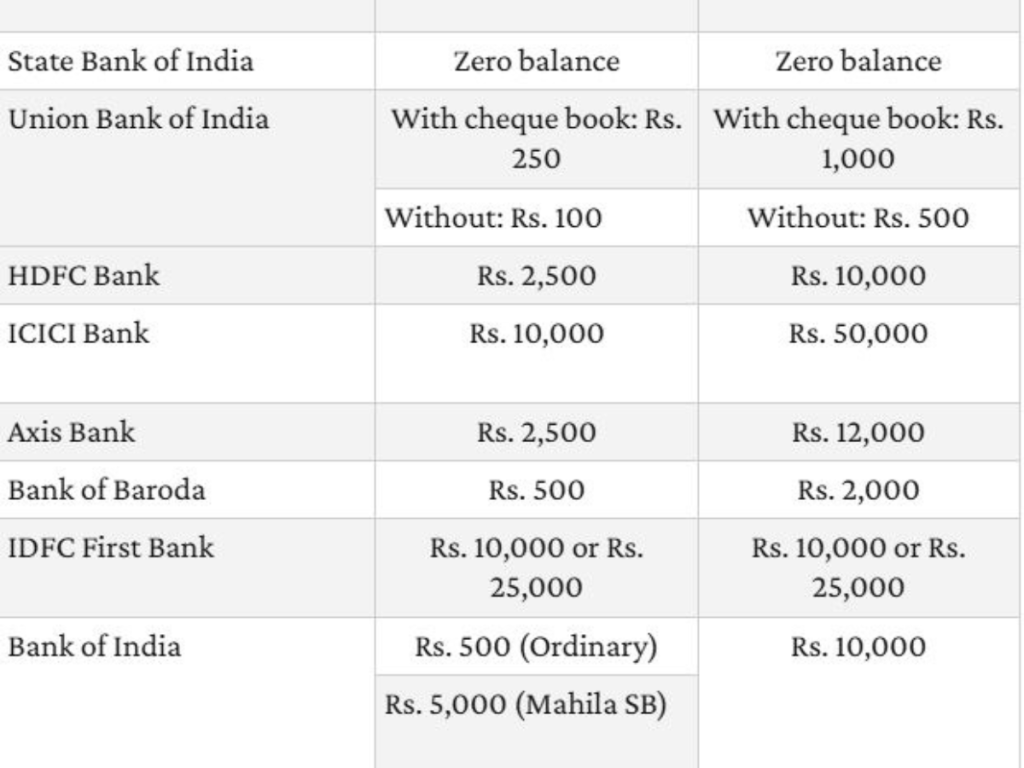
HDFC Bank: Disclosure and Transparency
Private lender HDFC Bank continues to enforce Minimum Balance Rules for standard savings accounts, especially in urban and metro locations.
However, the bank has strengthened communication:
- SMS warnings
- mobile app alerts
- monthly statements
- penalty breakdowns
Customers now receive advance notice rather than discovering deductions afterward.
Private banks depend heavily on deposits to support lending. Financial analysts say minimum balance policies help maintain stable funding for home loans, car loans and small business financing.
RBI’s Financial Inclusion Strategy
India’s banking reforms are tied to a long-term national strategy: bring every adult into the formal financial system.
Over the last decade:
- millions opened accounts under financial inclusion programs
- direct benefit transfers expanded
- UPI digital payments surged
The Minimum Balance Rules reform ensures those accounts remain usable.
BSBDA accounts provide:
- debit card access
- ATM withdrawals
- digital payments
- government transfers
Crucially, they do not require a minimum balance.
Digital Payments and Banking Behavior
India now processes billions of UPI transactions monthly. As mobile banking increases, regulators worry less about branch-based accounts and more about active usage.
Low-income users often maintain fluctuating balances. Strict Minimum Balance Rules historically caused accounts to become inactive after repeated deductions.
Financial technology researchers say reducing penalties increases digital adoption because customers are less afraid of losing money to fees.
International Comparison
India is not alone in revising minimum balance requirements.
- In the United States, many banks offer “basic checking” accounts with no minimum balance but monthly service fees.
- In the United Kingdom, basic bank accounts are mandated for financially vulnerable customers.
- In Brazil, public banking programs also expanded no-fee accounts to support social payments.
India’s difference lies in scale. Hundreds of millions of accounts are involved, making policy changes economically significant.
Consumer Impact
The effect varies by customer group.
Urban Salaried Workers
Mostly unaffected except for improved transparency.
Students
Benefit from fewer penalties and easier account maintenance.
Rural Households
Major beneficiaries because balances fluctuate with seasonal income.
Pensioners
Gain protection from deductions after receiving fixed payments.
Consumer rights advocates say the reform may also increase savings behavior because small balances are no longer eroded by fees.
Practical Steps for Customers
Experts recommend customers:
- Identify account type
- Check required average monthly balance
- Enable SMS alerts
- Ask bank about BSBDA conversion
- Monitor statements monthly
Banks must process account conversion requests without forcing customers to close accounts.
Why Banks Still Need Deposits
Banks earn profits by lending deposited money. Stable deposits reduce borrowing costs for banks.
Private lenders therefore maintain stricter Minimum Balance Rules because:
- deposits fund loans
- predictable balances reduce liquidity risk
- operational costs must be covered
Public banks, backed by government ownership, can prioritize access over profitability.
What Happens Next
Analysts expect further changes.
Possible developments:
- simplified savings accounts
- app-based micro-accounts
- tiered service pricing
- wider zero-balance eligibility
Digital banking may eventually replace the traditional minimum balance model entirely.
A banking policy expert summarized the shift:
“The future is activity-based banking, not balance-based banking.”
Outlook
The Minimum Balance Rules reforms represent a structural shift in Indian banking. Regulators are trying to ensure accounts remain functional, not merely open.
Financial inclusion policy now focuses on usability — ensuring citizens keep accounts active and participate in the digital economy.
A senior banker described the goal simply: “The system works only when people trust that their money will stay in their account.”
FAQs About Minimum Balance Rules
Can I avoid minimum balance penalties completely?
Yes. Convert your account into a Basic Savings Bank Deposit Account.
Will my debit card stop working?
No. Zero-balance accounts still include core banking services.
Are private banks likely to remove the rule?
Unlikely in the near term, but transparency and flexibility are increasing.
Is a salary account affected?
Salary accounts usually have no minimum balance requirement as long as salary is credited regularly.