

Millions of families relying on food assistance are bracing for a major shift: federal officials have signaled that every current SNAP household may be asked to submit a fresh application, not just go through the usual recertification. In plain terms, this means a full eligibility redo income checks, ID verification, household updates, rent and utility proofs, the works. The stated aim is to tighten program integrity, reduce improper payments, and rebuild how the safety net is managed. For recipients, the practical impact could be new timelines, heavier documentation, and more pressure to stay organized, so benefits don’t lapse.

SNAP reapplication requirement appears to be the operative phrase behind these changes, and it’s the lens through which every household should plan its next steps. If an across-the-board reapplication does roll out, states will need to process a surge of files. That introduces a real risk of procedural denials people losing benefits not because they’re ineligible, but because forms were late, incomplete, or stuck in a backlog. The best antidote is readiness: gather proof of income, housing costs, utilities, and identity now, keep copies, and watch for official notices from your state agency. Until formal directions arrive, continue to meet all current recertification deadlines, respond promptly to requests for information, and, if applicable, document work hours or qualifying exemptions.
In practical terms, a universal reapplication would differ from the normal renewal cycle by requiring every current recipient to file a new, full application within a defined window. That means submitting updated pay stubs or benefit letters, proof of rent or mortgage, utility bills, IDs for adult members, and documentation for children or other household members as required. If your situation changed new job, lost hours, moved apartments expect to document those shifts clearly. If you’re subject to work requirements, maintain accurate records of hours, approved training, or exemptions. And don’t ignore mail: official letters will specify your timeline and the exact documents your state needs.
Millions on SNAP Could Be Affected
| Item | What It Means For You |
|---|---|
| What’s Changing | A potential one-time, nationwide reapplication for all current SNAP households, beyond routine recertification. |
| Why It’s Changing | Fraud prevention, data integrity, and a broader “rebuild” of how eligibility is verified and maintained. |
| Who’s Affected | Virtually all current recipients tens of millions if a nationwide directive is finalized and implemented. |
| Timing | Details and dates will be set by federal guidance and state implementation; until then, follow current renewal rules. |
| What To Prepare | Income proofs, rent/mortgage statements, utility bills, IDs, household composition documents, and work/training records if applicable. |
| Risks To Plan For | Backlogs, call-center delays, procedural denials due to late or incomplete filings, and stricter work-rule enforcement. |
| Mitigation Steps | Organize documents early, keep copies, use online portals where available, and respond quickly to any state notices. |
Treat the SNAP reapplication requirement as a real possibility and get your documents in order now. Keep up with current recertifications, monitor official notices, and be ready to upload a complete, clearly labeled packet at short notice. If work rules apply to you, lock down your hours or an approved activity and save records. In a high-volume push, preparedness is the difference between uninterrupted benefits and avoidable gaps.
What Officials Are Signaling
Public statements point to a program-wide reset grounded in fraud prevention and data cleanup. The message is that business as usual is over, with leadership framing a “fundamental rebuild” of how eligibility is verified. While that language is sweeping, remember that SNAP is administered through state systems; execution will depend on state capacity, staffing, and technology. Expect specifics to arrive through formal notices, policy guidance, and state-level implementation plans. Until then, it’s about preparation and vigilance especially for households with complex income or living situations.
How Many People Could Be Impacted
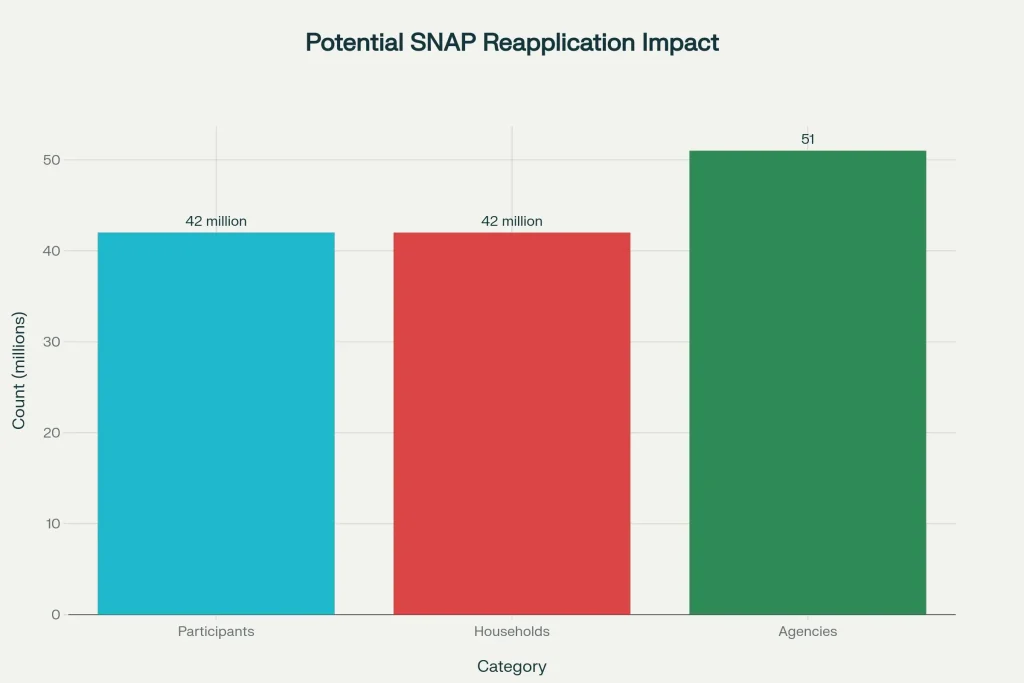
SNAP serves roughly 42 million people in a typical month, and a blanket reapplication would touch nearly all of them. That scale is why advocates and administrators are concerned about volume: caseworkers can only process so many applications per week. If timelines are compressed, delays become likely. For recipients, that means the difference between a smooth renewal and a gap in benefits may come down to whether documents are ready, readable, and submitted early. If your state offers online uploads, learn the portal now, save PDFs, and verify submissions are marked received.
Why This Is Happening Now
Several forces are converging. First, a high-profile push on program integrity and improper payments has elevated the priority of verification and cross-state data matching. Second, the policy pendulum has swung away from pandemic-era flexibilities toward stricter enforcement of eligibility and work requirements. Third, recent funding fights and legal pressures have made monthly issuance planning more volatile, which, in turn, amplifies the drive for uniform, defensible eligibility files. A one-time reapplication offers a clean baseline at the cost of significant administrative strain and potential temporary losses for otherwise eligible families.
Reapplication vs. Recertification
Think of recertification as a scheduled check-in where the state updates your file; a reapplication is a full restart. Recertification often accepts shorter forms and selective updates. Reapplication requires a complete form, fresh verification, and a full eligibility determination. If you’re used to quick phone renewals or short online updates, expect more steps and more evidence. Build a simple checklist for your household: IDs, Social Security numbers where applicable, pay stubs or benefits letters for the past 30–60 days, lease or mortgage statement, most recent utility bills, child care or medical expense proofs if counted, and any documents tied to work or training.
Work Requirements and Exemptions
Alongside the SNAP reapplication requirement conversation, states are preparing for tighter work rules for able-bodied adults without dependents. Some age brackets and categories may be newly affected, and waivers are likely to be narrower. If you’re in scope, the safest path is to track hours diligently or enroll in an approved work, education, or training program. Verify whether you qualify for an exemption such as certain medical limitations, caregiving responsibilities, homelessness, veteran status, or age-related exemptions and keep documentation ready to submit. During any reapplication or renewal, clearly indicate exemptions and attach proofs so caseworkers can code your case correctly.
What Recipients Should Do Now as Millions on SNAP Could Be Affected
- Get documents in order: photo IDs, Social Security numbers where applicable, proof of income, rent/mortgage, utilities, and any deductible expenses.
- Create digital copies: scan to PDF or take clear photos; name files by type and date; store them in a single folder for quick upload.
- Learn your state portal: set up your account, confirm your email and phone, and practice uploading a test document where allowed.
- Watch for mail and texts: states increasingly use text or email for reminders; respond fast to any request for information.
- Keep a timeline: note your normal recertification date, and if a reapplication directive arrives, pencil in internal deadlines a week early to avoid last-minute issues.
- Track work activity: if subject to time limits, log hours or participation in approved programs, and keep attendance or pay records.
What States and Advocates Are Watching
Agencies are modeling staffing needs, overtime costs, and portal capacity to absorb a reapplication surge. Some may stagger submission windows by alphabet or case number to avoid system overloads. Advocates are prioritizing clear communications, multilingual notices, and support for seniors, people with disabilities, and households without reliable internet. The overarching concern is preventing “procedural churn” eligible families losing aid due to missed mail, confusing forms, or technical errors. Expect pushes for grace periods, call-back systems, and community-based assistance to help people complete applications correctly the first time.
Trending Updates on SNAP
Expect phased guidance that clarifies the who, when, and how: which households must reapply first, acceptable forms of documentation, how phone interviews will be handled, and whether any temporary extensions are available. Also look for direction on alignment with work-rule enforcement so recipients aren’t whipsawed by overlapping deadlines. For households, the most reliable strategy is to assume higher scrutiny, prepare a complete packet, and submit early. If a decision is delayed beyond your current certification end, contact your agency to confirm interim coverage policies and whether additional information is needed.
Action Plan Checklist for Households
- Confirm your current certification end date.
- Assemble a document packet: IDs, SSNs (if required), income, rent/mortgage, utilities, childcare/medical expense proofs.
- Create digital backups and store them in one folder.
- Open or update your state benefits portal account.
- Turn on email and text alerts; add your agency’s number to contacts.
- If subject to work rules, secure enrollment in an approved activity or line up verifiable hours.
- Set two reminders: one for the agency’s deadline, one seven days earlier for your household deadline.
- After submitting, check status weekly and promptly answer any requests for more information.
FAQs on Millions on SNAP Could Be Affected
Is everyone on SNAP going to have to reapply?
Officials have signaled that a universal reapplication could be required. Until formal instructions arrive from your state, continue following your normal renewal schedule and respond to all agency requests.
When will the reapplication start?
Specific dates haven’t been finalized publicly. Watch for official notices and expect states to sequence submissions to manage volume.
What documents will I need if reapplication begins?
Plan on a full set: proof of identity, household composition, Social Security numbers if required, income (pay stubs, award letters), rent or mortgage, utilities, and any deductible expenses like childcare or certain medical costs.
Are work requirements changing alongside this?
Yes, enforcement is tightening for more adults, with fewer waivers. If you’re subject to time limits, document hours or enroll in approved work, education, or training, and check whether you qualify for an exemptions.