
If you’re planning to buy or sell property in 2025, New Land Registry Rules 2025 is the one update you can’t ignore. Under New Land Registry Rules 2025, registration is no longer just about submitting a thick file of papers it’s about passing strict digital checks that confirm who you are and whether the property record is genuine. The bigger shift is simple: the process is moving away from paperwork heavy routines and into verification backed by digital identity checks and verified land records. That means fewer loopholes for fake sellers, disputed ownership claims, and forged documents but it also means genuine buyers and sellers must prepare earlier than before.
New Land Registry Rules 2025 changes the mindset of property registration from “submit documents at the counter” to “get verified before you even reach the counter.” The rule is designed around two checks: identity verification of both parties and a verified digital property record that confirms authenticity and ownership. This matters because property fraud, disputed ownership, and fake documentation have been persistent problems in many areas. With New Land Registry Rules 2025, the goal is to restore trust in transactions by making sure the system cross checks details digitally instead of relying only on manual inspection.
Land Registry Rule 2025
| Topic | What’s New In 2025 | What It Means For You |
|---|---|---|
| Core requirement | Two mandatory documents | Without them registration won’t move forward |
| Identity proof | Updated digital identity verification of buyer and seller | Helps block impersonation and forged IDs |
| Property proof | Verified digital property record from land record authority | Confirms property exists and belongs to seller |
| Process flow | Upload and verify before visiting office | Appointment only after successful verification |
| Strictness | No exceptions for mistakes | Small mismatches can delay or reject the case |
| Transparency | More digital tracking of the application | Fewer hidden steps and better status visibility |
| Fraud control | Stronger validation before acceptance | Reduces chances of fake sales and duplicate claims |
Mandatory Documents Under New Rules
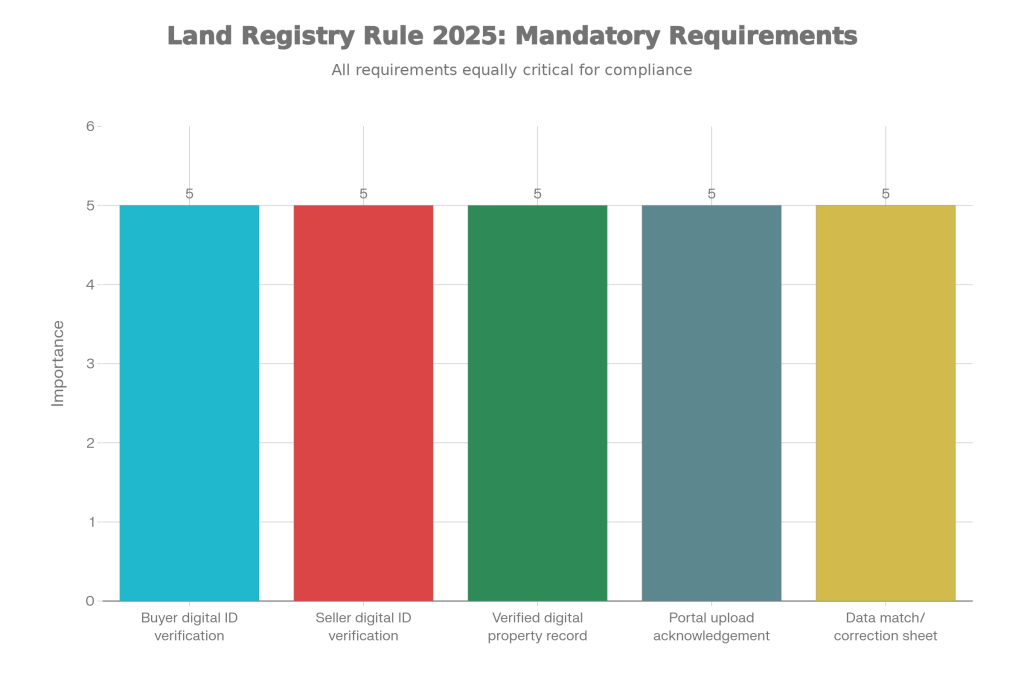
At the center of New Land Registry Rules 2025 are two mandatory documents. Think of them as the “entry ticket” to the registration process. If either one is missing or doesn’t pass verification, your file may not even reach the stage where the sub registrar can review it.
Identity Verification For Buyer And Seller
- The first requirement is updated digital identity verification for both buyer and seller. The idea is direct: authorities want to confirm in real time that the people signing the deal are the real parties, not stand ins using forged IDs or false names.
- In practical terms, this means your identity data must be consistent across systems. If you have spelling differences in name, an old address that doesn’t match, or outdated KYC information, you may face delays. Under New Land Registry Rules 2025, it’s smarter to fix these issues before you even schedule the registry date.
Verified Digital Property Record
- The second mandatory document is a verified digital property record issued by the official land record authority. This is not just a printout someone hands you. It’s meant to be an authenticated record that confirms the property exists, the seller’s ownership is recorded, and key details like survey number, plot boundaries, and ownership chain are available for checking.
- This step targets one of the biggest reasons for property disputes: buyers relying on informal or outdated paperwork. Under New Land Registry Rules 2025, the registry office expects the property record to be verified in a way that can be cross checked digitally.
Why These Two Documents Matter So Much
Earlier, many people treated registry as a paperwork event. You carried documents, signed in front of officials, paid stamp duty, and got the deed registered. Now, New Land Registry Rules 2025 pushes the system to behave more like banking or income tax processes where verification happens before approval. That one change increases accountability. It also reduces the chance that a person with incomplete rights or disputed ownership sells property, because verified records and identity checks become the gatekeepers.
Digital Verification Process For Land Registry Rule 2025
New Land Registry Rules 2025 is not only about what documents you submit, but also about when and how you submit them. The biggest operational change is the pre verification stage that happens before your office visit.
Step 1 Upload Documents on The Portal
- Both parties typically need to upload identity details and the verified digital property record on the official portal. This is important because the system uses uploaded data as the baseline for matching information across databases.
- If the portal asks for specific formats or file sizes, follow them strictly. A lot of rejections in digital systems happen due to avoidable technical mistakes like unreadable scans or incomplete uploads.
Step 2 Automated Cross Checking
After uploading, the system cross checks details with relevant databases. This is where New Land Registry Rules 2025 becomes stricter than before. Earlier, clerical staff might ignore small mismatches or accept an affidavit. Now, the system expects a clean match.
Common mismatch areas include:
- Name variations like Kumar versus Kumaar
- Different initials in old records
- Survey number formatting differences
- Ownership history not updated due to mutation pending
- Address differences between identity records and registry application
Step 3 Appointment And Office Visit
- Once verification is successful, you can book an appointment for the registry. The office visit then becomes shorter and more focused, because the initial verification has already been completed.
- This change can reduce crowding and waiting time, but only if you do the homework early. If you wait until the last week of a deal and then discover mismatches, the transaction may get delayed.
Step 4 Final Registration and Record Update
- After signatures and formalities, the registered deed is processed. In many cases, the goal is to create better linkage between registration and land record updates so the system reflects ownership more accurately over time.
- While the exact flow can vary state to state, New Land Registry Rules 2025 clearly pushes toward more consistent digital records and fewer manual loopholes.
Impact On Buyers and Sellers
New Land Registry Rules 2025 affects both sides of a deal in different ways. The best way to understand it is to see it as a shift from document submission to verification readiness.
What Buyers Should Expect
- For buyers, the biggest benefit is safety. Verified digital property records reduce the chance of walking into disputed ownership, fake seller identity, or manipulated documents.
- However, buyers also have a new responsibility: don’t assume the seller’s paperwork is enough. Ask early for the verified digital property record and confirm the identity data matches what will be used in registration. If you wait until the final day, you risk losing time, token money, or even the deal.
- Buyers should also treat this as a reason to do better due diligence such as checking encumbrances, pending litigation, and mutation status. New Land Registry Rules 2025 helps, but it doesn’t replace smart verification.
What Sellers Should Expect
- For sellers, clean records become the biggest asset. If your land record is updated and your identity details are consistent, the process can actually become faster because fewer questions are raised during registry.
- But sellers with old records, inheritance based ownership, or pending mutation might face delays. In those cases, it’s better to complete corrections and updates first instead of rushing into an agreement.
What Real Estate Agents And Brokers Should Expect
Agents and brokers will need to adapt too. Deals that relied on quick registry dates without deep verification will become harder to close. Under New Land Registry Rules 2025, the broker’s role shifts toward helping clients prepare verification ready documents rather than only coordinating visits. That’s good for professional agents because it improves trust, but it can squeeze out shortcuts.
Implementation Timeline and Compliance
New Land Registry Rules 2025 is positioned as a nationwide push starting in 2025, with states aligning their procedures to the central direction. In practical terms, rollout speed and portal readiness can differ by state, but the compliance mindset is the same.
No Exceptions for Errors
One of the most important signals in New Land Registry Rules 2025 is strictness. Minor mistakes that were earlier handled informally may now cause automated rejection or repeated delays.
So instead of thinking “we will fix it at the office,” it’s better to think “we must fix it before we upload.”
Training And Standardization
- Another key objective is standardization. Training of officials and better digital workflows aim to reduce the random experience people often face in different offices or districts.
- For the public, that should mean more predictable outcomes. For the system, it should mean fewer fraudulent registrations slipping through.
Surya Ghar Yojana 2025 – Install a 3KW Solar System at Just ₹1,800, See How Subsidy Works
What You Should Do Before You Finalize A Deal
If you are planning a transaction in 2025, here’s a practical checklist aligned with New Land Registry Rules 2025:
- Confirm your identity details are updated and consistent
- Collect and verify the digital property record early
- Check name spelling and survey number formatting carefully
- Resolve mutation or ownership history issues before booking dates
- Upload documents well in advance to avoid last minute surprises
FAQs on Land Registry Rule 2025
What Are the New Land Registry Rules 2025
New Land Registry Rules 2025 introduces a stricter digital verification first approach to property registration. It requires verified identity of both parties and an official verified digital property record, so registration happens only after key details match in the system.
Which Two Documents Are Mandatory for Property Registration In 2025
The two mandatory requirements are updated digital identity verification of buyer and seller and a verified digital property record issued by the land record authority. Without these, the registration process may not proceed.
Can Registration Be Rejected for Small Mistakes
Yes. Under New Land Registry Rules 2025, small mismatches in name spelling, survey number, or ownership history can cause delays or rejection. It’s best to correct records before uploading.
Do I Need to Upload Documents Before Visiting the Sub Registrar Office
Yes. A key change is portal-based upload and verification before an office appointment. The visit is expected to happen after the system validates your details.
How Can I Avoid Delay Under New Land Registry Rules 2025
Start early. Make sure identity details are updated, property records are verified digitally, and all key fields match exactly across documents. Upload documents ahead of time and fix mismatches before scheduling your registry date.