
In simple terms, JRFRY Scheme Explained How Jharkhand Farmers Can Apply for Crop Relief Support is about making sure that when nature hits your field, the government doesn’t leave you to manage everything alone. Jharkhand Rajya Fasal Rahat Yojana (JRFRY) works on a compensation-based model, not on a typical insurance policy structure. That means you do not pay anything in advance as premium, yet when an officially recorded natural calamity damages crops in your area beyond the specified limit, the government calculates compensation per acre and transfers it directly to registered farmers. This approach is especially useful for small and marginal farmers who cannot afford regular insurance premiums but still need solid support during a bad year.
When you see JRFRY scheme explained in detail, you realize it is a state-level crop relief scheme created to replace the conventional crop insurance model with something simpler and more farmer-friendly. Instead of involving private insurance companies, lengthy claim forms and fear of claim rejection, the state government itself assesses damage and pays compensation based on fixed slabs. Major crops of both Kharif and Rabi seasons, such as paddy, maize, wheat, mustard, gram and potato, are covered under this scheme in notified areas. When these crops are damaged due to drought, flood, hailstorm, pest attack or diseases, eligible farmers receive compensation per acre, usually in slabs like a lower rate for 30–50% loss and a higher rate for more than 50% loss, up to a certain acreage limit.
JRFRY Scheme
| Point | Details |
|---|---|
| Scheme Name | Jharkhand Rajya Fasal Rahat Yojana (JRFRY), a state crop relief scheme that replaces the usual insurance approach. |
| Objective | To provide crop relief support when registered farmers suffer yield loss due to drought, flood, hailstorm, pests or crop diseases. |
| Implementing Department | Department of Agriculture, Animal Husbandry and Cooperative, Government of Jharkhand. |
| Beneficiaries | Small, marginal and large farmers of Jharkhand, including eligible landowners and sharecroppers (bataidaar) under defined conditions. |
| Coverage Seasons and Crops | Major Kharif and Rabi crops like paddy, maize, wheat, mustard, gram and potato in notified areas. |
| Compensation Range | Generally around ₹3,000 per acre for 30–50% loss and about ₹4,000 per acre for more than 50% loss, usually up to 5 acres. |
| Premium Requirement | No premium is charged from farmers; the entire financial responsibility is taken by the state government. |
| Minimum Loss Threshold | Typically, a minimum crop loss percentage (often around 20–33%) at village or block level is required to trigger compensation. |
| Payment Mode | Direct Benefit Transfer into the farmer’s linked bank account after the claim is approved. |
| Application Mode | Online application through the official JRFRY portal or via nearby common service centres and facilitation centres. |
JRFRY Scheme Explained How Jharkhand Farmers Can Apply For Crop Relief Support is not just a formal government announcement, but a practical safety net for farmers when the weather turns hostile and crops fail. Farmers in Jharkhand often face losses due to drought, floods, untimely rain, hailstorms, pests or diseases, and this scheme is designed to give them timely financial relief so they can stand back on their feet and prepare for the next season instead of sinking into debt. The idea is simple: instead of asking farmers to pay any premium, the state steps in and compensates them directly when crop loss crosses a certain threshold in notified areas.
Eligibility Criteria And Benefits Of JRFRY Scheme
To truly understand JRFRY scheme explained in practical terms, eligibility is the first point to check. The farmer must be a permanent resident of Jharkhand and must be cultivating land within the state either as a landowner or, in some cases, as a sharecropper with proper consent and documents. The farmer’s name should be registered in the official Farmer Registration System, which acts as the base record for providing benefits. Basic requirements usually include being at least 18 years of age, having an Aadhaar-linked bank account, valid land-related documents like receipts or land possession certificates, and an active mobile number for communication and verification.
In the case of sharecroppers, the scheme may ask for a written consent or agreement between the landowner and the sharecropper to avoid disputes over who should receive the payment. On the benefits side, JRFRY Scheme Explained How Jharkhand Farmers Can Apply For Crop Relief Support makes it clear that the biggest advantage is “no premium, only relief.” Farmers do not lose money in years with no damage, and when there is significant crop loss due to notified events, they receive compensation calculated per acre. This helps cover essential costs like seeds, fertilisers and labour for the next season. The scheme treats small, marginal and larger farmers in a structured way so that the support does not remain limited to one category only.
Application And Claim Process Under JRFRY Scheme
A complete JRFRY scheme explained guide is incomplete without a clear view of the application and claim process. The first step is to get registered as a farmer on the official JRFRY portal. On the website, farmers need to complete their Farmer Registration by filling in details such as Aadhaar number, name, address, bank account information and land details. After successful registration, the farmer gets login credentials that can be used to access the profile and update crop information for different seasons.
When a particular season’s crop Kharif or Rabi gets affected by drought, flood, hailstorm or similar events, the farmer must inform the local agriculture office, block office or relevant field-level functionaries in time. Once such events are officially recorded, the administration conducts field surveys and crop cutting experiments to assess the extent of damage at village or block level. Based on this assessed percentage of loss, the area may be declared eligible for compensation under the scheme.
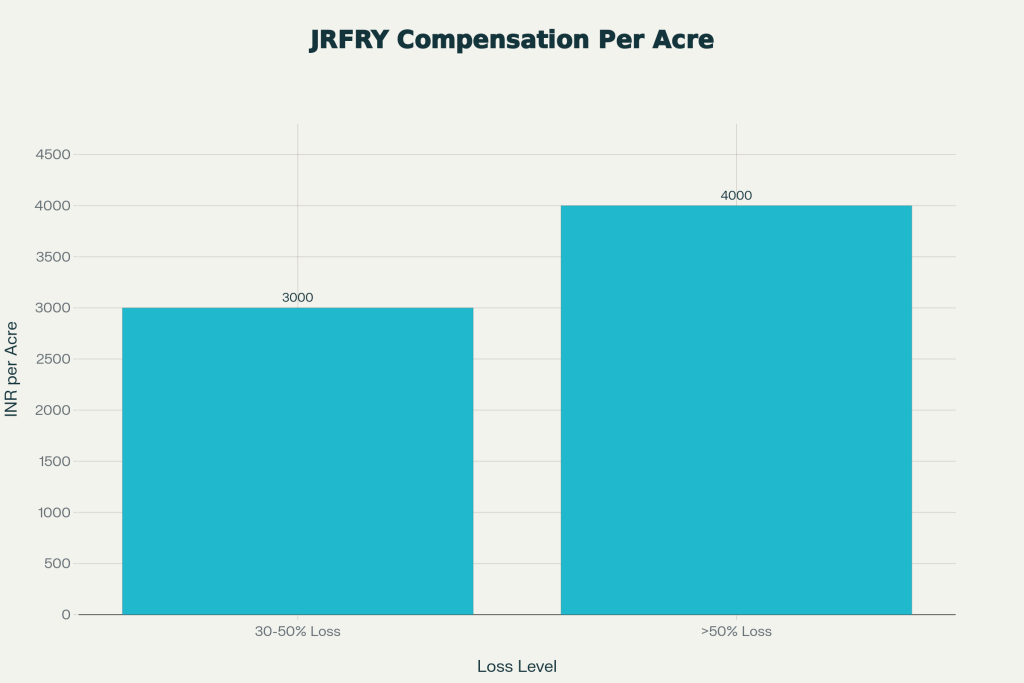
For farmers in that area who are already registered and whose crop data exists on the system, compensation is calculated according to the prescribed slabs and directly transferred into their bank accounts through Direct Benefit Transfer. Therefore, it is crucial to ensure that bank details in the registration are absolutely accurate and up to date.
लाड़ली बहनों को बड़ा तोहफा! अब ₹1500 नहीं, हर महीने मिलेंगे ₹5,000 अतिरिक्त, नया नियम जानें
Why JRFRY Is Different from Insurance
A common question is: if other crop insurance schemes already exist, why is JRFRY needed at all? The key difference, and the heart of JRFRY scheme explained, lies in the model. Traditional crop insurance runs through insurance companies. Farmers pay a premium, companies process claims, apply their own investigation rules and, sometimes, claims get delayed or rejected. Many small farmers hesitate to enter such systems due to cost and complexity.
JRFRY, on the other hand, is built as a compensation-based crop relief support model. There is no concept of an insurance policy or annual premium for the farmer. The state government itself bears the cost and takes responsibility for assessing damage and paying compensation as per rules. Damage assessment is done at local administrative levels using surveys and technical methods, and once an area is declared eligible, payments go directly to the registered farmers in that area. This removes the fear of losing money in premiums and reduces dependence on external companies. For small and marginal farmers, this difference is huge because it gives them a sense that the government stands firmly with them when they face a bad season.
FAQs on JRFRY Scheme
What is the main purpose of JRFRY?
The main purpose of JRFRY Scheme Explained How Jharkhand Farmers Can Apply for Crop Relief Support is to provide timely financial relief to registered farmers in Jharkhand when their crops are damaged by natural calamities or similar events, without asking them to pay any premium.
Is JRFRY a typical crop insurance scheme?
No, JRFRY is not a conventional crop insurance scheme. It is a compensation-based crop relief support model where there is no premium from farmers, and the state government directly pays compensation after assessing crop loss.
Who is eligible to apply under JRFRY?
Farmers who are permanent residents of Jharkhand, cultivating land within the state as landowners or accepted sharecroppers, registered in the Farmer Registration System and whose crops are affected by notified calamities, are generally eligible to receive benefits.
How can a farmer apply for JRFRY benefits?
Farmers need to complete Farmer Registration on the official portal, enter their land and crop details and ensure bank information is correct. When damage occurs, they should inform local authorities so that surveys can be conducted, and once the area is approved for relief, compensation is credited directly to their bank accounts.