

JRFRY 2025 Explained: How Jharkhand Farmers Can Claim Support Under the Fasal Rahat Scheme is a crucial topic for farmers in Jharkhand who depend on the monsoon and face heavy risks every crop season. When drought, floods, hailstorms, strong winds or pest and disease attacks destroy months of hard work, this scheme steps in as a safety net. By understanding JRFRY 2025 Explained: How Jharkhand Farmers Can Claim Support Under the Fasal Rahat Scheme properly, farmers can recover part of their losses and prepare for the next sowing season with more confidence. The major advantage is that they do not have to pay any premium; the state government directly provides compensation into their bank accounts.

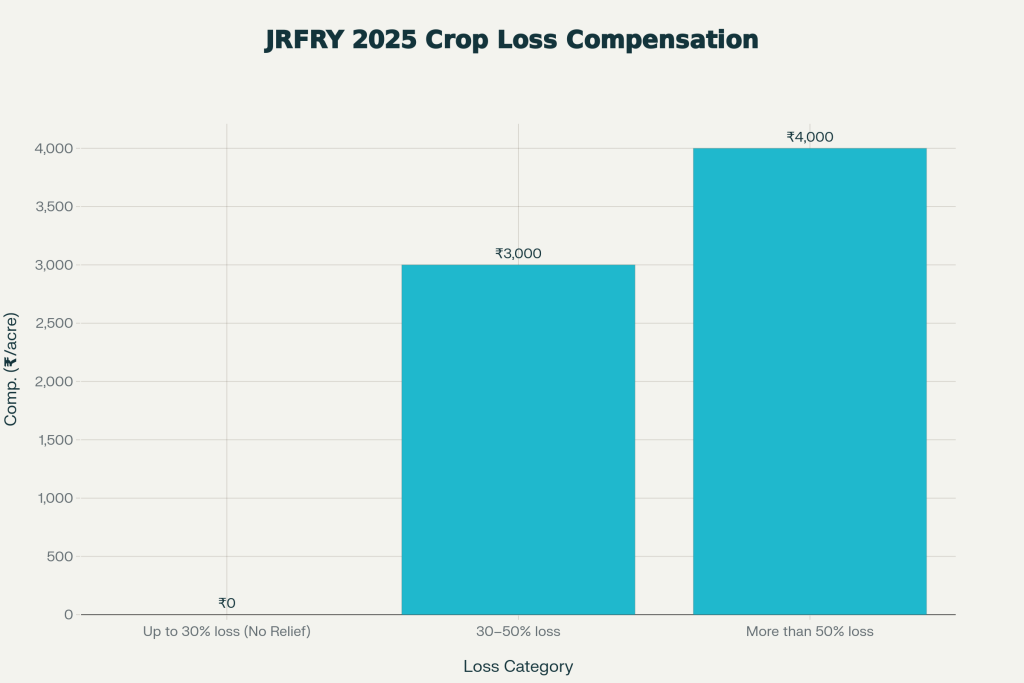
How Jharkhand Farmers Can Claim Support Under the Fasal Rahat Scheme, in simple terms, is a state-run crop relief scheme where the government itself assesses the crop loss and pays a fixed amount per acre to eligible farmers. There is no hassle of paying an insurance premium, filing long claims, or facing claim rejection. All categories of farmers in Jharkhand small, marginal, raiyat (land-owning) and bataidaar (sharecroppers) can come under this scheme if their Kharif or Rabi crops are damaged due to notified natural calamities. Typically, farmers get around ₹3,000 per acre for 30–50% crop loss and about ₹4,000 per acre for more than 50% loss, with a maximum limit of 5 acres. Because of this, many farmers now see JRFRY 2025 Explained: How Jharkhand Farmers Can Claim Support Under the Fasal Rahat Scheme as a real protective shield for their livelihood.
JRFRY 2025 Explained
| Point | Details |
|---|---|
| Scheme Name | Jharkhand Rajya Fasal Rahat Yojana (JRFRY) |
| Launched By | Government of Jharkhand, Department of Agriculture, Animal Husbandry & Cooperative |
| Main Objective | To provide direct financial relief to farmers when crops are damaged by natural calamities |
| Beneficiaries | Small, marginal, large, raiyat and bataidaar farmers of Jharkhand |
| Covered Crops | Kharif: Paddy, Maize; Rabi: Wheat, Mustard, Gram, Potato etc. |
| Covered Risks | Drought, flood, hailstorm, strong winds, pests and diseases causing crop loss |
| Assistance Amount | About ₹3,000/acre for 30–50% loss; about ₹4,000/acre for more than 50% loss (max 5 acres) |
| Premium | No premium for farmers; fully funded by state government |
| Minimum Loss | Generally, 20–30% or more crop loss due to natural calamities |
| Application Mode | Online through official JRFRY portal and nearby CSC centres |
| Payment Mode | Direct Benefit Transfer (DBT) to farmer’s bank account |
JRFRY Scheme for Farmers | Jharkhand Rajya Fasal Rahat Yojana
JrfrY Scheme For Farmers | Jharkhand Rajya Fasal Rahat Yojana is specially designed for situations where the weather or natural disasters go completely out of the farmer’s control. In traditional crop insurance schemes, farmers first pay premiums, then file claims and wait for an uncertain period to know whether the claim is approved or rejected. Here, the model is very different – the state government itself bears the risk and provides relief once crop loss is officially recorded in a notified area.
Both raiyat farmers cultivating on their own land and bataidaar farmers cultivating on leased or shared land are covered. The key conditions are that the farmer must be a resident of Jharkhand, must be cultivating at least the minimum required land, and must be registered in the government’s farmer registration system. With this structure, JRFRY 2025 Explained: How Jharkhand Farmers Can Claim Support Under the Fasal Rahat Scheme becomes a genuinely inclusive model that supports very small landholders as well as more commercial farmers.
Features Of Jharkhand Rajya Fasal Rahat Yojna (JRFRY Scheme)
Before looking at the features, it is important to remember that JRFRY is a relief scheme, not a conventional insurance product. Its framework is built to keep the process simple and the compensation timely.
- The entire scheme is funded by the Jharkhand government; farmers do not pay any premium at all.
- Major seasonal crops are covered in both Kharif and Rabi seasons, such as paddy and maize in Kharif, wheat, mustard, gram and potato in Rabi.
- Financial relief is linked to the percentage of damage – typically around ₹3,000 per acre for 30–50% crop loss and about ₹4,000 per acre for more than 50% loss, subject to a cap of 5 acres.
- There is no role of private insurance companies; all administration and payouts are handled by government agencies, which reduces paperwork and the fear of claim rejection.
- JRFRY 2025 Explained: How Jharkhand Farmers Can Claim Support Under the Fasal Rahat Scheme also focuses on transparent and relatively fast disbursal so that farmers are not left waiting for long periods.
Eligibility For Jharkhand Rajya Fasal Rahat Yojana
Clear eligibility conditions make sure that genuine farmers affected by crop loss can benefit from the scheme. For most actively cultivating farmers, these conditions are practical and achievable.
- The applicant must be a permanent resident of Jharkhand and must hold a valid domicile certificate.
- The farmer should be at least 18 years old and must have a valid Aadhaar number and an active mobile number.
- Both raiyat (land-owning) and bataidaar (sharecropping or leased) farmers are eligible, but they must have valid land-related documents such as LPC, land receipts, revenue records, settlement documents, or a consent letter in case of sharecropping.
- Usually, a minimum of around 20–30% crop damage due to natural causes like drought, flood, hailstorm, heavy winds or serious pest and disease attack is required.
- The farmer should be registered in the official farmer registration system or on the JRFRY portal and should be cultivating at least the minimum area specified by the scheme.
Once these conditions are met, JRFRY 2025 Explained: How Jharkhand Farmers Can Claim Support Under the Fasal Rahat Scheme becomes one of the most reliable ways to get financial relief when the crop fails despite all efforts.
Documents Required for Jharkhand Rajya Fasal Rahat Yojana Application
To make the application process smooth and avoid delays, farmers should prepare the required documents in advance. Incomplete paperwork is one of the biggest reasons why applications get stuck or returned.
- Aadhaar card – for identity verification and OTP-based login or registration.
- Bank passbook – with account number and IFSC code to receive DBT payments directly.
- Land documents – such as LPC, land receipts, revenue records, settlement papers, or bandobasti patta; in the case of bataidaar, a consent letter from the raiyat may also be needed.
- Domicile certificate – proof that the farmer is a resident of Jharkhand.
- Crop loss report – certified by the local agriculture or revenue officer, if required under the scheme guidelines.
- Active mobile number – to receive alerts and updates about registration, verification and payment.
When these documents are correctly uploaded or submitted, the file usually moves faster through verification and the chance of approval under JRFRY 2025 Explained: How Jharkhand Farmers Can Claim Support Under the Fasal Rahat Scheme increases significantly.
How To Apply For JRFRY 2025?
The application process has been kept as farmer-friendly as possible so that even those in remote villages can complete it with basic guidance or help from a nearby centre.
- Visit the official JRFRY website using any smartphone or computer and open the Farmer Registration section.
- If you are a new user, create your farmer profile by entering your Aadhaar number, mobile number and basic personal details, then verify with OTP.
- After registration, log in and select the appropriate season (Kharif or Rabi) and the crop for which you are seeking support under JRFRY 2025 Explained: How Jharkhand Farmers Can Claim Support Under the Fasal Rahat Scheme.
- Carefully fill in land details such as plot numbers, total cultivated area and type of crop, and then enter your bank account details correctly.
- Scan and upload all required documents – land records, consent letters, domicile certificate and crop loss-related papers where needed.
- Review all entries in the preview section to make sure there are no mistakes, then submit the application.
- Once the form is submitted, an Application ID is generated; note it down or save a screenshot to track your application status later.
If a farmer does not have direct access to the internet or a smartphone, the same process can be completed through the nearest Common Service Centre (CSC) or designated help centre at the block or panchayat level, where operators assist in filling and submitting the online form.
भारत टैक्सी शुरू! किन शहरों में मिलेगी सर्विस? Ola-Uber से कितनी सस्ती होगी राइड, पूरी लिस्ट
Benefits Of Jharkhand Rajya Fasal Rahat Yojana
Beyond the paperwork, the real value of the scheme is in how it reduces the financial shock of crop failure. On the ground, it offers several concrete benefits to farmers.
- The biggest relief is zero premium farmers are not burdened with extra cost at the beginning of the season, yet they still get a kind of protection cover.
- The scheme is open to small, marginal, landless cultivators as well as larger farmers, as long as they meet the eligibility rules, which makes it widely inclusive.
- A broad range of natural risks is covered, so JRFRY 2025 Explained: How Jharkhand Farmers Can Claim Support Under the Fasal Rahat Scheme can help in many different types of bad seasons, whether it is drought, flood or pest outbreak.
- Direct Benefit Transfer ensures that the compensation goes straight into the farmer’s bank account, cutting out middlemen, commissions and many common delays.
- When timely relief of a few thousand rupees per acre is received after a bad season, farmers can avoid falling into high-interest debt and can instead focus on preparing for the next crop cycle.
FAQs on JRFRY 2025
1. Is JRFRY 2025 a crop insurance scheme?
No, JRFRY 2025 is not a traditional crop insurance policy. It is a crop relief scheme where the government directly assesses and compensates farmers for crop loss without charging any premium from them.
2. Who can claim support under JRFRY 2025?
Registered farmers of Jharkhand, both raiyat and bataidaar, whose Kharif or Rabi crops have suffered damage beyond the specified minimum level due to natural calamities, can claim support, provided they fulfil the residency, age, documentation and registration conditions.
3. How much compensation can a farmer get under JRFRY 2025?
In general, financial assistance is linked to the percentage of crop loss. Farmers can receive around ₹3,000 per acre for 30–50% damage and about ₹4,000 per acre for more than 50% damage, subject to an upper limit of 5 acres per farmer.
4. How long does it take to receive payment after applying?
The exact time can vary by district and by how quickly surveys and verifications are completed. However, since this is a relief-based model with direct bank transfers, payments are usually faster compared to conventional insurance claim settlements once eligibility is confirmed.