
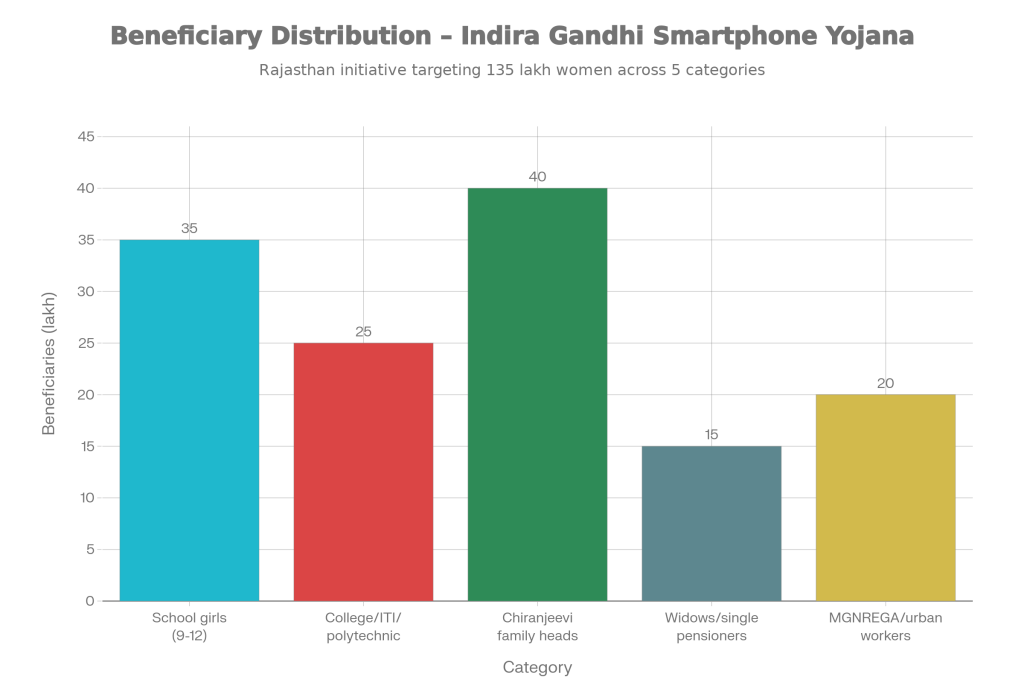
Indira Gandhi Smartphone Yojana was launched in August 2023 by the Rajasthan government with a target of covering roughly 1.3–1.35 crore women and girl students. The focus was on families enrolled under the Chiranjeevi Health Insurance scheme, so that the most economically vulnerable women could be connected digitally. In the first phase, lakhs of beneficiaries received smartphones and SIMs, and further lists were released in batches for the remaining phases.
Under this scheme, each eligible woman or girl was entitled to financial support of around ₹6,800, delivered digitally via e‑wallet or similar mechanisms during the camp process. This amount covered the cost of a decent 4G smartphone, SIM card and the initial data/voice pack. At the camp, beneficiaries could choose from the available brands and models instead of being forced to take a single fixed handset. Because of this, Indira Gandhi Smartphone Yojana was seen not just as a free mobile distribution exercise, but as a targeted digital subsidy.
Indira Gandhi Smartphone Yojana
| Point | Details |
|---|---|
| Scheme Name | Indira Gandhi Smartphone Yojana (Rajasthan) |
| Launch Year | August 2023 |
| Objective | Provide free smartphones and multi‑year internet access to women and girl students of Chiranjeevi families to boost digital empowerment |
| Target Beneficiaries | Female heads of Chiranjeevi families, widows and single‑woman pensioners, girls in classes 9–12, college/ITI/polytechnic students, women linked to rural and urban employment schemes |
| Approximate Coverage | Around 1.3–1.35 crore eligible women and girls in phases |
| Financial Support | About ₹6,800 per beneficiary for smartphone, SIM and initial data/voice pack (via digital transfer) |
| Connectivity Benefit | Free or subsidised data and calling for roughly three years through partner telecom operators |
| Application Mode | Offline registration and verification at government‑run camps with e‑KYC |
| Core Focus | Digital literacy, access to online education, banking, e‑governance and women’s safety |
| Current Status | After change of government, large‑scale new distribution paused; scheme under review and dependent on future policy decisions |
Key Objectives of the Indira Gandhi Smartphone Yojana
The main objective of Indira Gandhi Smartphone Yojana was to bridge the digital divide. In many villages and small towns, women and girls were cut off from online classes, e‑books, job portals, coaching apps, government apps and digital payments because they simply did not own a working smartphone. By ensuring that at least the female head of the family or a studying daughter had a device of her own, the government aimed to indirectly connect the entire household to the digital ecosystem.
A second key goal was to connect women directly with government schemes and financial services. Through their phones, beneficiaries could check Chiranjeevi health card details, pension credits, MGNREGA or urban employment wages, bank accounts, UPI transactions, ration entitlements, scholarships and more in real time. When a woman can read the SMS, OTP and official notifications on her own device, the scope for middlemen, misinformation and fraud naturally reduces.
Major Benefits Under Indira Gandhi Smartphone Yojana
One of the most attractive features of the scheme was the freedom to choose a handset at the camp. Rather than distributing a single fixed model, multiple brands and configurations were displayed at counters, and the beneficiary could select any phone falling within the approved budget limit. This gave women a sense of ownership and choice, not just charity.
Another major benefit was the financial assistance of around ₹6,800 that technically covered the full cost of the device and the initial telecom package. In some cases, if a beneficiary wanted a slightly costlier model, she could top up a small extra amount from her own pocket and upgrade. On top of this, the scheme bundled several years of internet data and calling, turning the phone into a complete tool for education, work, communication and access to online services rather than just a basic calling device.
Eligibility Criteria for Indira Gandhi Smartphone Yojana
Eligibility for Indira Gandhi Smartphone Yojana was kept targeted and clearly defined, to ensure that support reached those who genuinely needed it. The first basic condition was that the woman or girl had to be a permanent resident of Rajasthan and part of a family registered under the Chiranjeevi scheme. This Chiranjeevi database served as the backbone for beneficiary identification and list preparation.
Broadly, the main eligible categories were:
- Female heads of families covered under the Chiranjeevi Health Insurance scheme.
- Girl students studying in classes 9 to 12 in government or recognised schools.
- Girl students enrolled in colleges, universities, ITIs, polytechnics, nursing institutes and Sanskrit colleges.
- Widows and single women receiving pension from the state.
- Women from families that had completed the required number of workdays under MGNREGA or the Indira Gandhi Urban Employment Guarantee scheme.
Having the name correctly entered in the Chiranjeevi and Jan Aadhaar records was crucial. Any duplication, fake entry or mismatch in records could lead to rejection or exclusion from the beneficiary list.
Documents Required for Indira Gandhi Smartphone Yojana
To complete registration smoothly at the camp, beneficiaries had to carry a few essential documents. Without these, verification could not be completed and the process would get delayed or stalled. The typical list included:
- Jan Aadhaar card with clear family and member details.
- Aadhaar card for e‑KYC and identity verification.
- Passport‑size photograph, though in some camps photos were taken on the spot.
- School/college ID card, enrolment details or certificate for students.
- Pension‑related documents or PPO number for widows and single‑woman pensioners.
It was very important that the details on Jan Aadhaar, Aadhaar and other documents matched – especially name, age and family linkage. A minor spelling error in the name or a mismatch in date of birth could later cause the digital transfer to fail or the application to be flagged.
Registration And Camp Process
A distinctive feature of Indira Gandhi Smartphone Yojana was its camp‑based model. Instead of asking everyone to fill online forms, the government set up dedicated camps at village, ward, block and district level – often combined with महंगाई राहत camps or run as separate smartphone camps. At these camps, the entire journey from eligibility check to phone handover was completed in a single visit.
The typical process at the camp followed these steps:
- At the first counter, staff checked eligibility using the Jan Aadhaar database and confirmed whether the woman or girl appeared in the approved beneficiary list.
- Next, e‑KYC was completed using Aadhaar, and the beneficiary’s details were entered or confirmed in the digital system.
- After that, the woman or student moved to the counters of mobile brands and telecom operators, where she could see different smartphones and choose one within the sanctioned budget.
- Once the model was selected, the approved amount was mapped to her e‑wallet or digital account, and the handset was issued in her name.
- Finally, the SIM was activated, the data/voice plan was attached and basic guidance was given on how to use key features of the smartphone and essential apps.
This camp‑based setup was chosen so that even women with little or no digital literacy could complete the process with in‑person help and walk out of the camp with a working smartphone and active SIM.
Impact On Women And Students
The impact on students, especially girls in higher classes and college, was quite visible. Earlier, many households shared a single old phone with limited data, which made regular online study difficult. With their own devices, girls could attend online classes, watch lectures on YouTube, download PDF notes, use coaching and test‑prep apps and explore career information at their own pace. In areas where physical coaching centres are far away or expensive, this digital access made a real difference.
For women, the scheme had both economic and social benefits. Access to mobile banking and UPI allowed them to send and receive money, participate in self‑help group transactions and keep an eye on all government transfers directly. Pension credits, wages, subsidies and DBT payments could now be tracked on their own phone instead of depending on others to read messages. On the social side, features like helpline numbers, quick calling, location sharing, photo and video recording gave them additional confidence and a sense of safety.
Challenges And Ground Realities
Like any large‑scale public programme, Indira Gandhi Smartphone Yojana also faced its share of ground‑level challenges. In many places, eligible women were left out initially because their names were not correctly updated in the Chiranjeevi or Jan Aadhaar database. In other areas, overcrowded camps led to long queues, confusion and multiple visits for some beneficiaries.
Another issue was digital literacy. Some women who received phones were not familiar with Android interfaces, apps or basic settings, so they could not immediately use the device to its full potential. Over time, however, younger family members, classmates and local volunteers helped them learn how to use calling, messaging, WhatsApp, UPI, camera, browser and government apps. As this learning curve improved, the actual benefits of the scheme increased as well.
KCC Loan Waiver 2025: Farmers Eligible for Up to ₹2 Lakh Cancellation — Check Who Qualifies
Current Status And Future Possibilities
After a change of government in Rajasthan, the pace of new smartphone distribution under Indira Gandhi Smartphone Yojana slowed down, and large‑scale fresh allotments were put on hold. The new administration began reviewing the financial burden, targeting efficiency and priorities of the scheme. Because of this, it is still uncertain whether the programme will continue in the same form, come back with modifications or be replaced by a different digital access initiative.
Women and girls who already received smartphones under the scheme continue to benefit from their devices and the connectivity associated with them. Regardless of the political or policy changes ahead, one thing is clear – digital access for women and girl students is now seen as a necessity rather than an optional luxury. The experience of Indira Gandhi Smartphone Yojana has reinforced the idea that a simple 4G phone in the hands of a woman can influence education, income, awareness and social confidence for years to come.
FAQs on Indira Gandhi Smartphone Yojana
1. What is the Indira Gandhi Smartphone Yojana in simple words?
2. Who was eligible to get a free smartphone under this scheme?
Female heads of Chiranjeevi families, widows and single‑woman pensioners, girls studying in classes 9–12, and girl students in colleges, ITIs, polytechnics and similar institutes, along with women linked to rural and urban employment schemes, were covered if they were listed in the official beneficiary database.