
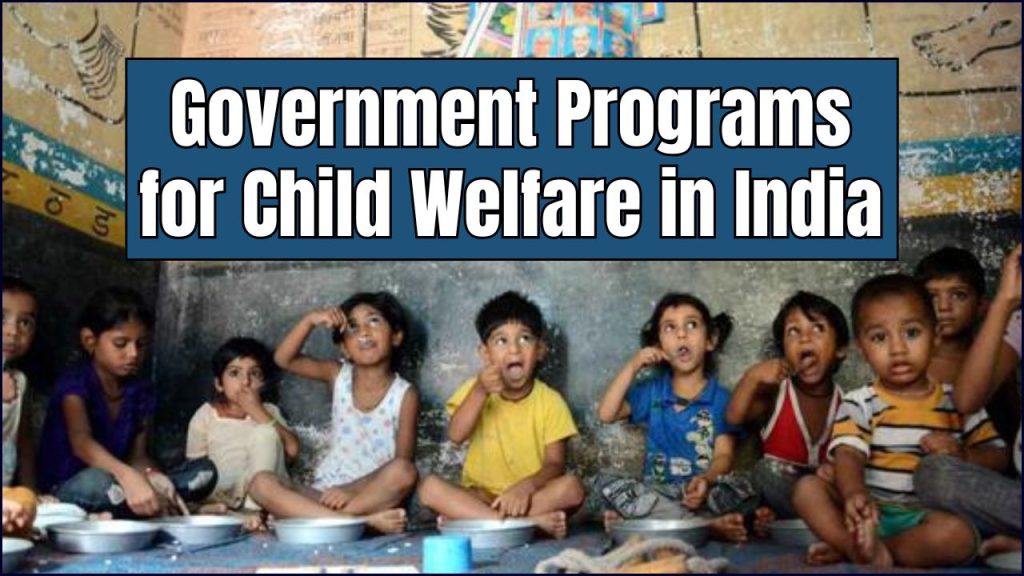
India has renewed its focus on government programmes for child welfare in India as policymakers prepare for the 2025–26 fiscal year. Officials from the Ministry of Women and Child Development (MWCD) said the coming year will give priority to improving nutrition, expanding child protection systems, and strengthening early childhood development services. Programmes such as Mission Vatsalya, Poshan 2.0, and the Integrated Child Development Services (ICDS) will continue to play central roles in addressing gaps in health outcomes, safety, and education for children across the country.
India’s Long-standing Commitment to Child Welfare
India’s investment in child welfare dates back several decades. The Integrated Child Development Services programme was launched in 1975 to tackle hunger, malnutrition, and lack of early education. Since then, successive governments have expanded the network of Anganwadi centres, introduced targeted health and nutrition interventions, and created a legal and institutional framework for child protection.
In recent years, the government has consolidated several related schemes into larger missions to reduce duplication, improve data management, and streamline service delivery. Policy analysts say the new structure creates opportunities for stronger coordination between states and the Centre, particularly at the district and block levels.
Government Strategy for 2025–26: Priority on Nutrition, Protection, and Early Development
Officials from the MWCD said the government’s strategy for the 2025–26 fiscal year focuses on strengthening three pillars: nutritional support, early childhood education, and child protection. The ministry’s Demand for Grants report highlights the need to reach children in low-income households, tribal districts, and urban slums, where services often remain inconsistent.
A senior ministry official said the government’s aim is to “build an integrated ecosystem that supports children from birth through adolescence,” adding that early childhood is the “foundation for long-term health, learning, and productivity.”
Poshan 2.0: Addressing Malnutrition Through an Integrated Approach
Poshan 2.0, created by merging three earlier schemes, is the government’s flagship nutrition programme. It provides supplementary nutrition, growth monitoring, and counselling for mothers and caregivers. The scheme focuses heavily on children under six, pregnant women, and lactating mothers.
According to the ministry’s latest estimates, nearly one-third of Indian children under five remain underweight or stunted. Poshan 2.0 aims to reduce these figures by strengthening community-based interventions, improving the quality of nutrition, and encouraging regular monitoring of child growth.
An official from the National Nutrition Mission said the programme would “expand its coverage in high-burden districts using digital tools such as the Poshan Tracker app, which allows real-time monitoring of services at Anganwadi centres.”
Mission Vatsalya: Strengthening India’s Child Protection System
Mission Vatsalya is the core scheme for child protection, supporting children in need of care, protection, or rehabilitation. This includes orphans, abandoned children, victims of abuse, and juveniles in conflict with the law.
The programme funds Child Care Institutions, foster care, adoption agencies, sponsorship services, and district child protection units. It also trains child-welfare committees and juvenile-justice boards.
A recent MWCD assessment found that some states lack adequate infrastructure for child protection homes, and many require renovations. Officials said 2025–26 funding will prioritise improving these facilities and increasing staff training.
Dr. Rita Verma, a policy researcher at the National Institute of Public Cooperation and Child Development, said the planned reforms are expected to “strengthen oversight of protection homes, improve rehabilitation services, and ensure children receive education and counselling.”
According to UNICEF India, nearly 70 per cent of cases of violence against children go unreported. Experts say strengthening Mission Vatsalya can help reduce these numbers.
Support for Children Affected by the COVID-19 Pandemic
The PM CARES for Children scheme, introduced in 2021, continues to support children who lost one or both parents during the COVID-19 pandemic. Benefits include:
- Financial assistance
- School support
- Health insurance
- Higher education scholarships
A ministry official said the government is conducting a nationwide audit of beneficiaries to ensure all eligible children continue receiving support until the age of 23.
The Role of ICDS and Anganwadi Centres
The ICDS programme remains one of the world’s largest early childhood-care systems, with more than 13.9 lakh Anganwadi centres. These centres offer preschool education, supplementary nutrition, immunisation linkage, and health counselling.
Digital innovations are increasingly being integrated into ICDS operations. The government has introduced the Poshan Tracker and digital weighing devices, and several states are experimenting with smart Anganwadis equipped with better teaching tools and child-friendly spaces.
Dr. Manish Kulkarni, a child-health specialist at the Public Health Foundation of India, said digital tools are enabling workers to “identify early signs of malnutrition and developmental delays, allowing quicker intervention.”
Technology and Data: A New Era in Service Delivery
India’s child-welfare programmes are gradually moving toward a data-driven approach. The Poshan Tracker has enabled real-time monitoring of service delivery, attendance, and distribution of food supplies. Experts say this has reduced leakages and improved transparency, although some states face connectivity challenges.
The MWCD is also developing a national dashboard to track progress on key indicators at the district level. This dashboard will integrate data from health, education, and child protection departments to provide a clearer picture of children’s well-being.
On-ground Challenges: Gaps in Staffing, Infrastructure, and Awareness
Despite improvements, the child-welfare system faces several challenges:
- Shortages of trained Anganwadi workers
- Delays in fund disbursement
- Inadequate infrastructure at child-care institutions
- Lack of community awareness about nutrition and early childhood development
- Limited monitoring in remote districts
A recent UNICEF evaluation found that many families in tribal and rural areas do not regularly access Anganwadi services due to distance, social barriers, or irregular functioning. Experts suggest that improving the quality of centres and involving local communities can help close these gaps.
Comparison with Global Standards
Internationally, India’s spending on child welfare remains lower than many middle-income countries. Countries like Brazil and South Africa devote a higher proportion of their national budgets to child-focused services. UNICEF recommends that nations invest at least 1.5 per cent of GDP in child welfare; India’s spending remains below this benchmark.
However, experts acknowledge that India’s scale—home to the world’s largest population of children—makes progress slower and more complex.
What Experts Recommend
Child-rights experts propose several steps for India to strengthen its systems:
- Increase investment in early childhood development
- Expand nutrition support in high-burden districts
- Improve training for child-care and Anganwadi workers
- Strengthen monitoring of child protection homes
- Integrate mental-health services for children
- Encourage community participation
A UNICEF India report said long-term solutions require “a coordinated effort involving parents, local governments, community workers, and civil-society organisations.”
Looking Ahead: The Future of Child Welfare in India
As India prepares for the 2025–26 fiscal year, officials say the government intends to continue strengthening early childhood services, modernising child-protection systems, and expanding access to nutrition. Analysts believe these reforms will contribute to stronger health and education outcomes in the coming decade.
Policy experts say investments made today will help India’s next generation become healthier, more productive, and better prepared to contribute to the country’s economic development.