
Free Laptop Yojana 2025 is designed to help students get a free laptop or receive ₹25,000 directly in their bank account to buy one, depending on their state’s notification and eligibility rules. The aim is simple: reduce the digital divide so that meritorious and deserving students can access online learning, competitive exam prep, and skill-building without device barriers. In 2025, most implementations are led by states, and many now prefer the DBT model of ₹25,000 so students can pick a laptop that fits their course needs. Always apply via the official state education portal or a trusted government directory and avoid third-party forms or agents.
If you’re hearing about Free Laptop Yojana 2025 for the first time, think of it as a cluster of verified, government-backed student benefit programs that either distribute laptops physically or credit ₹25,000 to eligible students via direct bank transfer. The model varies by state, but the core idea is consistent: support students in Class 10, Class 12, and higher education who meet notified merit or income criteria. Applications are online, verification is strict, merit lists are published, and distribution happens through schools, district camps, or DBT.
Free Laptop Yojana 2025
| Item | Details |
|---|---|
| Scheme Model | State-run laptop distribution or ₹25,000 DBT assistance |
| Beneficiaries | Class 10, Class 12, and higher-education students (as per state rules) |
| Selection Basis | Merit cut-offs, domicile, institute recognition, and sometimes income/category norms |
| Application Mode | Online on official government portals |
| Distribution | Device camps through schools/districts or direct bank transfer |
| Key Example | State models offering ₹25,000 to meritorious Class 12 students via DBT |
| What To Avoid | Unofficial websites, fee demands, or agent-driven forms |
| Tracking | Portal dashboard, SMS, email notifications for merit lists and disbursals |
Free Laptop Yojana 2025 whether as a free device or a ₹25,000 grant can be the boost that gets you into digital classes, coding labs, or test-prep platforms without strain. Treat the application like a formal process: use only official portals, upload clean documents, and keep your acknowledgment and updates handy. If your state follows the DBT route, prioritize a balanced laptop configuration within budget and keep the purchase invoice. With a careful, step-by-step approach, you’ll navigate the application smoothly and get the support you need for the year ahead.
Eligibility Criteria And Cut-Offs
Eligibility generally revolves around four pillars: domicile, academic merit, recognized institution status, and (where specified) income ceilings or category priorities. Many state cycles prioritize Class 12 meritorious students for the ₹25,000 grant, while others include Class 10 and college students with board-notified percentage cut-offs. In some states, reserved categories, EWS students, rural students, and PwD candidates may receive preference or relaxed thresholds. Always check the current-year circular for your state to confirm marks, board equivalence, and any exclusions.
Documents You Need for Free Laptop Yojana 2025
Before you apply, assemble clean, legible scans of the following:
- Aadhaar card
- Domicile certificate
- Latest marksheet (board or university)
- Admission proof or bonafide certificate
- Passport-size photograph
- Bank account details (name, account number, IFSC)
- Income certificate (if required)
- Caste/category certificate and disability certificate where applicable
Ensure your bank account name matches your application details exactly to prevent DBT failures. Keep mobile and email active for OTP logins and alerts.
How To Apply Online for Free Laptop Yojana 2025
- Find the official portal: Start from your state education department’s website or a trusted government scheme directory. Look for the current session’s laptop or student device support link.
- Register and fill details: Create an account, add personal information, academic data, institution details, and upload documents in the specified format and size.
- Submit and note your ID: After submission, note your acknowledgment or application ID. You’ll need it to track your status.
- Track verification: Authorities verify your documents and eligibility. If you’re shortlisted, you’ll see status updates in the portal dashboard.
- Distribution or DBT: If your state provides laptops, you’ll be called to a designated venue with your ID. If it’s a grant model, watch for the ₹25,000 credit and any instruction to retain purchase invoices.
What The Scheme Covers
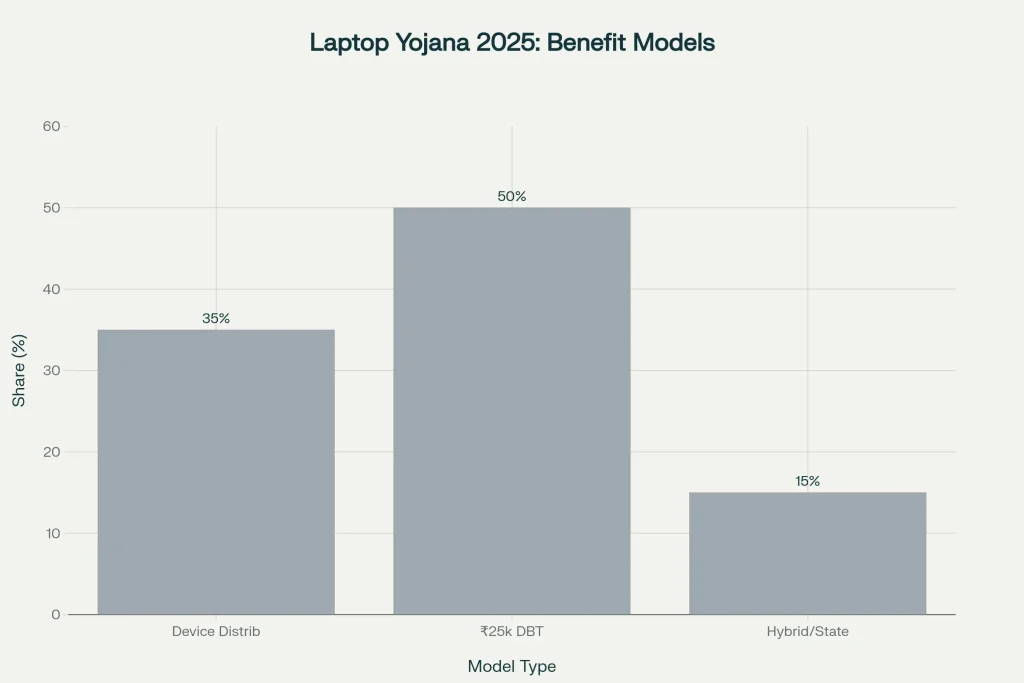
Two delivery modes dominate in 2025:
- Physical Laptops: States procure and distribute laptops in bulk via schools, colleges, or district-level camps. You receive a sealed device, often with preloaded software for study and office use.
- ₹25,000 DBT: Instead of device procurement, states transfer money directly so you can buy a suitable laptop. This model reduces logistics, supports student choice, and speeds up access.
In both cases, the program’s goal is the same equip you for digital classrooms, recorded lectures, coding labs, design tools, and test platforms.
State-Wise Implementations To Know
While names differ, the structures are alike: merit-centric selection, strict verification, and distribution tied to academic calendars. Some states announce beneficiary numbers before the cycle begins and align releases with board results or special events. Expect annual recalibration of cut-offs, categories covered, and timelines based on budget and policy decisions. Because of this, checking your state’s current-year PDF notification is non-negotiable.
Selection, Verification, And Distribution
Once the window closes, applications go through multi-layer verification personal details, academic marks, domicile, income, and category certificates all get checked against official records. A merit list is then published, either in one go or in phases.
- If you’re allotted a device, carry your original ID, acknowledgment slip, and any requested documents to the collection venue.
- If your state uses DBT, verify and correct bank details quickly if the portal flags mismatches to avoid delays.
Common Mistakes to Avoid
- Applying on unofficial portals: Real portals never ask you to pay an “application fee” to agents or third-party pages.
- Mismatched bank details: Small errors in account name or IFSC cause DBT failures. Double-check.
- Multiple applications: Duplicate submissions can get flagged and rejected during verification.
- Wrong document formats: Oversized or unreadable uploads slow verification and may lead to rejection.
Who Should Apply In 2025
Apply if you meet your state’s domicile rule, study in a recognized institution, and satisfy the notified merit or income criteria. This includes:
- Class 12 students aiming for the ₹25,000 grant in merit-led models.
- Class 10 students in states that extend the scheme to secondary level.
- College students where higher-education variants are active.
- Students from EWS, SC/ST/OBC, and PwD categories if your state provides priority or relaxed cut-offs.
Realistic Timelines and What to Expect
- Announcement and portal opening typically follow board result timelines or state budget schedules.
- Application windows often stay open for a few weeks.
- Verification and merit list publication can take several more weeks.
- Distribution camps or DBT credits roll out in phases; watch for SMS/email notices.
- Keep copies of everything application ID, submitted documents, and any DBT acknowledgment or laptop handover receipt.
Laptop Buying Tips If You Receive ₹25,000
If your state credits ₹25,000, spend it wisely:
- Processor: Aim for at least Intel Core i3/Ryzen 3 or Apple Silicon if using a Mac ecosystem.
- RAM: 8 GB is the sweet spot for smooth multitasking in study apps and browser tabs.
- Storage: A 256 GB SSD boots faster and feels snappier than larger HDDs; consider external storage for bulk files.
- Display and battery: A 14–15.6-inch, full HD panel with 6+ hours battery suits lectures and notes.
- Warranty: Opt for 1–2 years with on-site service if available. Keep the invoice safe in case your state asks for proof of purchase.
Safety And Authenticity Checks
- URL Check: Government domains typically end with .gov.in or are clearly referenced from department pages.
- Notice PDF: Look for a current-year PDF with dates, eligibility, and helpdesk contacts.
- Helpline: Use only the helpline listed on the official notice.
- No Fees: Genuine schemes do not require application fees.
- Updates: Rely on official dashboards for status; avoid social links posting unofficial forms.
RBI Announces New Minimum Balance Rules for Bank Accounts, Effective November 10
Action Checklist for Students
- Confirm your state’s current notification, eligibility, and deadlines.
- Gather Aadhaar, domicile, marksheet, admission proof, income/category certificates, and bank details.
- Apply only on the official portal; save your acknowledgment ID.
- Track verification status; respond quickly to any discrepancy requests.
- For DBT models, verify bank details and watch for the ₹25,000 credit; for device models, attend distribution as scheduled.
FAQs on Free Laptop Yojana 2025
Is There One National Free Laptop Yojana For Everyone?
No. In 2025, active implementations are primarily state-led programs. Each has its own eligibility, timelines, and distribution model. Always check your state’s official notice.
Who Can Apply Under These Schemes?
Typically Class 10, Class 12, and higher education students enrolled in recognized institutions, subject to domicile rules, merit cut-offs, and where specified, income/category criteria.
How Much Assistance Is Provided If It’s Not A Physical Laptop?
Many states provide ₹25,000 via DBT so eligible students can purchase a device that fits their academic requirements. Keep your invoice safe if your state asks for proof.
How Do I Verify If a Link Is Genuine?
Start from your state education department’s homepage or a trusted government scheme directory, check for a current-year circular, and avoid any portal that asks for fees or personal data without official validation.