

Retirement should bring peace of mind, not constant tension about how to pay for medicines, rent, and basic groceries. EPS-95 Gets a Major Boost Monthly Pension Raised to ₹7,500 for Retirees is a big step in that direction, especially for pensioners who were surviving on a very low monthly income for years. With this move, thousands of former employees from the organised sector can finally look at their pension as a meaningful support system, not just a symbolic amount that disappears in a few days.

It also sends a clear message that the contributions of these workers are being recognised in a more serious way. Instead of the old minimum pension of around ₹1,000, eligible retirees can now expect a fixed base of ₹7,500 every month, making it easier to plan household expenses, medical bills, and small personal needs. For many families where the pension is the only stable income after retirement, this change could be the difference between just managing and living with some comfort and dignity.
EPS-95 Gets a Major Boost
| Detail | Earlier Situation | After EPS-95 Gets a Major Boost — Monthly Pension Raised to ₹7,500 for Retirees |
|---|---|---|
| Minimum monthly pension | Around ₹1,000 for many pensioners | Minimum ₹7,500 per month for eligible EPS-95 retirees |
| Practical monthly support | Covered only a fraction of basic expenses | Can realistically support essential costs like food, rent, and medicines |
| Main beneficiaries | Old-age pensioners under EPS-95 | Existing and future EPS-95 pensioners with low pensions |
| Application requirement | Not relevant | Generally processed automatically for eligible pensioners |
| Impact on family support | Heavy dependence on children | Better sharing of financial responsibility within the family |
| Policy message | Pension as token support | Pension as a serious social security measure |
It is not just a policy headline; it is the result of years of demand and struggle by pensioners’ associations. They have consistently argued that a pension of ₹1,000 per month is simply not realistic in today’s economy. With the revised structure, the new minimum pension of ₹7,500 aims to match the rising cost of living and offer a more practical safety net. In many cases, additional benefits like dearness allowance (DA) or related reliefs may further increase the effective monthly support for eligible pensioners, making the scheme more meaningful in real life.
This boost under EPS-95 is expected to benefit a large section of retired workers who spent their active years in factories, shops, offices, and other EPFO-covered establishments. Many of them had no other major savings or pension plans, so this revised amount now becomes the backbone of their monthly budget. The idea behind EPS-95 Gets a Major Boost Monthly Pension Raised to ₹7,500 for Retirees is to ensure that old age is not spent depending entirely on children or loans, but with a basic level of financial independence.
What Has Changed Under EPS-95
- The biggest change is that the minimum pension under EPS-95 is no longer a token amount. Earlier, many pensioners received barely enough to cover a few days of expenses. With EPS-95 Gets a Major Boost Monthly Pension Raised to ₹7,500 for Retirees, the base level of support has gone up sharply. This means that any eligible pensioner who was getting a lower pension earlier will now see a much higher amount credited every month.
- Another important point is that the increase is designed as a structural change, not just a one-time benefit. That makes it easier for retirees to plan ahead. Instead of worrying each month about how to stretch ₹1,000, they now have a more predictable and usable pension amount. In real terms, this can help them manage recurring costs like electricity, mobile bills, local transport, and routine healthcare.
Why This EPS-95 Increase Was So Necessary
The cost of living has been rising steadily for more than a decade, but EPS-95 pensions had not kept pace with this reality. Basic items like food, rent, and medicines have become significantly more expensive, while many EPS-95 pensioners were stuck at a low, almost static pension figure. EPS-95 Gets a Major Boost Monthly Pension Raised to ₹7,500 for Retirees is an attempt to bridge that gap and bring the pension structure closer to ground realities. Another reason this hike was crucial is the age and vulnerability of the beneficiaries. Most EPS-95 pensioners are senior citizens, often facing health issues and recurring medical expenses. A higher pension allows them to visit doctors on time, buy prescribed medicines, and take better care of their overall well-being. Instead of postponing treatment due to lack of money, they now have a better chance of staying healthy and active.
Who Stands To Benefit The Most
The primary beneficiaries are retired employees who were members of the Employees’ Pension Scheme (EPS-95) and have completed the required minimum service period. Many of them come from lower and middle-income backgrounds and worked in private or organised sector jobs where EPF and EPS contributions were deducted from their salaries. EPS-95 Gets a Major Boost Monthly Pension Raised to ₹7,500 for Retirees is particularly significant for those who do not have other big investments or private pension plans.
Family pensioners, such as widows or other dependants of deceased members, can also gain from the improved pension structure, depending on how the final rules are applied in each case. For such families, even a few thousand rupees extra every month can make a huge difference in managing education costs, house expenses, and healthcare. In short, the reform does not only support individuals; it stabilises entire households.
Real-Life Impact on Retirees’ Daily Budget
To understand the value of EPS-95 Gets a Major Boost Monthly Pension Raised to ₹7,500 for Retirees, it helps to look at a typical monthly budget. Earlier, a pensioner with ₹1,000 per month could not even cover basic groceries for the full month, let alone medicines or rent. Most of the burden automatically fell on children or relatives, leading to financial stress and emotional discomfort.
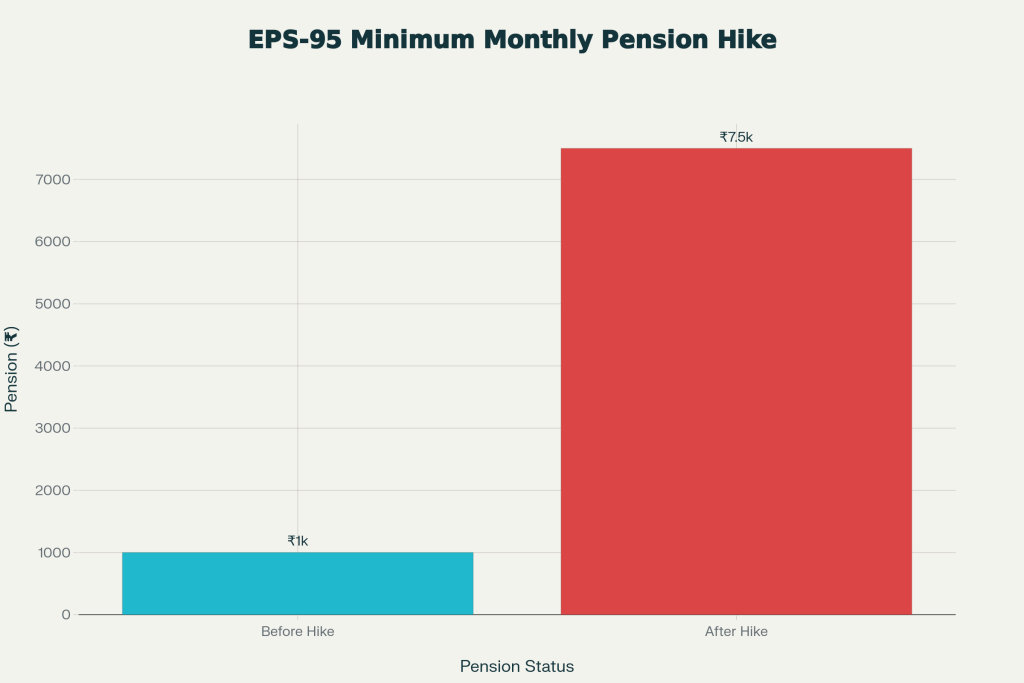
With a monthly pension of ₹7,500, the situation changes noticeably. While it may still not be a luxury income, it is enough to handle essential items like food, basic rent in smaller towns, electricity charges, and at least part of the medical costs. Retirees can now buy healthier food, pay for regular check-ups, and maintain a little more independence. That sense of control and dignity is one of the biggest unseen benefits of this hike.
What Pensioners Should Do Now
- Even though the idea of the hike is to benefit eligible pensioners automatically, it is still important for retirees to keep their records updated. Bank details, Aadhaar, and KYC information should be correct and active, so there are no delays or rejections when the revised pension is processed. If there are mistakes in name, date of birth, or account numbers, those should be corrected at the earliest through the official channels.
- Pensioners should also keep an eye on official announcements and stay in touch with local EPFO offices or trusted advisors for any procedural updates. Whenever EPS-95 Gets a Major Boost Monthly Pension Raised to ₹7,500 for Retirees is implemented in their case, they should verify the new amount reflected in their bank statement and raise queries immediately if something does not match expectations. Being informed and proactive can prevent many small issues from turning into major problems.
Future Scope Of EPS-95 Reforms
This pension hike is a strong step forward, but it may not be the last word on EPS-95 reforms. As inflation and living standards evolve, there will likely be fresh discussions about linking pensions more closely to price levels and reviewing them at regular intervals. Many experts believe that a stable system should have a clear formula for future revisions, not just one-time corrections after long gaps. Furthermore, debates around funding, long-term sustainability, and the balance between employee contributions, employer contributions, and government support are likely to continue. However, no matter how these discussions shape up, EPS-95 Gets a Major Boost Monthly Pension Raised to ₹7,500 for Retirees has already set a new benchmark in how the country looks at old-age income security for private and organised sector workers.
FAQs on EPS-95 Gets a Major Boost
Will every EPS-95 pensioner get exactly ₹7,500 per month?
The new structure focuses on setting ₹7,500 as a minimum benchmark for eligible pensioners who were previously receiving very low amounts. Those already getting higher pensions may not see a major change, while those below this level are expected to be raised closer to or up to the new minimum.
Do pensioners need to submit a new form to receive the higher pension
In most cases, the revised pension is meant to be processed automatically based on existing EPS-95 records. However, pensioners must ensure that their KYC, Aadhaar, and bank details are complete and correct so the higher amount can be credited without any technical issues.
Does EPS-95 Gets a Major Boost Monthly Pension Raised to ₹7,500 for Retirees affect EPF balances?
No, this change relates specifically to the pension part under EPS-95. Your EPF (Provident Fund) balance and withdrawals are separate, and this hike does not reduce or alter the EPF corpus that you may have already taken or kept invested.
Can family pensioners also benefit from the higher EPS-95 pension?
Yes, in many cases, family pensioners such as widows or dependants of deceased members are also covered under the improved structure, although the exact amount and calculation can differ. They should check their specific entitlement and ensure all documentation is up to date to receive the revised pension smoothly.