
If you are planning to buy an e‑scooter for the first time and are confused about which scheme is real and which one is just hype, this guide is for you. Here you get a clear, step‑by‑step explanation of the electric scooter subsidy for women maximum benefit, eligibility rules, documents, state policies and the full application process.
Different states have launched women‑focused EV schemes in their own way. In some, you get a direct cash subsidy; in others, the discount is adjusted in the on‑road price; some give extra relief in tax and registration charges. The bigger idea is simple: bring the effective price of an electric scooter so low that even a middle‑class or low‑income woman can buy it without taking on a heavy loan burden.
Electric Scooter Subsidy for Women
| Point | Details |
|---|---|
| Maximum total subsidy | Up to around ₹46,000 (state subsidy + central/other EV incentives combined) |
| Target group | Women aged 18 years and above registering an e‑scooter/e‑bike in their own name |
| Main objective | Improve women’s mobility, safety and savings while accelerating EV adoption |
| State subsidy range | Usually up to around ₹20,000, varying by policy |
| Central/other support | Battery‑linked, FAME‑style or EV policy incentives on top of state support |
| Coverage | Multiple states such as Delhi, Gujarat, Maharashtra, Tamil Nadu, Karnataka, Telangana and others |
| Key documents | Aadhaar, ID and residence proof, income certificate, bank details, passport‑size photos |
| Payout method | Adjusted directly in the dealer invoice or credited later via DBT to the bank account |
Electric Scooter Scheme 2025 – What It Is
The Electric Scooter Scheme 2025 is essentially an umbrella concept under which different states and the central government provide their own versions of two-wheeler subsidy. The mission is the same reduce dependence on petrol and diesel and push especially women towards low‑cost, low‑maintenance electric scooters.
Under this scheme, approved electric scooter models get support either as a fixed amount or per kWh of battery capacity. In many states, this subsidy is deducted directly from the invoice, so you see a lower price right at the showroom. In some cases, you pay the full price first and then receive the subsidy via Direct Benefit Transfer (DBT) in your bank account.
Who Can Get The Women Electric Scooter Subsidy
To claim the electric scooter subsidy for women, the basic condition is that the buyer must be a woman and the vehicle must be registered in her name. Usually, the minimum age is 18 years so that she is eligible to hold or obtain a valid driving licence.
Most schemes check these common points:
- The applicant is an Indian citizen.
- She is a permanent resident of the state from which she is claiming the subsidy.
- Family income stays within a fixed limit (BPL, low‑income or lower‑middle class, depending on policy).
- No prior two‑wheeler EV subsidy has been claimed on the same name.
- Valid KYC and a functional bank account are available.
Some schemes also give priority to working women, students, members of self‑help groups or beneficiaries of other social welfare schemes. In that way, the electric scooter subsidy for women targets those who are economically or socially more vulnerable and need mobility support the most.
Understanding The ₹46,000 Subsidy Figure
The popular “up to ₹46,000 benefit” figure is usually a combined number. It is made up of:
- One part from the state government as a direct subsidy.
- Another part from central or EV‑policy‑based incentives linked to battery capacity or model.
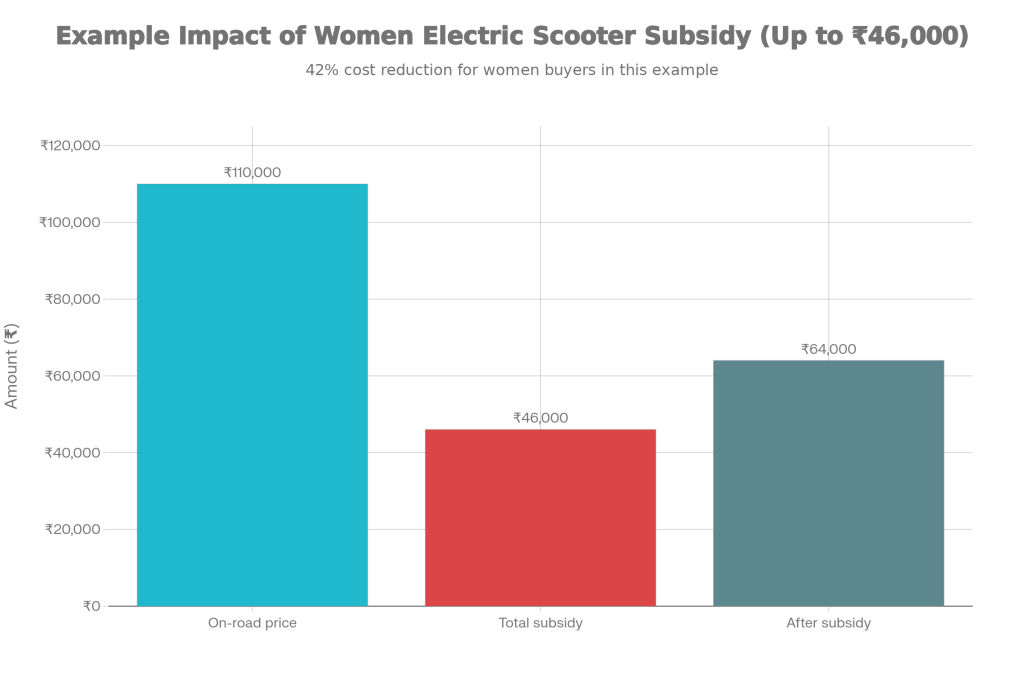
For example, if a particular model gets around ₹20,000 from the state and another ₹26,000 through battery‑linked or FAME‑style incentives, the effective total reaches about ₹46,000.
Now take an electric scooter with an on‑road price of around ₹1,10,000. If the full two wheeler subsidy applies, the buyer may need to pay only about ₹64,000 from her pocket, while the rest is covered through government support and incentives. This is why many women are dropping petrol scooters and switching directly to EVs by using the electric scooter subsidy for women to its full potential.
Key Conditions In The Electric Scooter Subsidy Scheme
Basic eligibility is not the only filter. Schemes also carry several specific conditions such as:
- Subsidy is available only on registered and officially approved EV models.
- Usually there is a cap of one vehicle per beneficiary.
- The vehicle price must fall under a defined ceiling so that luxury or premium models do not capture most benefits.
- In some policies, you are not allowed to transfer or resell the vehicle to another state for a certain number of years after taking subsidy.
These checks are meant to prevent misuse and ensure that the electric scooter subsidy for women actually reaches genuine buyers. To avoid surprises, always read your own state’s EV policy and official notifications carefully before purchase.
States Implementing The Scheme
The landscape differs from state to state, but one clear trend is that larger and industrial states have gone more aggressive on EV support. In broad terms you see things like:
- Extra top‑up incentives when the two‑wheeler EV is registered in a woman’s name.
- Separate quotas and categories for working women or girl students.
- Local bodies offering relief in parking, toll or city entry charges for EV users.
In this way, the electric scooter subsidy for women is not limited to upfront price cuts. It is turning into a complete ecosystem benefit – tax, fees, parking and charging infrastructure all together.
Real Cost Of An Electric Scooter After Subsidy
From a buyer’s point of view, the real question is simple: “What do I actually pay in the end?” If you look at it from this angle, you can clearly see the strength of the two wheeler subsidy.
If an e‑scooter costs somewhere between ₹1,00,000 and ₹1,20,000 without subsidy, the combined support can often bring the effective price down to roughly ₹60,000–₹80,000 depending on model and state. Beyond that, you save month after month because:
- Electricity is far cheaper than petrol for the same distance.
- Service and maintenance are usually cheaper due to fewer moving parts.
- In many cities, road tax and registration fees are reduced or waived for EVs.
So the electric scooter subsidy for women is not just a one‑time bonus. It significantly lowers the total cost of ownership over several years.
Electric Scooter Models Covered Under Subsidy
Not every model from every brand is eligible. The government maintains an approved list that includes only those models which:
- Meet minimum standards for range and speed.
- Use safe and standardised battery and motor technology.
- Have passed formal testing and certification processes.
Multiple popular brands like Ola, Ather, Hero Electric, Okinawa and Bajaj have models in this list, but the subsidy amount can differ from variant to variant. Before visiting a showroom, it is smart to clarify two things:
- How much total electric scooter subsidy for women (state + central) applies on your chosen model.
- Whether this amount will be reduced directly in the invoice or paid later through DBT.
Once you know this breakup, planning EMI and arranging down payment becomes much easier.
Important Documents To Prepare In Advance
Many good applications get delayed or rejected due to incomplete paperwork. To avoid that, keep these documents ready from the start:
- Aadhaar card and another photo ID proof.
- Residence proof of the state (ration card, electricity bill, domicile certificate, etc.).
- Bank passbook or cancelled cheque and an active mobile number.
- Income certificate if the scheme has an income cap.
- Passport‑size photographs.
- Where applicable, proof of self‑help group membership or job/education proof.
The cleaner and more updated your documents, the faster your electric scooter subsidy for women is likely to be approved, whether at the dealer level or via the state portal.
Step‑By‑Step Online Application Process
Most states now handle the process digitally through their EV or transport portals. In general, the steps look like this:
- Visit your state’s EV/transport portal and complete the basic registration.
- Log in and go to the Electric Scooter Subsidy for Women or two wheeler subsidy section.
- Fill the online application form with personal, contact, income and address details.
- Upload clear scanned copies of the required documents.
- Select or link an authorised dealer and an approved scooter model.
- Wait for verification; the portal or dealer will update the approval status.
- Once approved, the subsidy is either adjusted in the invoice or credited to your bank account later.
Many dealerships support women buyers through this whole digital process, from account creation to form filling, so you mainly provide signatures and information. If you are not comfortable online, you can take help from a trusted cyber café or a common service centre.
Ration Card Update: Free LPG Cylinder + ₹1,000 Support Approved — Check Who Qualifies
Benefits For Women – Beyond Just Money
The most visible benefit of the electric scooter subsidy for women is obvious lower price, lighter EMIs and reduced monthly spending. But there are several deeper advantages as well:
- Control over your daily schedule instead of depending on buses, shared autos or others’ vehicles.
- Better personal safety and comfort during late‑evening or early‑morning travel.
- Ability to manage office, market, children’s school and tuition runs on your own time.
- A small but meaningful contribution to cleaner air and lower noise in your city.
That is why more women are seeing this not only as a “cheap scooter deal” but as a lifestyle upgrade and a step towards real independence.
FAQs on Electric Scooter Subsidy for Women
Q1. What is the maximum benefit available under the electric scooter subsidy for women?
In many cases, when you combine state subsidy with central or EV‑policy incentives, the effective benefit can go up to about ₹46,000.
Q2. Is this subsidy only for first‑time two‑wheeler buyers?
Most schemes give priority to first‑time EV buyers and include a rule that no previous two‑wheeler EV subsidy has been claimed on the same name.
Q3. Can women in private jobs or self‑employed women also claim this subsidy?
Yes. In many schemes, eligibility is based more on income and residency than on job type. So a private‑sector employee, self‑employed woman or homemaker can all claim the two wheeler subsidy if they meet the basic criteria.
Do I need to submit a separate form at the bank to claim the subsidy?
Generally, no. The subsidy process runs through the state portal and dealership systems, which are already linked to your bank details.