
If you work in a government job or are preparing for one, you have probably seen viral messages claiming that the retirement age increased in 2025 and that completely new rules are now in force. Many people are sharing screenshots, videos and forwards that make it sound like everything has already changed overnight. In this noise, it becomes very hard to understand what is real, what is only a proposal and what is just clickbait. That is why it is important to calmly look at the situation before believing that the retirement age increased for everyone across the board. This guide walks you through what these headlines actually mean, what kind of changes are being talked about, how they could affect your job, and what you should do right now. The aim is simple: you should finish reading with a clear, practical understanding instead of confusion or false hopes.
Across social media and some websites, you will find detailed stories claiming that from 2025 the retirement age for government employees has been raised from 60 to 62, sometimes even more for specific categories. These updates often say that central government staff, many public sector employees and certain professional groups will now work longer before drawing a pension. Some of this content is based on genuine discussions and policy debates, but much of it presents future possibilities as if they are already final decisions. As a smart reader and employee, you need to treat the phrase retirement age increased with caution and always separate confirmed rules from rumours and interpretations.
Big Change for Govt Employees
| What People Are Hearing | What Is Usually Claimed | What You Should Remember |
|---|---|---|
| Central government retirement age | That it has already gone up to 62 from 60 for everyone. | In reality, any genuine change would require a clear official order, not just a viral message. |
| Public sector retirement age | That all public sector units now follow a higher common age. | Different organisations follow their own service rules and do not change simply because of rumours. |
| State government staff | That states must automatically follow central rules. | Each state decides its own retirement age and can choose a different path. |
| Professionals like doctors and teachers | That they are getting a fresh age hike from 2025. | Many such posts mix old decisions with new claims and present them as one new package. |
| Young aspirants | That there will be no vacancies for years. | Recruitment plans adjust over time and depend on many factors beyond just retirement age. |
Key Highlights Of The New Retirement Policy Narrative
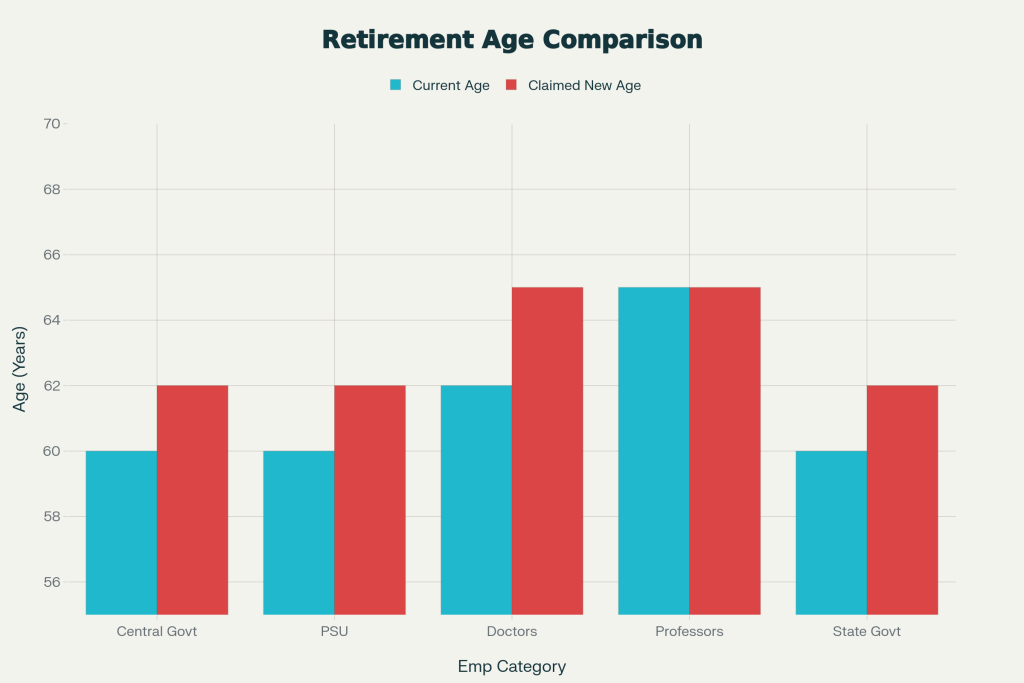
Even though official rules may not have changed everywhere, there is a clear narrative that keeps getting repeated and shared. According to this story, the retirement age for central government employees is set to go up from 60 to 62, with similar extensions in many public sector companies. The same narrative often adds that doctors, professors and some specialised cadres will be allowed to serve even longer, sometimes till 65.
In most versions, this supposed new policy is described as a big reform that will keep experienced staff in service, reduce the immediate pension burden and bring India closer to countries where people work till a higher age. The idea sounds attractive to many employees, which is why the phrase retirement age increased spreads so quickly. However, the key word for you to remember is narrative. Until clear, written rules are notified by the competent authority, these remain talking points, not guaranteed benefits.
Retirement Age Increased – Who Is Covered
The next common question is about coverage. When people say the retirement age increased, who are they actually talking about. The broad claim usually covers:
- Recruitment plans employees in different groups and grades
- Staff in public sector undertakings and government controlled companies
- Employees of autonomous bodies funded or supported by the government
- Selected professional groups such as doctors, teachers and researchers
On paper, this sounds like almost everyone who draws a government paycheck. But in reality, service conditions are not controlled by a single line in a social media post. Central services, state services, PSUs and autonomous bodies often have their own service rules and approval processes. Some may already have a higher retirement age due to older decisions, while others may still be at 58 or 60. So even if you hear that the retirement age increased, you must always check what applies to your exact cadre, organisation and state.
The Labour Codes strengthen worker protection with mandatory 1-month notice, retrenchment compensation, reskilling fund provision. Further the increased threshold gives employer the flexibility to hire directly increasing formal jobs and ensuring social security. #ShramevJayate pic.twitter.com/8b77RGie0q
— Ministry of Labour & Employment, GoI (@LabourMinistry) December 3, 2025
Impact Of Retirement Age Extension On Government Operations
If or when a real increase happens, it will not just change the year in which you retire. It will also affect how the entire system functions. The most direct impact will be on workforce planning. With employees staying two or more years longer, departments will have more experienced hands at the top and middle levels. That can improve continuity, project delivery and institutional memory.
On the other hand, slower retirements also mean slower promotions and fewer vacancies opening up in the short term. This is why many young aspirants get worried when they hear that the retirement age increased, because they see it as an immediate reduction in opportunities. For the government, it becomes a balancing act between retaining experience and creating space for new talent. Financially, pension payments may be delayed, but salary expenditure for senior staff continues for longer. Any serious policy has to weigh all these factors together.
Why Many Support A Higher Retirement Age
There are several reasons why the idea of a higher retirement age keeps coming back into the public discussion. One major point is increasing life expectancy. Today, many government employees remain active, healthy and mentally sharp well past 60. For them, the moment they hear that the retirement age increased somewhere, it feels like a recognition of their continued capability.
Another factor is the changing nature of work. Government jobs today often involve complex policy, digital systems and long term projects. Training an officer or specialist to handle these tasks takes years. From that angle, it can make sense to use their skills for a few more years instead of letting them go as soon as they reach 60. Finally, there is the financial side. A gradual rise in retirement age spreads out pension obligations and can make it easier to manage budgets, especially as the number of retirees grows every year.
Concerns About Retirement Age Increased News
For every group that welcomes the idea of an extension, there is another group that looks at the same news with concern. The first obvious worry comes from students and competitive exam aspirants who already face tough competition for limited seats. When they read that the retirement age increased, they naturally imagine a direct drop in vacancies for the next couple of years.
Serving employees at the junior and middle levels may also worry that their promotions and postings will be delayed if seniors stay longer. For some, this can affect family planning, housing decisions and children’s education plans. There is also a social angle. Not everyone wants to work longer. Many people plan to retire at 60, spend more time with family or start something of their own. For them, a forced extension may not feel attractive. Any serious retirement age reform has to consider these human and career related concerns, not just balance sheets and headlines.
MNSSBY Bihar Student Credit Card: How to Apply Online and Track Your Loan Approval
How To Respond To Retirement Age Increased Updates
With so many videos, blogs and forwards flying around, you need a simple method to protect yourself from misinformation. A practical approach is to treat every claim in two steps. First, assume that any breaking headline about retirement age increased is just a rumour until you see an official document. Second, even after you see a document, check whether it applies to your specific organisation, cadre and state.
It also helps to maintain your own career and retirement plan based on current confirmed rules, not on expected changes. Plan your savings, loans and family commitments as if you will retire at the existing age. If a genuine extension comes later, you can treat it as an extra cushion rather than something you were depending on. This mindset keeps you safe from disappointment and gives you control over your financial future, instead of letting random messages dictate your expectations.
FAQs on Big Change for Govt Employees
Has The Retirement Age Really Increased For All Government Employees In 2025
No single rule automatically raises the retirement age for every government employee across the country. Different services, states and organisations follow their own approved rules. Unless you see a clear official order for your specific cadre or institution, you should not assume that the retirement age increased for you personally.
Will A Higher Retirement Age Completely Stop New Government Recruitment
A higher retirement age can slow the pace of new vacancies for a while because existing employees continue longer. However, it does not completely stop recruitment. Departments still need fresh talent in priority areas, and long term workforce planning usually adjusts to balance experienced staff with new entrants over time.
Is Retirement Age the Same for Central Government, State Government and PSU Employees
No, it is not the same everywhere. Central government services, each state government and every public sector undertaking can have its own retirement rules. Some may already be at 60, others may be higher or lower. That is why hearing that the retirement age increased in one context does not automatically mean it changed in yours.
Why Do Some Employees Support Increasing Retirement Age While Others Oppose It
Those who support a higher retirement age often feel they are still capable of contributing and want more financial security and service years. Those who oppose it may be looking forward to retirement at 60, or may worry about delays in promotion and fewer chances for younger candidates. Both reactions are understandable, which is why any policy change attracts mixed responses.
What Is the Safest Way to Verify Any News About Retirement Age Increased
The safest way is to ignore unverified forwards and always look for official notices from the relevant ministry, department, commission or organisation you work for or are applying to. Check official websites, circulars and orders, not just headlines and thumbnails. Only when you see a clear, written rule should you treat the retirement age increased news as truly applicable to you.