

The idea of a five day workweek in Indian banks has been discussed for years, but it is now closer to becoming a reality than ever before. With changing work culture, rising employee expectations, and the rapid shift toward digital banking, the traditional six day banking model is gradually being questioned. The Bank 5-Day Working Rule 2026 has emerged as a major topic of interest for bank employees, customers, and policymakers alike.

It reflects not just a change in the number of working days, but a broader transformation in how banks operate and serve the public. As banking services become increasingly digital, the need for physical branch visits has reduced significantly. Customers now rely on mobile banking apps, UPI, ATMs, and internet banking for most routine transactions. At the same time, bank employees are seeking better work life balance, similar to what is already available in many government departments and corporate sectors. Against this backdrop, the Bank 5-Day Working Rule 2026 is seen as a practical and progressive step that aligns operational efficiency with employee wellbeing and customer convenience.
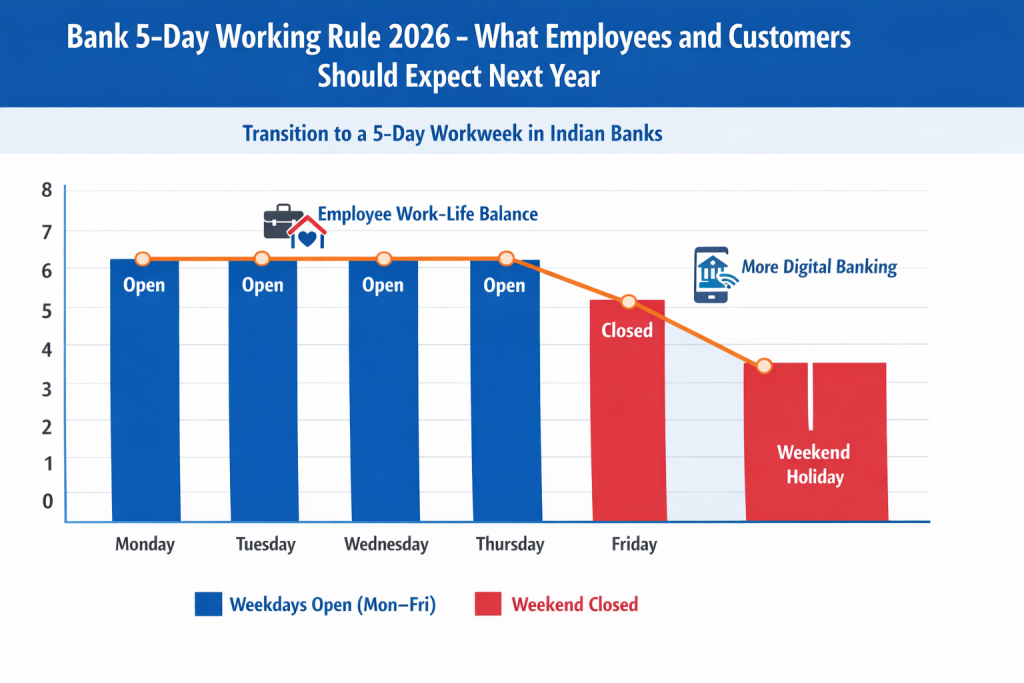
The Bank 5-Day Working Rule 2026 proposes a uniform five day workweek for banks across India. Under this rule, bank branches would operate from Monday to Friday, while Saturday and Sunday would be weekly holidays. The proposal is aimed at standardizing bank working days with other government offices and improving the overall quality of work life for bank employees. This rule is expected to apply to public sector banks, private sector banks, and regional rural banks. While daily working hours are likely to remain unchanged, internal processes and workflows may be reorganized to ensure that customer services continue smoothly. Although the rule has not yet been officially notified, discussions between bank unions, the Indian Banks’ Association, and government authorities indicate that 2026 is being considered as the target year for implementation.
Bank 5-Day Working Rule 2026
| Key Aspect | Details |
|---|---|
| Proposed Workweek | Five days |
| Working Days | Monday to Friday |
| Weekly Holidays | Saturday and Sunday |
| Expected Implementation Year | 2026 |
| Applicable Banks | Public, private, and regional rural banks |
| Core Objective | Better work life balance and efficiency |
| Customer Services | Supported by digital banking |
Background Of 5-Day Working In Banks
- The demand for five day working in banks did not arise overnight. For decades, banks followed a six day workweek, often resulting in long working hours and limited personal time for employees. Over time, the banking sector began to acknowledge the strain this placed on staff, especially with increasing workloads and performance targets.
- A significant milestone came with the introduction of holidays on the second and fourth Saturdays of every month. This change demonstrated that banking operations could continue effectively even with fewer working days. Customer adaptation was smooth, and service delivery remained largely uninterrupted. This success strengthened the case for a complete five day workweek and encouraged bank unions to push for full parity with other government departments.
Why Banks Are Moving Toward A Five Day Workweek
One of the strongest drivers behind the Bank 5-Day Working Rule 2026 is the rise of digital banking. Today, most banking transactions can be completed without visiting a branch. Services such as fund transfers, bill payments, balance inquiries, and account management are available online around the clock. Another important reason is employee wellbeing. Banking has become a high-pressure profession, with strict compliance requirements, sales targets, and customer expectations. A fixed two day weekend can help reduce stress, prevent burnout, and improve overall job satisfaction. From an organizational perspective, well rested employees are more productive, focused, and less prone to errors.
Expected Changes in Bank Working Hours
- While the number of working days may be reduced, banks are not expected to extend daily working hours. Branches will likely continue operating during existing weekday timings. However, internal scheduling may be adjusted to ensure that essential tasks such as clearing, settlements, and back office operations are completed efficiently within the five day framework.
- Banks may also strengthen appointment based services and encourage customers to use digital channels for routine needs. These adjustments aim to maintain service quality without increasing the workload on employees.
Impact Of Five Day Working in Banks on Employees
For bank employees, the Bank 5-Day Working Rule 2026 could bring a significant improvement in quality of life. A predictable weekend allows time for rest, family, personal commitments, and skill development. This balance is particularly important in a profession known for long hours and high responsibility. The rule may also enhance employee morale and motivation. When staff feel valued and supported, it positively affects workplace culture and performance. In the long run, a five-day workweek could make banking careers more attractive to younger professionals who prioritize flexibility and work life balance.
Impact Of Five Day Working In Banks On Customers
- Customers may initially need to adjust their routines, especially those who are used to visiting branches on Saturdays. However, the impact is expected to be minimal due to the widespread availability of digital banking services. Most everyday banking needs can already be handled online or through ATMs.
- Banks are likely to increase awareness programs to help customers become more comfortable with digital platforms. Over time, customers may benefit from improved service quality during weekdays, as better rested staff can provide more focused and efficient assistance.
Role Of Digital Banking In Five Day Working In Banks
Digital banking is central to the success of the Bank 5-Day Working Rule 2026. Online services ensure uninterrupted access to banking facilities even when branches are closed. Mobile banking apps, UPI systems, internet banking portals, and automated customer support tools play a crucial role in maintaining continuity. To support this transition, banks are investing heavily in technology upgrades, cybersecurity measures, and user-friendly interfaces. These efforts not only support the five day work model but also enhance overall customer experience and trust in digital banking.
Current Status of the Bank 5-Day Working Rule 2026
- As of now, the Bank 5-Day Working Rule 2026 is still under consideration and has not been officially implemented. However, discussions among stakeholders suggest a positive outlook. Bank unions continue to advocate strongly for the rule, while authorities are evaluating its operational and customer impact.
- If approved, banks are expected to announce the changes well in advance. This will allow sufficient time for internal restructuring, employee training, and customer communication. A phased and well planned rollout will be essential for smooth implementation.
Challenges In Implementing Five Day Working In Banks
Despite its benefits, the transition to a five day workweek is not without challenges. Some customers still rely heavily on branch based services, particularly in rural and semi urban areas. Ensuring digital accessibility and literacy in these regions will be crucial. Banks will also need to manage peak weekday demand effectively. Proper staffing, efficient workflows, and strong digital support systems will be key to preventing congestion and service delays.
PNB Account Holder Update – Who Can Receive Up to ₹1 Lakh and How the Credit Works
Long Term Benefits of Five Day Working in Banks
- In the long term, the Bank 5-Day Working Rule 2026 has the potential to create a more sustainable and modern banking ecosystem. Improved employee wellbeing can lead to better performance, reduced attrition, and stronger customer relationships.
- For customers, the shift encourages greater adoption of digital banking, which is faster and more convenient. For banks, it offers an opportunity to optimize operations, reduce costs, and align with global best practices.
The Bank 5-Day Working Rule 2026 marks an important step in the evolution of India’s banking sector. It reflects changing societal expectations, technological advancements, and a growing emphasis on employee welfare. While some adjustments will be required from both customers and banks, the long-term advantages outweigh the short-term challenges. If implemented thoughtfully, this reform can improve efficiency, enhance service quality, and create a healthier work environment for bank employees. As 2026 approaches, all eyes will remain on how this proposed rule takes shape and transforms the future of banking in India.
FAQs on Bank 5-Day Working Rule 2026
Will all banks follow the five-day working rule
If approved, the rule is expected to apply to public sector banks, private banks, and regional rural banks across India.
Will bank working hours increase after the rule is implemented
No major increase in daily working hours is expected. Banks are likely to maintain current weekday timings.
How will customers handle urgent banking needs on weekends
Digital banking services such as UPI, mobile apps, internet banking, and ATMs will continue to operate round the clock.
Will this change affect loan processing and approvals
Loan processing timelines are not expected to be affected, as most back-end operations already function digitally.