
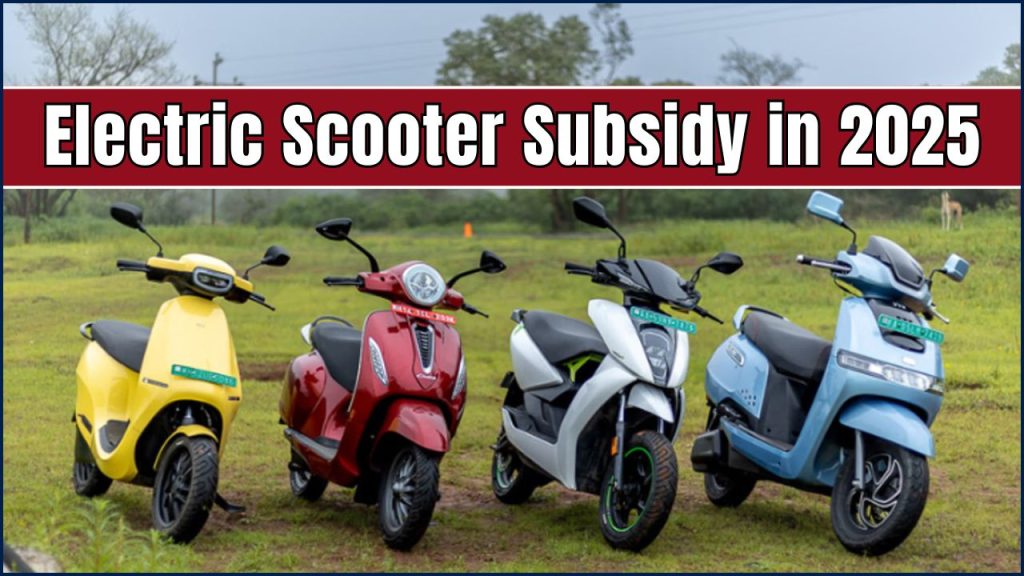
India is witnessing a fresh push toward cleaner, more accessible two-wheeler mobility in 2025 — especially for women. A new subsidy initiative offers eligible women buyers up to ₹46,000 off when they purchase an electric scooter. This move aims not just at promoting electric vehicles (EVs), but also at empowering women with greater independence, affordability, and access to sustainable transport. For many first-time buyers, the subsidy could make the difference between sticking with a petrol scooter and switching to an e-scooter.
Electric Scooter Subsidy in 2025
Under the scheme announced for 2025, women purchasing an electric scooter from approved dealers stand to get a substantial discount — up to ₹46,000 — depending on battery capacity, licence status, and purchase details. This targeted incentive links electric mobility with women’s empowerment, making e-scooters more than just a green choice, but also a tool for social and economic inclusion.
Electric Scooter Subsidy in 2025 Overview Table
| Benefit / Criteria | Details |
|---|---|
| Maximum total subsidy | Up to ₹46,000 for eligible women buyers. |
| Battery capacity-based subsidy | ₹12,000 per kWh — e.g., a 3 kWh battery scooter gets ₹36,000 subsidy. |
| Additional incentive for licence holders | Extra ₹10,000 if buyer has a valid driving licence. |
| Eligibility conditions | — Purchase from a government-approved / authorised dealer — Scooter registered in woman’s name — Only first-time electric scooter buyers eligible. |
| Subsidy application method | Discount applied directly at the time of purchase (not later reimbursement). |
Why the Electric Scooter Subsidy Matters: Bigger Picture
Boosting India’s Electric Two-Wheeler Growth
The subsidy for women isn’t happening in isolation — it coincides with a broader surge in India’s electric scooter market. The demand for EVs has been rising sharply, driven by increasing fuel prices, growing environmental awareness, and improved government policy support. Industry reports estimate that the market for electric two-wheelers could grow significantly over the next several years.
By lowering upfront costs, subsidies like this one encourage adoption among demographics — such as women and first-time buyers — who might otherwise hesitate due to cost. Greater adoption could further accelerate economies of scale, better battery-technology, and wider supporting infrastructure like charging stations.
Environmental and Lifestyle Benefits
Switching to electric scooters offers benefits well beyond the price:
- Cleaner air & lower pollution: E-scooters produce zero tailpipe emissions, helping improve air quality in cities.
- Lower maintenance and running cost: Electric scooters tend to have lower upkeep and fuel costs than conventional scooters — over time, savings on fuel and maintenance can add up.
- Reduced noise & smoother commuting: Electric two-wheelers are quieter and can ease traffic-related noise pollution — improving urban living quality.
- Empowerment and convenience: For women, having a scooter in her own name — at an affordable price — can bring freedom, flexibility for work, errands, travel without relying on others.
Connecting With National EV Policies
Beyond this women-oriented subsidy, there are broader national-level incentives under various EV-promotion schemes. These include direct purchase subsidies, tax and registration-fee waivers, and sometimes interest-subvention on loans. Such policies aim to lower the cost gap between electric and conventional vehicles.
That means, for some buyers, it’s possible that they benefit both from state-level/subsidy-scheme discounts and central-level subsidies (or other incentives) — making the effective cost of owning an EV even lower.
Who Can Claim — Important Eligibility & Conditions for Electric Scooter Subsidy in 2025
If you’re considering buying an e-scooter under this subsidy, here’s what you need to check:
- The buyer must be a woman.
- The scooter must be purchased from a government-approved or authorised dealer (not a random third-party seller).
- The vehicle must be registered in the woman’s name.
- It should be her first electric two-wheeler purchase under the scheme.
- A valid driving licence helps — it can earn an extra ₹10,000 subsidy.
- Ensure you purchase a scooter with appropriate battery capacity (schemes usually calculate subsidy per kWh).
Also, make sure to carry correct documentation — identity proof, address proof, invoice from the dealer, and vehicle registration details. These help make the subsidy claim valid.
Things to Keep in Mind — Caveats and Practical Advice
- Check model eligibility: Not all electric scooters may qualify — sometimes only certain approved models under national or state EV programmes get the subsidy.
- Battery type & specs matter: Many subsidy schemes prefer modern lithium-ion battery scooters over older lead-acid ones, and expect minimum performance benchmarks (range, speed) to count.
- First-time buyers only: If you already own an EV or have already used subsidy, you may not be eligible again under this scheme.
- Dealer legitimacy: Always buy from authorised/approved dealers to avoid issues with registration or subsidy claim.
- Plan for charging & usage needs: While subsidy reduces cost, remember to consider charging infrastructure and whether the scooter’s range suits your daily travel.
The Bigger Impact: What This Could Mean for Women & Cities
For many urban and semi-urban women — students, working professionals, homemakers — this subsidy could make owning a scooter feasible. That’s not just convenience: it’s a boost for independence, mobility, and freedom. Women may find it easier to commute to work, run errands, visit family, or travel on their own terms.
On a larger scale, increased adoption of electric scooters contributes to cleaner air, quieter streets, and reduced carbon emissions. As more people shift from petrol scooters to e-scooters, cities may gradually see lower noise and air pollution, improving overall quality of life.
Moreover, as demand rises, manufacturers and the government may invest more in battery-tech, better e-scooter models, and expanded charging infrastructure — making EVs more accessible to all, not just early adopters.
Why 2025 is the Right Time: Market & Policy Convergence
The timing of this subsidy is not accidental. The electric two-wheeler market in India is already growing fast. Rising fuel prices, growing environmental awareness, and wider availability of EV models are making electric scooters more attractive than ever.
Meanwhile, government policies — at both state and national levels — are converging to support EV adoption: purchase subsidies, tax exemptions, registration benefits, and even loan incentives.
This combination — of demand, supply readiness, policy support, and targeted incentives for women — makes 2025 a potentially pivotal year for turning electric scooters from niche gadgets into mainstream transport for everyday Indians.
Conclusion
The 2025 electric scooter subsidy aimed at women — offering up to ₹46,000 benefit — is more than just a discount. It is a strategic nudge toward sustainable mobility, gender empowerment, and cleaner cities.
For many women, this subsidy makes buying a scooter affordable, giving them mobility, independence, and convenience. For society at large, wider adoption of e-scooters means reduced pollution, quieter roads, and progress toward environmental goals. When coupled with broader EV policies and market momentum, this initiative could mark a turning point in India’s journey toward greener, inclusive, and modern transport.
If you’re a woman thinking of buying your first scooter — this might be the right time. But before you buy: check eligibility carefully, choose a suitable model and battery capacity, confirm dealer’s approval, gather required documents, and assess your commuting needs.
With the right planning and awareness, this subsidy can become a stepping stone — not just to a scooter, but to a cleaner, freer, and more empowered journey.