
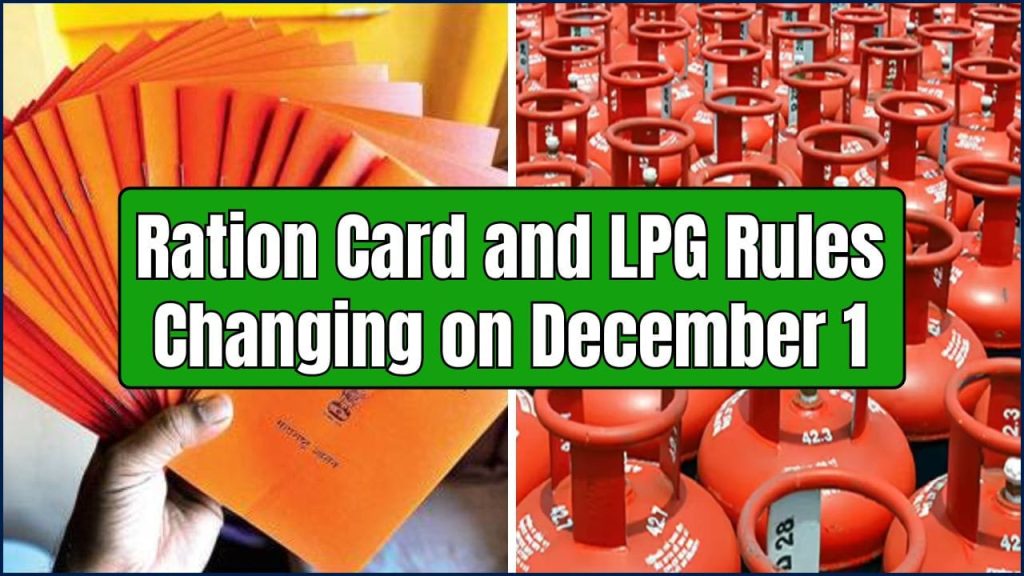
India will implement four major changes to the Ration Card and LPG Rules beginning 1 December, as part of a nationwide effort to improve the accuracy of welfare distribution. The reforms focus on Aadhaar-based verification, digital authentication systems, and tighter eligibility checks, according to statements from the Ministries of Consumer Affairs and Petroleum.
Why the December Rules Matter
India’s Public Distribution System (PDS) serves over 800 million people under the National Food Security Act (NFSA), making it one of the world’s largest food-security programmes.
Similarly, subsidised LPG supply reaches millions of households under the Direct Benefit Transfer for LPG (DBTL) system.
Government officials say the new December rules strengthen these programmes by improving data accuracy, curbing duplication, and ensuring that the right households receive benefits in real time. The step follows repeated observations from the Comptroller and Auditor General (CAG) that outdated records and mismatched identities resulted in leakages.
Key Changes Taking Effect on December 1
Mandatory Aadhaar Verification for All Ration Card Members
The Ministry of Consumer Affairs has directed that every individual listed on a ration card must complete Aadhaar-based e-KYC. According to the ministry, this measure is intended to eliminate duplicate or ghost beneficiaries often detected during physical audits.
A ministry spokesperson said, “Aadhaar authentication helps ensure that benefits reach legitimate families. This enhances transparency and reduces diversion at multiple stages of the supply chain.”
Some states, such as Telangana and Gujarat, already report Aadhaar seeding levels above 95 percent, while others are in earlier stages of integration.
Stricter Aadhaar–Bank Linking for LPG Subsidy Transfers
From December, LPG subsidies will only be transferred to households whose Aadhaar numbers match their LPG connection and bank account.
The Ministry of Petroleum and Natural Gas emphasised that the reform aligns with Direct Benefit Transfer (DBT) requirements.
An official statement noted, “The linking of Aadhaar with LPG and bank accounts ensures that subsidies are transferred without delay or error.”
Fuel-sector analysts say this may streamline subsidy distribution but will require households to update their details promptly.
Consumer groups have welcomed the clarity but cautioned that rural households may face delays if banking correspondents are unavailable.
Expansion of Digital and Biometric Systems at Ration Shops
Ration dealers nationwide are transitioning towards biometric-enabled point-of-sale devices that check beneficiary identity using fingerprints or iris scans. This system also supports portability under the One Nation, One Ration Card (ONORC) initiative.
According to government data, more than 90 percent of fair-price shops operate with digital authentication systems.
A policy expert at the Indian Council for Research on International Economic Relations (ICRIER) said, “Digital PDS is not just an efficiency measure; it provides mobility for migrant workers who were previously excluded when living outside their registered district.”
Tighter Checks to Remove Duplicate or Fake Ration Cards
The government has directed state food departments to conduct fresh audits of ration-card records.
This includes identifying beneficiaries who have moved, passed away, or no longer qualify under NFSA criteria.
A research fellow at the National Institute of Public Finance and Policy (NIPFP) noted, “These measures reflect a shift to data-driven governance, reducing both fiscal pressure and administrative burdens.”
How Ration Card and LPG Rules Changes Affect Households
Impact on Low-Income Families
The most affected group is low-income households dependent on subsidised grain and LPG.
While the government has announced help desks to support the verification process, concerns remain over Aadhaar authentication failures—particularly among the elderly.
Impact on Migrant Workers
ONORC-enabled portability is expected to give migrant families improved access to food grains even when residing temporarily in other states.
Social-policy advocates say this is a major step toward inclusive welfare.
Impact on LPG Distributors
LPG agencies may experience increased footfall as customers verify bank details, though industry groups say this will stabilise once records are updated.
What the December Rules Don’t Change
The quantity of subsidised food grains, LPG cylinder pricing, and eligibility under the National Food Security Act remain unchanged. The reforms affect only verification and documentation systems.
International Comparison
Several countries, including Indonesia and Brazil, use centralised digital databases to verify welfare beneficiaries.
Experts say India’s system is among the largest, though challenges such as biometric failures and connectivity issues persist.
What Households Should Do Before December 1
- Ensure Aadhaar numbers of all ration-card members are updated.
- Check linkage between LPG connection, Aadhaar, and bank account.
- Update mobile numbers linked to Aadhaar for OTP authentication.
- Visit local ration shops or LPG distributors for support if needed.
Looking Ahead
Experts anticipate further reforms, including real-time tracking of foodgrain movement, automated subsidy calculation, and deeper integration of welfare databases.
Officials say the December rules lay the groundwork for a more accountable and efficient subsidy framework.
Student Credit Card Scheme 2025: New Rules, Application Process & How to Get ₹10 Lakh with Ease!
Conclusion
The reforms to the Ration Card and LPG Rules mark a significant shift in the government’s approach to welfare delivery. By tightening identity checks and embracing digital systems, India aims to reduce leakages and strengthen its social-support mechanisms. The success of these reforms, however, will depend on coordinated execution and effective outreach to vulnerable groups.