
If you are filling any government or admission form in India this year, you will almost certainly see one term pop up again and again, Domicile Certificate 2025. Understanding Domicile Certificate 2025 properly can save you from rejected applications, lost quota benefits, and last minute panic when a college or recruiter suddenly asks for proof that you are a permanent resident of a particular state. At its core, a domicile certificate is your state’s official proof that you genuinely belong there, not just someone staying temporarily for work or study. For students, job seekers, and families looking to use state level schemes, this one document quietly decides whether you are treated as a local or an outsider. Once you know what it is, who needs it, and how to apply, the process becomes far less scary and much more manageable.
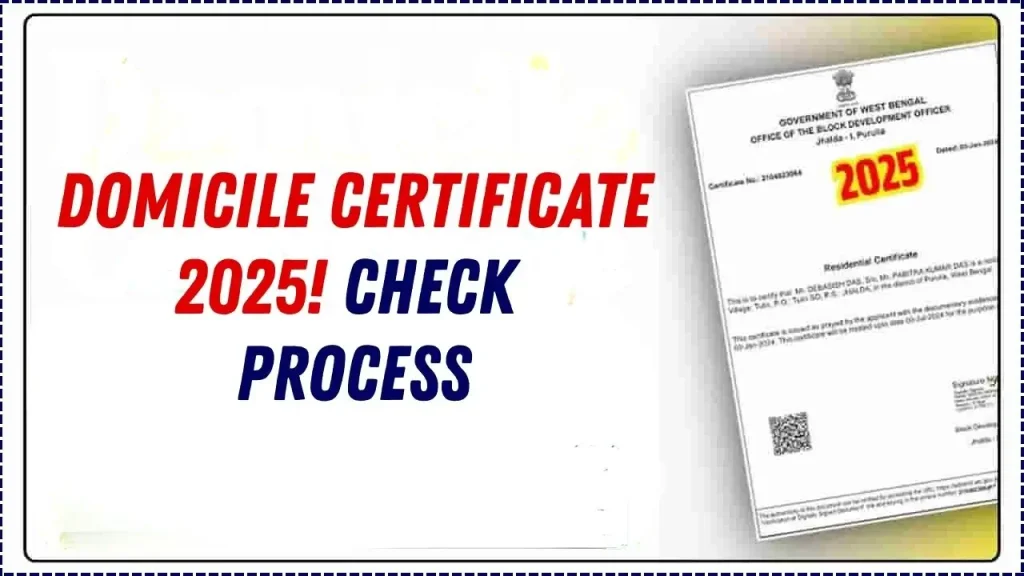
Domicile Certificate 2025 is the document that confirms your long term residential link with a specific state or Union Territory in India. It is normally issued by the revenue authorities of that state, such as the Tehsildar, Sub Divisional Magistrate, or District Magistrate. This certificate is widely used for state quota seats in professional courses, state government jobs, local scholarships, and state specific welfare schemes. In 2025, most states support online applications for Domicile Certificate 2025 through their official service or e governance portals, while still allowing offline submission through tehsil offices and common service centres for people who prefer or need a paper based route.
Domicile Certificate 2025
| Point | Details |
|---|---|
| What It Proves | That you are a permanent or long term resident of a particular state or Union Territory. |
| Issuing Authority | Usually Tehsildar, Sub Divisional Magistrate, District Magistrate, or other notified revenue officials. |
| Main Uses | State quota admissions, state government jobs, competitive exam domicile criteria, local scholarships, and state level schemes. |
| Who Can Apply | People born, educated, or residing for a defined continuous period in the state, and children or spouse of an existing domicile holder. |
| Application Modes | Online applications through state service or e District portals and offline applications via Tehsildar, SDM, or common service centres. |
| Key Documents | Identity proof, address proof, age or education proof, photographs, and sometimes an affidavit or family register extract. |
| Processing Time | Typically around 7 to 15 working days after submitting a complete application, depending on the state. |
| Validity | Generally treated as long term and often lifelong, unless your permanent residence officially shifts to another state. |
| Legal Rule | A person is expected to hold domicile of only one state or Union Territory at a time. |
Meaning And Uses of Domicile Certificate
A domicile certificate is an official statement from a state government that you are a genuine permanent resident of that state. It is different from a simple address proof because it is meant to reflect a deeper and more stable connection, such as birth, long residence, or roots through your parents or spouse.
Institutions use domicile when they need to separate local candidates from those coming from outside the state. For example, state medical and engineering colleges use it to decide who qualifies for state quota seats. Recruiters use it in government job notifications where some posts are reserved for state residents. Many state scholarships, fee waivers, and local welfare schemes will clearly mention that a valid domicile certificate is mandatory to claim the benefit.
Eligibility Criteria For Domicile Certificate 2025
- Every state frames its own rules, but the broad pattern for eligibility is similar across India. You are usually considered eligible if one or more of the following conditions apply to you.
- First, you were born in the state or have studied there for a continuous number of years fixed by that state. Second, you or your parents have been living in that state for a long continuous period, often measured in years of residence or entries in local records such as the voter list or family register. Third, minors usually claim domicile through their parents or legal guardians, and married women can often apply for domicile in the state where their husband is a permanent resident.
- The exact years of stay, required proofs, and special relaxations differ from state to state. That is why you should always check the specific conditions on your own state portal before filing your Domicile Certificate 2025 application.
Documents Required For Domicile Certificate 2025
- Although formats vary, most states ask for a similar core set of documents to support a domicile certificate request. Having these ready in advance will save you time and reduce the risk of rejection.
- You will normally need at least one clear identity proof, such as Aadhaar card, voter identity card, passport, driving licence, or a similar government issued photo document. You will also need address proof, which can include electricity or water bills, bank statements, ration card, rent agreement, or any official document that clearly carries your current address.
In addition, you are usually asked for proof of age or education, such as a birth certificate, school leaving certificate, or transfer certificate from a recognised institution. Passport size photographs are compulsory, and many states also ask for a self declaration or affidavit confirming that you are a permanent resident and that you are not holding domicile of any other state. Some states, especially hill or special category states, may also require local records like a family register entry, land papers, or a report from local authorities.
Online Application Process For Domicile Certificate 2025
In 2025, the online route for Domicile Certificate 2025 is the default option in most states, and it is usually the fastest and most convenient way to apply. The exact portal name changes by state, but the basic steps are almost the same everywhere.
- First, you visit the official state service or e District portal and search for the domicile certificate service. You then create a user account if you are a new user, or log in if you already have one. After that, you open the domicile application form and fill in your personal, contact, and address details exactly as they appear in your supporting documents. Any spelling mismatch can slow the process or trigger objections.
- Next, you upload scanned copies of your identity proof, address proof, age or education proof, photographs, and any additional documents listed for your state. After reviewing the details, you pay the required fee online using the available payment options. Once you submit the form, the system generates an acknowledgement or application number, which you should save or print. This number allows you to track the status of your Domicile Certificate 2025 application on the same portal.
Offline Application Process for Domicile Certificate 2025
- If you are more comfortable with paper forms, or if your area still relies heavily on physical applications, you can apply for Domicile Certificate 2025 offline. The process is slightly slower but simple if your documents are in order.
- You start by visiting the Tehsildar office, Sub Divisional Magistrate office, District Magistrate office, or an authorised common service centre that handles domicile certificate applications. There you collect the printed application form or get it filled by the staff if that service is provided. You then complete all personal, address, and family details carefully, attach photocopies of all required documents, and add your photographs in the prescribed size.
- The filled form, along with the fee, is submitted at the counter. In return, you receive a receipt or acknowledgement with a reference number. Your application then goes through verification, which may include checking records and, in some cases, a local enquiry. Once approved, the domicile certificate is prepared and either handed over at the office or made available for download if your state has linked offline applications to its digital system.
Fees Processing Time And Validity
- The fee for Domicile Certificate 2025 is intentionally kept low by most state governments so that every eligible resident can afford it. In some places the certificate is almost free, especially when applied online, while a small charge is taken at common service centres or for urgent processing. Since fees do change from time to time, it is always better to confirm the current amount on the official portal or at the local office before applying.
- Processing time also depends on the state and on how complete your documents are. A common service level promise is around seven to fifteen working days from the date of submission. If there are mismatches in names, missing pages, or doubts about your period of stay, it can take longer, because the authorities may ask for clarification or additional evidence. Keeping your paperwork neat and consistent is the best way to avoid such delays.
- In many states, domicile certificates are treated as valid for life unless you formally change your permanent residence to another state. Some specific exams or schemes may still insist on a recently issued certificate, for example not older than six months, so it is wise to read each notification carefully. If you know you will need Domicile Certificate 2025 for admissions or recruitment, do not wait until the last week before the deadline.
YSR Cheyutha 2025 — How Women Can Receive the ₹75,000 Financial Support
Practical Tips For Applicants In 2025
- For a smooth experience, treat Domicile Certificate 2025 as a key document and plan for it early, especially if you are in class twelve, preparing for competitive exams, or actively applying for government vacancies. Start by checking your basic documents and making sure that your name, your parents names, and your address are written in the same way everywhere. Even small spelling differences between Aadhaar, school records, and bank statements can create unnecessary queries.
- Finally, remember that you are expected to hold domicile of only one state or Union Territory at a time. Trying to obtain multiple domicile certificates may look attractive in the short term, but it can create serious legal problems and permanently affect your eligibility in competitive exams and jobs. It is always better to choose the state where you genuinely qualify and build your documentation honestly around that.
FAQs on Domicile Certificate 2025
Q1. Who should apply for Domicile Certificate 2025
Anyone who plans to claim state quota seats in colleges, apply for state government jobs, access local scholarships, or use state specific welfare schemes should apply.
Q2. Can I apply for domicile if my parents live in another state
In many states, minors and young adults can link their domicile claim to their parents’ permanent residence.
Q3. What if my application for domicile certificate gets rejected
If your application is rejected, the order usually mentions the reason, such as missing documents, unclear address proof, or not meeting the minimum residence requirement.
Q4. Is a domicile certificate the same as a residence certificate
No, a domicile certificate is meant to prove long term and permanent residential connection with a state, while a residence certificate may only show where you are currently staying.