

The new 401(k) rule targets high-income Americans in 2026 by changing how age-50-and-over savers make catch-up contributions. If your prior-year wages cross a set threshold, your catch-up dollars must go into Roth (after-tax) instead of pre-tax, shifting the tax break from now to retirement. Limits are also rising in 2026, so there’s more room to save even as tax timing changes. This isn’t a cut to how much you can contribute it’s a change in how those catch-up contributions are taxed.
The 2026 401(k) rule targets high-income Americans in a very specific way: it ties mandatory Roth treatment of catch-ups to your prior-year wages from your current employer. If you’re age 50 or older and your W‑2 Social Security wages exceed the indexed threshold in the prior year, your catch-up contributions in 2026 have to be Roth. Plans need Roth functionality to accept those catch-ups; otherwise, affected participants can’t make catch-ups at all. This provision is part of the SECURE 2.0 framework, alongside higher contribution limits and a “super catch-up” window for savers ages 60–63.
This section breaks down what’s actually changing in 2026, who’s affected, and how to prepare so you don’t miss savings or trigger payroll corrections. The mandate applies to catch-up contributions for age-50+ participants who exceed the prior-year wage threshold from their current employer. It does not reduce your ability to make regular deferrals. Most savers will focus on three actions: confirm Roth is available in the plan, set 2026 elections correctly before the first payroll, and re-run tax estimates to account for the loss of a pre-tax catch-up deduction. The higher 2026 contribution limits and the optional super catch-up for ages 60–63 expand how much late-career workers can set aside, but the tax timing for high earners shifts to Roth. Use this to your advantage by planning for tax-free withdrawals later.
New 401(k) Rule Targets High-Income Americans in 2026
| Key Point | 2026 Details |
|---|---|
| Employee 401(k) deferral limit | $24,500 employee cap for 401(k)/403(b)/governmental 457/TSP |
| Standard age‑50+ catch‑up | $8,000 (mandatory Roth for high earners over the wage threshold) |
| Super catch‑up (ages 60–63) | $11,250 where the plan offers it, in addition to standard limits |
| Roth catch‑up trigger | Prior‑year W‑2 Social Security wages above the indexed threshold (employer-specific) |
| Effective date | Plan years beginning on or after Jan 1, 2026 |
| Plan amendments | Generally due by end of the 2026 plan year; operational readiness needed by Jan 1, 2026 |
| Overall additions cap (415(c)) | Around $72,000 total employee + employer, depending on final COLA |
The 2026 401(k) rule targets high-income Americans by mandating Roth catch-ups once you cross the prior‑year wage threshold, but it doesn’t shrink your savings capacity. With higher limits and a clear start date, the winners will be those who update elections early, confirm Roth availability, and fine‑tune tax withholding. Treat this as an opportunity to build more tax‑free retirement income while still maximizing employer matches and, where available, after‑tax strategies up to the overall additions cap.
What’s Changing and Why
Congress designed the Roth catch-up requirement to accelerate tax revenue from higher earners while preserving the amount they can save. Starting in 2026, affected catch-up contributions must be Roth no upfront deduction while qualified withdrawals remain tax-free. Regular deferrals still allow pre-tax or Roth subject to plan rules. The policy nudges high-income savers to pay tax now, while maintaining the core incentive to maximize retirement contributions.
Who Is Affected In 2026
The 2026 401(k) rule targets high-income Americans who are age 50+ and whose prior-year wages from the current employer exceed the indexed threshold (widely communicated as $150,000 for the 2025 wage year determining 2026 status). The test uses W‑2 Social Security wages for the employer sponsoring the plan; switching jobs can change which wages count. If your plan doesn’t offer Roth, catch-ups may be blocked for those over the threshold until Roth is added. Those below the threshold can still choose pre-tax or Roth catch-ups if the plan offers both.
Key 2026 Limits You Need to Know
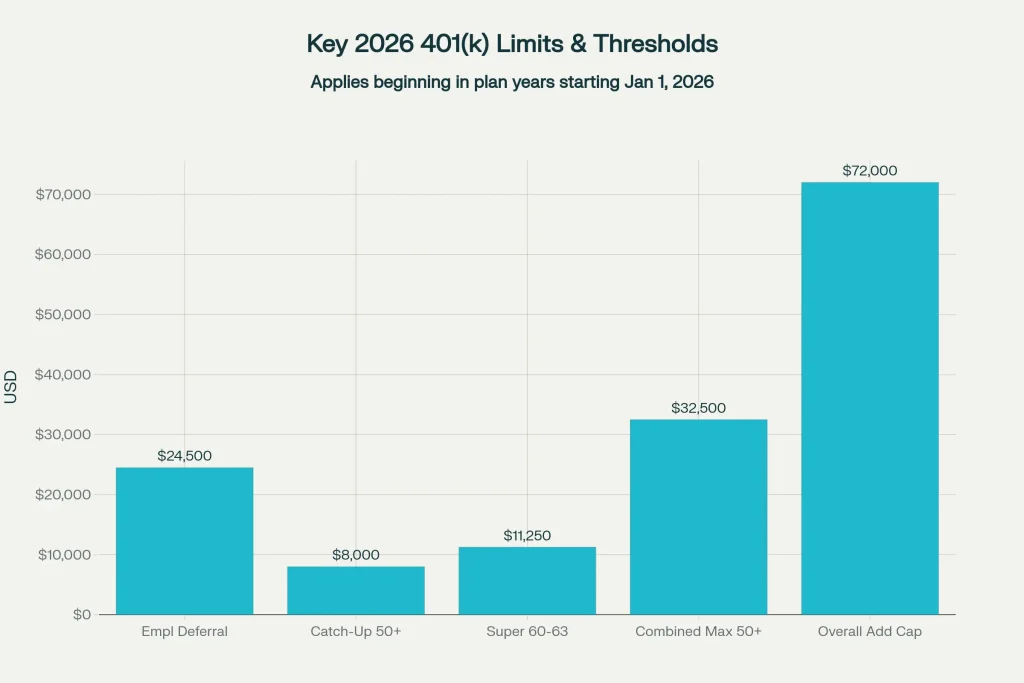
Employees can defer up to $24,500 in 2026. The age‑50+ catch-up rises to $8,000. That means someone 50 or older can contribute up to $32,500 in employee dollars before any employer match. For ages 60–63, plans may offer a higher “super catch-up” of $11,250, increasing the total you can add in those years. Separate from employee contributions, the overall additions cap employee plus employer rises too, giving room for matches, profit sharing, and after-tax contributions where allowed.
Nuances, Exceptions, And Special Catch-Ups
Governmental 457(b) plans have a special three‑years‑to‑retirement catch‑up that remains pre-tax and sits outside the Roth‑only mandate; any age‑50 catch-ups beyond that special window follow the Roth rule if you’re over the wage threshold. In 403(b) plans, the 15‑year service catch‑up stays pre-tax and is coordinated with age‑based catch-ups; contributions typically apply first to the 15‑year catch-up, then to age‑based catch-ups, including the super catch‑up where offered. SIMPLE plan catch‑up coordination follows its own guardrails and cannot stack certain boosts in the same year.
How Plan Sponsors Are Preparing
Plan sponsors are working with payroll and recordkeepers to ensure Roth is enabled, catch-up codes are mapped correctly, and participant notices go out before the first 2026 paycheck. Operational compliance starts January 1, 2026, even though formal amendments can be adopted by the end of the plan year. Plans without Roth need to decide whether to add it or limit catch-ups for those over the threshold; most employers add Roth to avoid restricting benefits for older high earners.
How To Stay Ahead of New 401(k) Rule If You’re High Income
- Set your elections early: If your 2025 W‑2 wages from your current employer will exceed the threshold, switch 2026 catch-ups to Roth before the first payroll.
- Re-run your tax forecast: Without the pre-tax catch-up deduction, your 2026 taxable income will be higher; adjust withholding or quarterly estimates now.
- Sequence intelligently: If you prefer current-year deductions, fill the $24,500 pre-tax limit first, then layer Roth catch-ups to reach $32,500 (or more with the super catch‑up ages 60–63).
- Confirm features: Check your plan portal for Roth availability, super catch-up eligibility, and any steps required to enable Roth withholding in payroll.
- Coordinate equity comp: RSU vests and ESPP purchases can spike taxable income; plan Roth catch-ups and withholding with those dates in mind.
- Use after-tax strategies if available: If your plan allows after-tax contributions and in-plan Roth conversions (mega backdoor), you may be able to save beyond employee caps up to the overall additions limit.
If You’re Under The Threshold
You can still choose pre-tax or Roth for your catch-ups when the plan offers both. Consider your current marginal tax rate versus your expected retirement tax rate. If you expect higher rates later or want tax diversification, Roth may still make sense. If you value current-year tax savings and anticipate lower retirement rates, pre-tax catch-ups can be compelling. Either way, the higher 2026 limits expand your room to save.
Interactions With HCE Status And Testing
“High earner” for the Roth catch-up trigger is not the same as being a “Highly Compensated Employee” under testing. The HCE compensation figure used in nondiscrimination testing has its own threshold and purpose. Even with higher 2026 limits, participants in non‑safe‑harbor plans may see refunds if testing fails. Encouraging broad participation and considering safe harbor designs can help protect contributions for HCEs.
Millions on SNAP Could Be Affected—Trump Officials Say This Is Why You Might Need to Reapply
Correction Rules And Clean-Up
If a catch-up is mistakenly withheld pre-tax for someone above the threshold, the latest rules outline correction methods. These include recharacterizing the amount as Roth via reporting adjustments, and in some cases using deemed Roth treatment under a plan’s written procedures. There is also a de minimis exception for small amounts before correction is required. The practical takeaway: set elections correctly in December, verify in January pay stubs, and work with HR promptly if something looks off.
Practical Next Steps For 2026
- Verify your 2025 W‑2 wage level in December or as soon as practical.
- Confirm your plan supports Roth and, if relevant, the super catch-up ages 60–63.
- Update your 2026 elections to direct catch-ups to Roth if you’re over the threshold.
- Book a quick tax check-in to recalibrate withholding and estimated taxes.
- If you changed employers in 2025, remember that only prior‑year wages from your current employer count toward the trigger.
- Review after-tax and in-plan Roth conversion options to expand savings up to the annual additions cap.
FAQs on New 401(k) Rule Targets High-Income Americans in 2026
When does the new Roth catch-up rule start?
It applies for plan years beginning on or after January 1, 2026. Make sure your first payroll of 2026 routes catch-ups correctly.
What are the 2026 401(k) limits for employees age 50+?
Regular deferrals rise to $24,500 and the standard catch‑up is $8,000, for a combined employee maximum of $32,500 before any employer contributions. If your plan offers it and you’re ages 60–63, the super catch-up is $11,250.
Does the rule reduce how much I can save?
No. It changes the tax treatment of catchups if you exceed the wage threshold. Your contribution space increases in 2026; the catch-up just becomes Roth if you’re over the line.
How do job changes affect the threshold?
The test uses your prior‑year W‑2 Social Security wages from your current employer. A job switch may change whether you’re subject to the Roth-only rule in 2026.