

The Employees’ Pension Scheme has re-entered the spotlight with a proposal to raise the EPS-95 pensionable salary cap from ₹15,000 to ₹25,000 a move that could meaningfully increase pension payouts for millions of salaried workers if and when it is officially notified. The logic is straightforward: your EPS accruals are calculated on a capped wage; when that ceiling rises, the employer’s 8.33% contribution allocated to your pension rises in tandem, strengthening the base that ultimately determines your monthly pension at retirement.

The EPS-95 pension update, if approved, would shift the pensionable salary ceiling used for computing the employer’s 8.33% contribution from ₹15,000 to ₹25,000. That takes the employer’s EPS allocation from ₹1,250 per month to ₹2,083 per month for members hitting the cap, without increasing your own 12% EPF deduction. While the proposal is pending formal notification, it aligns with the broader modernization drive to make social security reflect current wage structures and reduce benefit compression for employees whose earnings have long surpassed the old ceiling.
Under EPS-95, only the capped wage counts as the pensionable salary, regardless of actual eligible pay. This restricts accruals for workers earning above the ceiling. Raising the cap to ₹25,000 expands the pensionable base and increases the employer’s monthly EPS contribution to ₹2,083, which compounds over years of service. Practical timelines and procedural details will be clear only after the government issues a notification and EPFO publishes operating guidelines for payroll compliance.
EPS-95 Pension Update
| Item | Detail |
|---|---|
| Scheme | Employees’ Pension Scheme, 1995 (EPS-95), administered by EPFO |
| Current Pensionable Salary Cap | ₹15,000 per month |
| Proposed Pensionable Salary Cap | ₹25,000 per month (under consideration) |
| Employer EPS Rate | 8.33% of pensionable salary (up to the cap) |
| Current Employer EPS Contribution | ₹1,250 per month at ₹15,000 cap |
| Proposed Employer EPS Contribution | ₹2,083 per month at ₹25,000 cap |
| Potential Beneficiaries | 6.5 crore+ EPFO subscribers likely impacted |
| Status | Proposal; formal notification pending |
If approved, the EPS-95 salary cap hike to ₹25,000 is a simple, high-impact lever to strengthen pensions for millions without raising the employee’s contribution rate. By lifting the pensionable base, the employer’s 8.33% contribution climbs from ₹1,250 to ₹2,083 per month at the new ceiling, and that added flow compounds across service years. Keep an eye on the official notification and the subsequent EPFO circulars. Those will be the green light for employers to adjust payroll, for employees to track enhanced EPS credits, and for pension projections to reflect the revised ceiling in a way that’s finally aligned with today’s wage landscape.
Why The Salary Cap Matters
Pension adequacy depends on two pillars: pensionable salary and pensionable service. The cap constrains the first. When the cap is low compared with real wages, monthly inflows into EPS underrepresent actual earning power, dampening the final pension. Raising the ceiling lets more of your real pay count toward the pension formula, especially for workers in urban centers and growth industries where ₹15,000 no longer mirrors typical salaries.
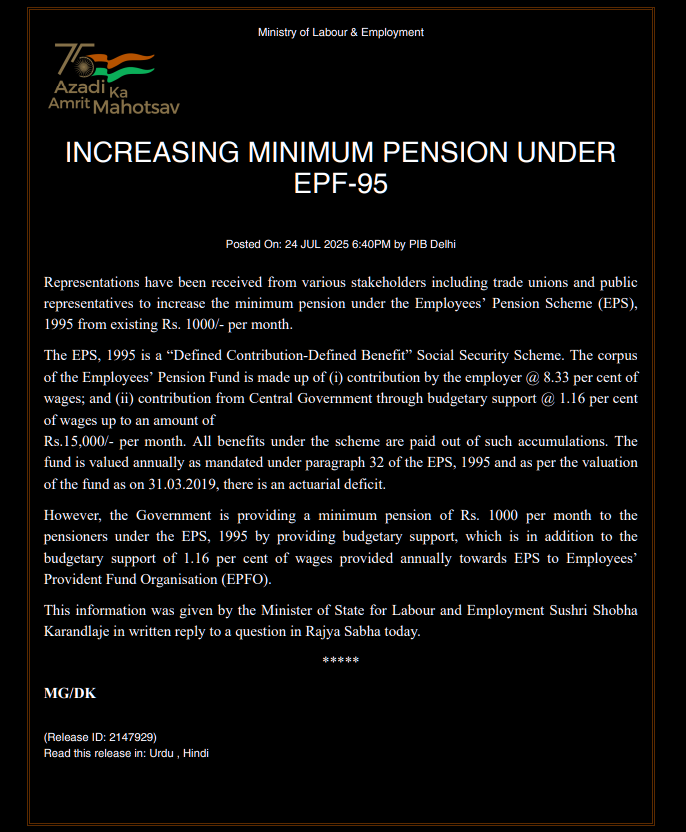
How The Math Works for EPS-95 Pension Update
- Today: 8.33% of ₹15,000 = ₹1,250 per month into EPS.
- Proposed: 8.33% of ₹25,000 = ₹2,083 per month into EPS.
- Difference: About ₹833 more each month—or nearly ₹10,000 extra each year flowing to the pension side for capped earners. Over a decade or two, that persistent increase in contribution base can translate into a materially higher pension at superannuation, subject to the scheme’s calculation rules.
Who Stands To Benefit
- Employees with eligible wages above ₹15,000 in sectors like services, manufacturing, logistics, retail, and MSMEs.
- Mid-career professionals and younger employees with rising earnings trajectories who’ll gain more years of higher accruals.
- New entrants close to or above the old threshold, building a stronger pensionable base from the start.
- Establishments with sizable workforces in the ₹15,000–₹25,000 bracket that will see a larger share of the employer contribution diverted to EPS up to the new ceiling.
Context And Status Check
The last major wage ceiling revision lifted the EPS cap from ₹6,500 to ₹15,000 in 2014. Since then, wages have grown across many segments, while the cap remained static widening the gap between actual earnings and pensionable salary. Discussions about increasing the minimum pension have also circulated, but that track is distinct from the wage ceiling change. As of now, the salary cap hike remains a proposal. It will take effect only after formal notification, followed by EPFO circulars detailing the effective date and payroll instructions.
Practical Takeaways for Employers and Employees
- For employers: The statutory 12% employer contribution remains the same. The internal split between EPF and EPS changes once the cap is revised ensure HRMS and payroll rules allocate 8.33% of the revised pensionable salary to EPS (up to the new ceiling) and maintain accurate compliance records.
- For employees: Your own 12% contribution to EPF does not rise because of the cap change. The impact is on how the employer’s 12% share is apportioned. With a higher cap, more of the employer contribution flows into EPS, improving your pensionable base without increasing your take-home reduction beyond the existing statutory structure.
Impact On Pension Payouts
EPS pensions depend on average pensionable salary and the length of pensionable service. A higher ceiling directly increases the pensionable component for those previously constrained, which can result in a noticeable uplift in the final pension. The exact benefit will vary by individual service histories, contribution patterns, and the scheme’s calculation method at exit.
Alignment With EPFO Modernization
The proposed cap hike fits within the effort to modernize and rationalize social security digitally enabled, equitable, and aligned to contemporary pay scales. It narrows the mismatch between actual earnings and pensionable salary, making EPS fairer for those whose incomes have moved well beyond ₹15,000. In effect, it updates a legacy ceiling to today’s realities without altering the 8.33% EPS rate or the employee’s 12% EPF contribution.
Case Illustration: Mid-Career Employee
Consider a 35-year-old employee with eligible wages above ₹25,000, 10 years of service completed, and 20 years to go. Under the old cap, the EPS inflow is ₹1,250 per month. Under the proposed cap, it becomes ₹2,083 per month a 66% jump. Over 20 years, that additional ₹833 per month compounds into a significantly larger pensionable base, potentially adding a meaningful margin to monthly pension at retirement, all else equal. While this is a simplified illustration, it captures the directional effect of a higher ceiling over long tenures.
What To Watch Next
- Official notification in the Gazette confirming the wage ceiling revision and effective date.
- EPFO circulars clarifying payroll implementation, any transitional provisions, and validation checks for compliance.
- Employer updates to HRMS, payslips, and Form 10D-prep workflows to reflect the revised pensionable salary.
- Any accompanying clarifications regarding eligibility, average pensionable salary computation windows, and coordination with the 1.16% support mechanism parameters.
FAQs on EPS-95 Pension Update
Is the EPS salary cap change already in effect?
No. It remains a proposal. It will apply only after a formal government notification and EPFO implementation guidelines are released.
How much will the employer contribute if the cap becomes ₹25,000?
At 8.33% of ₹25,000, the employer’s EPS contribution would be ₹2,083 per month for employees whose pensionable salary reaches the cap.
Will my own EPF deduction increase due to this proposal?
No. Your employee contribution stays at 12% of eligible wages. The change primarily shifts a larger portion of the employer’s 12% into EPS up to the revised cap.
Who benefits the most from this revision?
Employees with eligible wages above ₹15,000 especially mid-career and younger workers because a larger share of actual pay becomes pensionable, lifting eventual pension outcomes over time.