

A steady income is non-negotiable when budgeting for monthly bills, EMIs, and medical expenses. That’s where the Post Office Monthly Income Scheme steps in: a government-backed savings plan designed to generate predictable monthly interest for five years with low risk and easy access through India Post branches. It’s simple to open, straightforward to manage, and it does exactly what it promises credit interest every month, so your cash flow stays smooth.
The Post Office Monthly Income Scheme offers a fixed annual rate paid out monthly for a five-year term, combining sovereign safety, a modest lock-in, and nationwide servicing. You can open single or joint accounts, add a nominee, and have interest auto-credited to your linked Post Office Savings Account or bank account via ECS.
Post Office Plan Offers Monthly Interest
| Item | Details |
|---|---|
| Scheme | Post Office Monthly Income Scheme (POMIS) |
| Tenure | 5 years with monthly interest payout |
| Minimum Deposit | ₹1,000 (in ₹1,000 multiples) |
| Maximum Deposit | ₹9,00,000 (single) and ₹15,00,000 (joint up to 3 adults) |
| Payout Frequency | Monthly credit to linked Post Office/Bank account |
| Liquidity | Premature closure allowed after 1 year with deductions |
| Taxation | Interest taxable as per slab; plan advance/self-assessment taxes |
| Ownership | Single and joint accounts; nomination facility |
| Servicing | Available across India Post network; ECS/auto credit supported |
The Post Office Monthly Income Scheme is a practical, low-drama way to convert a lump sum into steady monthly income for five years with the comfort of sovereign backing. It’s easy to open, easy to run, and easy to map to your bills. Use it as the monthly anchor, then layer SCSS and Time Deposits by your eligibility and goals to build a resilient income ladder. That simple blueprint keeps your essentials funded, reduces reinvestment risk, and preserves peace of mind exactly what dependable cash flow should do.
What The Scheme Is and Why It Matters
The Post Office Monthly Income Scheme is a small savings instrument built for predictable cash flows. Unlike market-linked options, your principal is protected, and your interest arrives monthly, making it ideal for retirees, homemakers, and conservative savers. The five-year tenure strikes a balance: not too short to compromise returns, not too long to restrict flexibility.
Key Features At A Glance
- Government backing that emphasizes safety first and dependable execution.
- Monthly interest credit to support budgeting for utilities, rent, EMIs, or medical costs.
- Low entry point of ₹1,000 so you can start small and scale within limits.
- Flexible holding formats single or joint (up to three adults) plus nomination for ease of transmission.
Eligibility And Account Opening
Adults can open the account individually or jointly; minors may be allowed under guardian rules as per postal norms. Non-resident Indians aren’t eligible. Opening is handled at designated India Post branches with standard KYC (identity, address, photos) and a linked Post Office or bank savings account for crediting interest.
Interest Rate And How Payouts Work
Think of it in two steps:
- Interest accrues daily on your principal at the notified annual rate.
- It’s credited to your linked account every month, giving steady, calendar-friendly cash flow.
A quick rule-of-thumb for estimates:
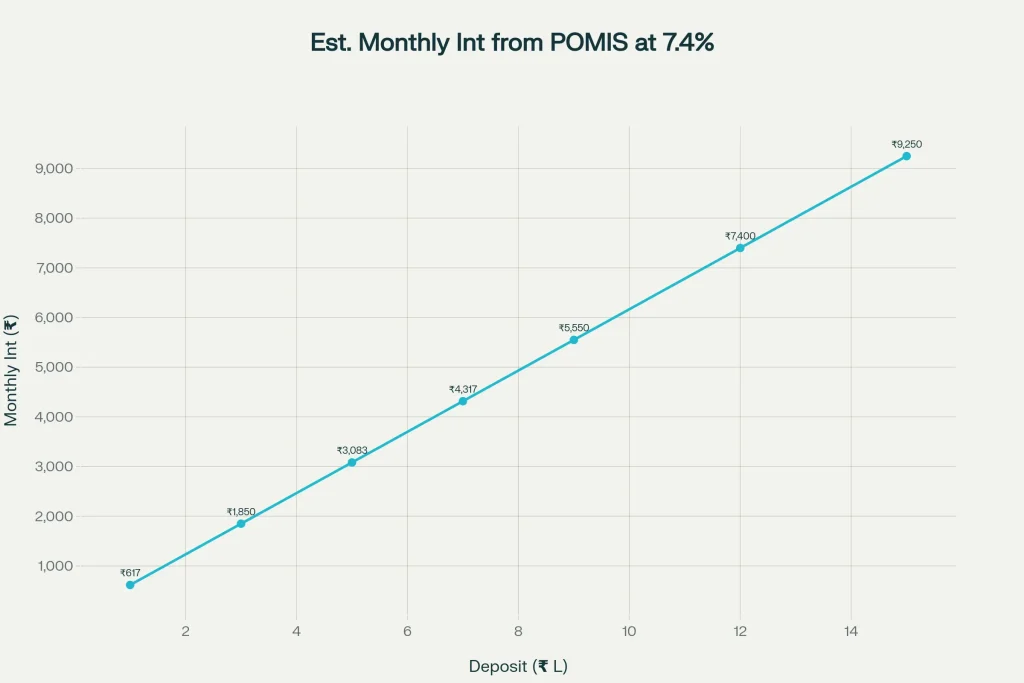
Monthly Interest ≈ Principal × Annual Rate ÷ 12
Illustrations at the Commonly Cited Rate:
- ₹1,00,000 → about ₹617 per month
- ₹6,00,000 → about ₹3,700 per month
- ₹9,00,000 → about ₹5,550 per month
- ₹15,00,000 → about ₹9,250 per month
These examples help align your deposit with your target monthly need. Always confirm the prevailing official rate at opening and compute your exact payout before committing.
Deposit Limits And Practical Planning
The current caps are ₹9 lakh for a single account and ₹15 lakh for a joint account (up to three adults). Use the limits to reverse-engineer your monthly target. For instance, if your essential bills need ₹9,000 per month, a joint account around ₹15 lakh at the indicative rate broadly aligns with that figure. If your needs exceed what POMIS alone can produce under deposit caps, consider layering with other low-risk, government-backed options.
Liquidity And Premature Closure
The plan is meant for five years, but life happens. If you need funds earlier, premature closure is permitted after one year, subject to deductions. That creates a useful safety valve: you retain monthly income potential with the knowledge that access is possible if circumstances change.
Tax Treatment And Record-Keeping
Interest earned is taxable as per your income slab. Since the monthly credits can add up, plan for advance tax or self-assessment to avoid a year-end surprise. Keep KYC, nomination details, and bank mandates updated so interest credits remain seamless throughout the tenure.
How It Compares With Other Low-Risk Options
- Senior Citizens Savings Scheme (SCSS): Typically offers a higher nominal rate with quarterly interest payouts. Great for retirees, but with age-based eligibility and different deposit caps. It complements POMIS if you want both monthly and quarterly inflows.
- Post Office Time Deposits: Offer competitive rates with annual payout or compounding, better for those who prefer accumulation over monthly cash flow. Pair with POMIS if you want a mix of immediate income and compounding.
Who Should Consider This
- Retirees aiming for predictable income to cover recurring monthly costs.
- Families who want a dependable stream to offset EMIs, school fees, or household expenses.
- Conservative investors who prefer sovereign-backed, rules-based income over market-linked volatility.
Building A Monthly Income Ladder
A smart approach is diversification across payout frequencies:
- Use the Post Office Monthly Income Scheme for monthly inflows.
- Add SCSS (if eligible) for quarterly credits.
- Keep a Time Deposit or two for annual compounding and maturity-stage cash lumps.
This staggering of cash flows reduces reinvestment risk and keeps money arriving on a schedule that matches real-life bills.
Application Tips For Better Outcomes
- Confirm the official rate on the day of opening and compute your exact monthly payout before funding.
- Stay within deposit caps and avoid common errors like missing nomination.
- Don’t let credited interest sit idle either deploy it for expenses or funnel it into a savings account or RD to keep cash working.
- Revisit your setup annually to check whether your monthly inflow still matches your budget after tax and inflation.
Worked Examples You Can Copy
- Single account, ₹9,00,000:
- Annual interest ~₹66,600
- Monthly interest ~₹5,550
- Joint account, ₹15,00,000:
- Annual interest ~₹1,11,000
- Monthly interest ~₹9,250
These aren’t promises—just clean arithmetic based on the commonly referenced rate. Always plug in the actual notified rate for the date you invest.
ATM Fees Set to Rise in 2025 — How Each Swipe Could Cost You More Than Before
Common Mistakes to Avoid
- Treating the headline monthly payout as net of tax. Always compute post-tax income.
- Exceeding deposit caps across accounts. Respect scheme limits to stay compliant.
- Forgetting to update bank details or nomination, which can delay credits or complicate transmission.
- Chasing unrealistic monthly targets from a single account. If your need is beyond caps, build a layered strategy with other instruments.
FAQs on Post Office Plan Offers Monthly Interest
What is the Post Office Monthly Income Scheme?
It’s a government-backed small savings plan that pays interest every month for five years, designed for predictable cash flows and lower risk than market-linked products.
How much can I invest in POMIS?
The typical caps are ₹9 lakh for a single account and ₹15 lakh for a joint account with up to three adults. Use these limits to size deposits for your target monthly income.
Can I close my account before five years?
Yes, after one year you can opt for premature closure subject to applicable deductions. It’s a helpful backstop if you need funds earlier than planned.
Is the interest taxable?
Yes. Interest is taxed as per your slab. Plan for tax payments so your monthly budget reflects the post-tax amount you actually receive.