

Indian Railways has shifted from band-aid cleaning to a fast, tech-driven solution that actually keeps train toilets clean, odour-free, and supplied with water throughout long journeys. The push centers on sub-one-minute mechanised cleaning, smarter maintenance using live monitoring, and system upgrades that reduce stink and clogs while conserving water.
The Railway New Rules, Innovative Fix Solves Train Toilet Problem initiative speeds up cleaning at intermediate stops, uses battery-powered tools for quick turnarounds, and relies on live water-level monitoring so toilets don’t go dry between major halts. Alongside bio-toilet coverage and vacuum-style upgrades, it tackles the biggest complaints head-on: foul odour, blockages, and empty taps on long routes.
Railway New Rules
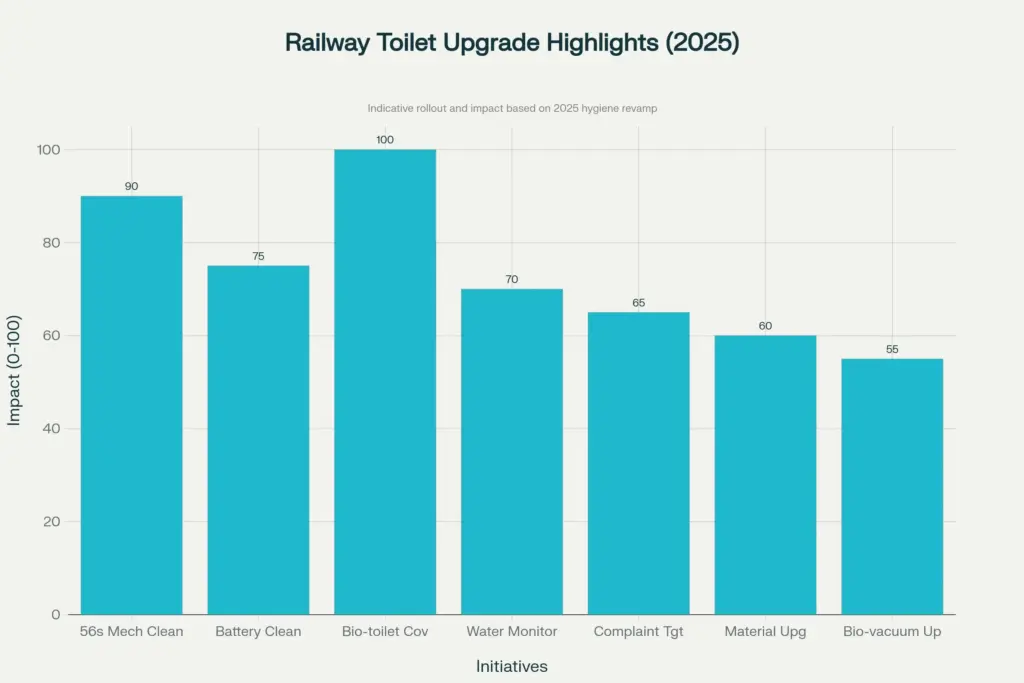
| Key Change | What’s New | Why It Matters | 2025 Status |
|---|---|---|---|
| 56-Second Cleaning | Mechanised kits refresh a toilet in under a minute | Enables cleaning at smaller halts, multiple times per day | Rolling out across zones |
| Battery-Powered Gear | Cordless, portable cleaning equipment | Faster touchups without power points | Deployed with mechanisation push |
| Bio-Toilet Coverage | All passenger-carrying mainline coaches with bio-toilets | Zero discharge on tracks; less odour/corrosion | Standard across network |
| Live Water Monitoring | IoT-based water-level checks per coach | Prevents “dry” toilets; timely refilling en route | Implemented and expanding |
| Complaint Targeting | Data-led station and route prioritisation | Fixes hotspots faster; better resource allocation | Integrated with operations |
Indian Railways has finally tackled the core pain points of onboard sanitation with a practical, system-wide approach that blends speed, smart monitoring, and better toilet technology. Sub-one-minute mechanised cleaning means toilets can be refreshed at smaller halts without disrupting schedules, while live water-level tracking prevents those dreaded “no water” moments on long routes. With bio-toilets standard across passenger coaches and ongoing upgrades to materials and fittings, odour control and reliability are set to improve noticeably for everyday travelers.
What’s Changing and Why It’s Different
- Ultra-fast cleaning under a minute lets staff sanitize toilets at several intermediate stations rather than waiting only for major halts. This keeps odour and grime in check even during peak loads.
- Battery-operated equipment removes dependence on platform power, so crews can work quickly during short halts without delaying departures.
- Operations are increasingly data-led: live dashboards highlight low water levels early and direct watering teams at the right stations, shrinking the window for “no water” incidents.
Bio-Toilets: The Scale-Up That Cleaned The Tracks
- Bio-toilets are now standard across passenger-carrying mainline coaches, eliminating direct discharge and improving hygiene around stations and yards.
- Network-wide fitment achieved over the last decade means a higher baseline of cleanliness and fewer corrosion-related issues under the coaches.
- The bio-digester process converts waste into treated water and gases, cutting odour and reducing the environmental footprint.
Water Won’t Run Out Mid-Journey
- Live monitoring of coach water tanks flags low levels well before taps run dry, enabling planned refills at the next suitable halt.
- En-route refilling has been prioritised on longer routes and busy corridors, addressing one of the most common passenger complaints.
- Data from complaints and audits has been channeled into scheduling and routing, ensuring faster resolution in historically problematic stretches.
Faster Cleaning, Better Materials, Less Odour
- Sub-minute cleaning cycles are matched with materials and design tweaks that resist residue and make each cleaning pass more effective.
- Automation and sensors support smart triggers for cleaning, so toilets are refreshed more often without waiting for a long halt.
- The combined effect is fewer foul-smell incidents, quicker recovery after heavy use, and a more consistent standard coach-to-coach.
How This Aligns With Real-World Usage
- Historically, water unavailability and odour were top friction points on long-haul services; the new regime targets both with live monitoring and frequent touchups.
- Quick-watering infrastructure and scheduling are being aligned with actual train timings, so refills happen proactively.
- Mechanisation reduces variability and manual lag, delivering consistency across zones and during peak travel periods.
What Passengers Will Notice First
- Cleaning teams working at smaller stops, not just big junctions, with in-and-out service that doesn’t disrupt the timetable.
- Fewer “no water” notices as dashboards prompt refills ahead of time.
- Cleaner floors and basins, reduced odour, and faster recovery when a toilet gets messy mid-journey.
Why This Is A Meaningful Upgrade Right Now
- The 56-second cleaning breakthrough aligns sanitation frequency with real train operations, allowing multiple refreshes daily without timetable changes.
- Pairing mechanisation with data-led refilling targets the exact pain points passengers reported most odour and water availability.
- With bio-toilets standardised and monitored, the system reduces stink, protects infrastructure, and sets a higher, more consistent cleanliness baseline.
Kerala Joined PM SHRI Scheme Just to Access Central Funds, Says Thomas Isaac
What To Expect Next on Your Route
- Wider adoption of under-a-minute cleaning across more stations, turning short halts into reliable sanitation windows.
- Expansion of live monitoring and proactive watering to more routes and zones, especially long-haul corridors.
- Continued upgrades in fittings and finishes so cleanliness lasts longer between stops even during peak usage.
The direction is clear: frequent, data-led cleaning and refilling, less manual lag, and a consistently cleaner experience across zones. As deployment widens, passengers should see cleaner floors and basins, fewer smells, and faster turnaround after heavy use exactly the improvements riders have been asking for.
FAQs on Railway New Rules
How fast can train toilets be cleaned now?
In around 56 seconds per toilet with mechanised cleaning, enabling multiple sanitation cycles per day at intermediate halts.
Will this fix “no water” issues during long trips?
Yes. Live water-level monitoring triggers timely refills en route so taps and flushes don’t run dry before the next major halt.
Are bio-toilets installed in all trains?
All passenger-carrying mainline coaches with toilets are equipped with bio-toilets, ending direct discharge on tracks.
What caused most complaints earlier?
Water shortages and odour during long runs, compounded by infrequent cleaning windows and slow manual refilling.