

Buying or selling property in India has never been a simple task. For years, people have dealt with confusing paperwork, outdated land records, long registration delays, and unexpected legal disputes that surface long after a deal is closed. A single missing document or incorrect entry could stall a name transfer indefinitely.
This is exactly why the Land Registry New Rules 2026 are being seen as one of the most important reforms in India’s real estate system in recent times. These rules aim to clean up the process from the ground level and restore trust in property transactions. The Land Registry New Rules 2026 are not just a minor procedural update. They fundamentally change how property ownership is verified, recorded, and transferred. With a stronger focus on clear titles, updated land records, and digital verification, the new framework is designed to protect buyers, bring accountability for sellers, and reduce disputes that clog Indian courts. If you are planning to buy, sell, inherit, or transfer property, understanding these changes is essential.
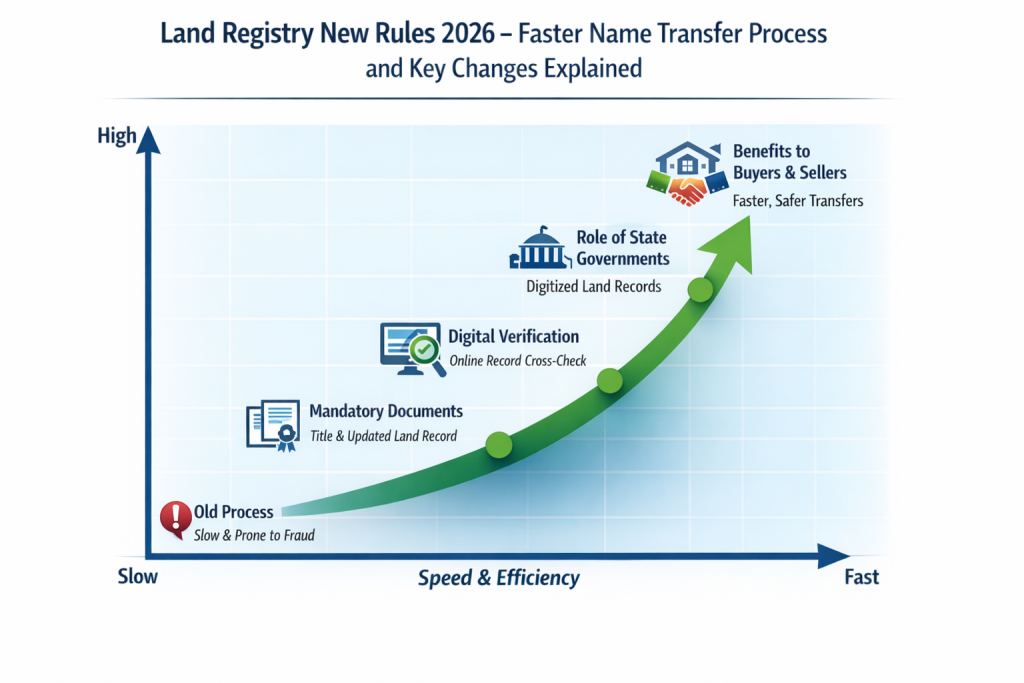
The Land Registry New Rules 2026 introduce a more structured, transparent, and verification driven property registration system. Earlier, registration mainly confirmed that a transaction took place, not whether the ownership was legally sound. This often resulted in people buying land that later turned out to have disputes, missing heirs, or unclear boundaries. Under the new rules, property registration is directly linked with verified land records. This means registration offices will no longer rely only on physical deeds. Instead, ownership claims will be cross checked with official land databases. The goal is to ensure that only properties with clear and legally valid ownership can be registered. For ordinary citizens, this translates into faster name transfers, fewer legal surprises, and greater peace of mind when investing in property.
Land Registry New Rules 2026
| Area | New Requirement | Benefit |
|---|---|---|
| Mandatory Documents | Two documents required for registration | Prevents fraudulent ownership claims |
| Verification Method | Digital cross checking with land records | Faster and more accurate processing |
| Buyer Safety | Registration only after ownership verification | Reduces future disputes |
| Seller Responsibility | Updated records before sale | Improves trust and transparency |
| Government Role | Digitized and integrated land systems | Efficient and uniform registration |
The Land Registry New Rules 2026 mark a turning point in how property ownership is recorded and transferred in India. By making two documents mandatory and linking registration to verified land records, the system shifts its focus from paperwork to legal clarity. While adjustment may take time, the long-term benefits of transparency, faster name transfers, and reduced disputes far outweigh the challenges. Anyone involved in property transactions should start preparing now to align with the new rules and avoid future complications.
Why New Land Registry Rules Were Introduced
- Property related disputes form a large part of civil litigation in India. Many of these cases begin with unclear land titles, missing inheritance records, or outdated government entries. Earlier, someone could register a sale deed even if land records were incorrect or incomplete. This gap between registration and ownership verification created endless legal complications.
- The Land Registry New Rules 2026 were introduced to address these long standing problems. The government recognized that without clean and updated land records, real estate growth would remain risky and unorganized. By tightening documentation requirements and linking registration to official records, the new system aims to reduce fraud, speed up transactions, and bring long term stability to the property market.
- Another important reason for these rules is digital transformation. With most states now working on digitizing land records, it became possible to integrate registration offices with land databases. This allows real time verification and reduces dependence on manual processes that are prone to errors and manipulation.
Two Mandatory Documents for Property Registration
One of the most talked about changes under the Land Registry New Rules 2026 is the requirement of two mandatory documents. Property registration will not proceed unless both documents are submitted and verified.
Title Ownership Document
- The title ownership document establishes the legal right of the seller to transfer the property. It acts as proof that the seller is the lawful owner. Depending on how the property was acquired, this document may differ.
- Common examples include sale deeds, gift deeds, partition deeds, inheritance documents, or court orders. In cases of inherited property, all succession related paperwork must be complete and legally valid. Registration officials will examine whether the title is clear and free from conflicting claims.
- This requirement helps prevent situations where buyers unknowingly purchase property from someone who does not have full legal ownership.
Updated Land Record Document
- The second mandatory document is the updated land record maintained by the government. This document reflects official ownership details, land boundaries, survey numbers, and classification. Different states use different names such as patta, jamabandi, khata, record of rights, or property card.
- Under the Land Registry New Rules 2026, the details in the title document must exactly match the land record. If there is any discrepancy, it must be corrected before registration. This ensures consistency between private documents and government records, significantly reducing future disputes.
Linking Property Registration With Digital Land Records
- A major strength of the Land Registry New Rules 2026 lies in digital integration. Registration offices are being connected to digitized land record systems. This allows officials to verify ownership details electronically instead of relying only on physical paperwork.
- Digital verification makes the process faster and more reliable. It reduces human error and limits opportunities for manipulation. Once land data is digitized and updated, every change leaves a trace, creating accountability at every level. Over time, this system is expected to bring a major reduction in land fraud and duplicate registrations.
- This integration also supports better record maintenance. Property history becomes easier to track, which is useful not only for buyers and sellers but also for banks, developers, and government authorities.
Impact On Property Buyers
- For buyers, the Land Registry New Rules 2026 offer stronger protection than ever before. Verified ownership reduces the risk of buying disputed land. Buyers can be more confident that registration itself confirms legal ownership, not just the exchange of money.
- Another major benefit is reduced legal stress after purchase. Since discrepancies are addressed before registration, buyers are less likely to face ownership challenges later. This is especially important for first time buyers who may not have legal expertise.
- However, buyers also have responsibilities. They must ensure both mandatory documents are accurate and up to date. Rushing into a deal without proper verification can still cause delays or cancellation. Due diligence remains an important part of any property transaction.
Impact On Property Sellers
Sellers are equally affected by the Land Registry New Rules 2026. Before listing a property for sale, sellers must ensure that land records reflect correct ownership details. Any errors related to inheritance, partition, or past transactions must be resolved in advance. While this may seem like extra work, it ultimately benefits sellers. Clear records improve buyer confidence and reduce the chances of deals falling through at the registration stage. Properties with clean documentation are also likely to sell faster and at better prices.
Role Of State Governments
Land and property fall under state jurisdiction, which means implementation of the Land Registry New Rules 2026 depends heavily on state governments. Each state is responsible for digitizing land records, integrating databases, training registration officials, and maintaining updated systems. Some states are already advanced in digitization, while others are still catching up. Uniform implementation across states will be critical to ensuring that the benefits of these reforms are felt nationwide. Over time, coordination between central and state authorities will determine the overall success of the system.
Challenges During Transition
- While the Land Registry New Rules 2026 bring many advantages, the transition phase may involve challenges. In areas where land records are outdated or poorly maintained, updating data may take time. Rural regions may face delays due to lack of infrastructure or awareness.
- Public education will play a key role. Buyers and sellers must understand the importance of updated records and proper documentation. Without awareness, people may still face delays despite improved systems.
Long Term Benefits of The New Rules
In the long run, the Land Registry New Rules 2026 are expected to transform India’s real estate sector. Cleaner land records will reduce litigation, improve investor confidence, and support faster urban development. Banks and financial institutions will also benefit from clearer property titles when approving loans. A transparent and reliable registration system strengthens the overall economy. Property transactions become smoother, trust in the system improves, and citizens feel more secure investing their savings in real estate.
FAQs on Land Registry New Rules 2026
What Is The Land Registry New Rules 2026
They are new regulations that require mandatory ownership and land record documents for property registration.
Which Documents Are Required for Registration
A valid title ownership document and an updated official land record document.
Do These Rules Apply to Inherited Property
Yes, inherited properties must also have clear titles and updated land records.
Are The Rules Applicable Across All States
The framework is national, but implementation depends on individual state systems.