

Gratuity is one of the most important yet often overlooked benefits for salaried employees in India. Most people only start paying attention to it when they are about to resign, retire, or switch jobs. At that point, questions around eligibility, calculation, and tax exemption become very real. With policy discussions intensifying, the Gratuity Rules 2026 Update has become a major point of interest for employees, HR professionals, and employers across sectors. This update is expected to reshape how gratuity works in line with today’s changing job market. What makes the Gratuity Rules 2026 Update particularly significant is the proposed change in eligibility from five years of continuous service to just one year. This single move could allow millions of employees, especially those working in private companies, startups, and contract roles, to receive gratuity for the first time. At the same time, the government aims to retain stability by keeping the calculation method and the Rs 20 lakh tax free limit unchanged.

The Gratuity Rules 2026 Update is designed to make gratuity more inclusive and relevant for the modern workforce. Over the years, employment patterns have changed drastically. Long tenures with a single employer are becoming less common, particularly in sectors like IT, startups, media, and consulting. The updated rules acknowledge this shift by ensuring that employees are not denied gratuity simply because they changed jobs early. Under this update, employees who complete at least one year of service may become eligible for gratuity. While the core principles of gratuity remain intact, this expanded eligibility can significantly improve financial security for working professionals. Importantly, employers are still governed by the Payment of Gratuity Act, ensuring uniformity and legal clarity.
Gratuity Rules 2026 Update
| Category | Details |
|---|---|
| Minimum service requirement | 1 year proposed |
| Earlier eligibility rule | 5 years continuous service |
| Applicable law | Payment of Gratuity Act |
| Calculation basis | Last drawn salary and years of service |
| Maximum gratuity limit | Rs 20 lakh |
| Tax exemption | Up to Rs 20 lakh |
| Payment timeline | Within 30 days of separation |
What Is Gratuity
- Gratuity is a statutory benefit paid by an employer to an employee as a reward for service rendered to the organization. It applies to companies, factories, shops, and establishments employing ten or more people. Gratuity becomes payable when an employee resigns, retires, or is terminated after meeting the eligibility criteria. In cases of death or permanent disability, gratuity is payable regardless of the length of service.
- Unlike bonuses or incentives, gratuity is not linked to performance. It is purely based on tenure and last drawn salary. For many employees, gratuity acts as a financial buffer during career transitions or retirement, making it a crucial component of long term financial planning.
Eligibility Rules Under Gratuity Rules 2026
- Eligibility is where the Gratuity Rules 2026 Update brings the biggest change. Until now, employees had to complete five years of continuous service with the same employer to qualify for gratuity. This condition excluded a large number of employees who switched jobs before completing five years.
- Under the proposed update, the minimum service requirement may be reduced to one year. This means employees who leave an organization after completing one year could still receive gratuity. The update is expected to benefit employees working in private sector roles, startups, and fixed term contracts.
- This change also aligns gratuity benefits with the realities of today’s workforce, where skill based mobility is common and encouraged.
Continuous Service Explained
- To understand eligibility clearly, it is important to know what continuous service means. Continuous service does not necessarily require uninterrupted attendance. An employee is considered in continuous service even if there are breaks due to approved leave, sickness, maternity leave, accident, or layoff.
- For employees working less than one year, the law also considers minimum working days. If an employee has worked at least 240 days in a year, or 190 days in specific sectors, that year may be counted as completed service. These provisions continue to apply under the Gratuity Rules 2026 Update.
Gratuity Calculation Formula Explained
- While eligibility rules may change, the gratuity calculation formula remains the same. This ensures simplicity and avoids confusion for both employees and employers. The standard formula used is:
- Gratuity equals last drawn salary multiplied by 15 multiplied by years of service divided by 26.
- Here, last drawn salary includes basic pay and dearness allowance. The number 15 represents 15 days of wages for every completed year of service, and 26 represents the number of working days in a month.
- If an employee has worked for more than six months in a particular year, that year is rounded off as a full year for calculation purposes.
Example Of Gratuity Calculation
Suppose an employee earns a last drawn salary of Rs 50,000 and has completed 4 years and 7 months of service. Since the service exceeds six months, it will be rounded to 5 years.
Gratuity would be calculated as follows:
- 50,000 × 15 × 5 ÷ 26
- This results in a gratuity amount of approximately Rs 1,44,231.
- This same formula will continue to apply under the Gratuity Rules 2026 Update, even with the reduced eligibility period.
Rs 20 Lakh Gratuity Limit Explained
- The maximum tax-free gratuity limit remains Rs 20 lakh. This limit applies to the total gratuity received by an employee during their entire working life, across all employers. Any amount received beyond this limit becomes taxable as per income tax rules.
- Government employees are fully exempt from tax on gratuity. For private sector employees covered under the Payment of Gratuity Act, exemption is limited to the least of the actual gratuity received, Rs 20 lakh, or the amount calculated using the prescribed formula.
- The Gratuity Rules 2026 Update does not change this limit, ensuring continuity in tax treatment.
Tax Treatment of Gratuity
- Taxation of gratuity depends on the type of employee and the amount received. For private employees, gratuity up to Rs 20 lakh is tax free. If gratuity exceeds this limit, the excess amount is added to taxable income.
- Employees should keep proper records of gratuity received from previous employers, as the exemption limit is cumulative. Proper documentation helps avoid tax complications later.
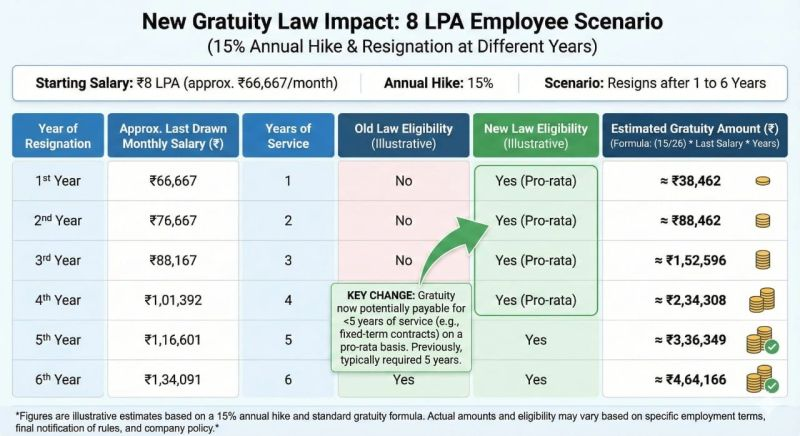
Who Benefits Most from Gratuity Rules 2026 Update
- The biggest beneficiaries of the Gratuity Rules 2026 Update are employees who previously did not complete five years with a single employer. This includes professionals in IT, startups, media, sales, and consulting roles where job changes are frequent.
- Young professionals and mid-career employees will now receive financial recognition even for shorter tenures. This improves overall employee morale and strengthens social security coverage.
Employer Responsibilities Under the New Rules
- With broader eligibility, employers will need to prepare for increased gratuity liabilities. Companies must ensure accurate service records, proper accounting provisions, and timely payment of gratuity within 30 days of an employee’s exit.
- Failure to comply can result in penalties and interest. The Gratuity Rules 2026 Update makes it even more important for employers to review HR policies and payroll systems.
Impact On Private and Contract Employees
Private sector and contract employees stand to gain the most from this update. Earlier, many contract workers completed assignments without qualifying for gratuity. With the new eligibility threshold, they may now receive gratuity benefits, improving financial security and fairness in employment practices.
Key Points to Remember
The Gratuity Rules 2026 Update reduces eligibility to one year while retaining the same calculation formula. The Rs 20 lakh tax free limit remains unchanged. Employees gain wider access to gratuity, and employers must strengthen compliance and financial planning.
- The Gratuity Rules 2026 Update represents a meaningful step toward modernizing employee benefits in India. By lowering the eligibility period to one year, the government acknowledges changing career patterns and ensures that gratuity is no longer limited to long serving employees alone. At the same time, stability is maintained through an unchanged calculation formula and tax exemption limit.
- For employees, this update brings greater financial inclusion and security. For employers, it emphasizes the need for better compliance and long term planning. As 2026 approaches, understanding these rules will help everyone stay prepared and make informed decisions.
FAQs on Gratuity Rules 2026 Update
When Will the Gratuity Rules 2026 Update Come into Effect
The update is expected to be implemented in 2026 after official government notification.
Will Gratuity Be Paid After One Year of Service
Yes, under the proposed rules, employees completing one year of service may become eligible for gratuity.
Has The Gratuity Calculation Formula Changed
No, the calculation formula remains the same under the Gratuity Rules 2026 Update.
Does The Update Apply to Private Sector Employees
Yes, the updated rules are expected to apply to both private and public sector employees covered under the Payment of Gratuity Act.